|
|

This Project Gutenberg EBook was produced by Jason Isbell, Taavi Kalju and the Online Distributed Proofreading Team at http://www.pgdp.net
Transcriber's note: Until recently this work was attributed to John Lydgate, but now most scholars consider that the author is unknown. The first mention of Lydgate's authorship of this work was made by Stephen Hawes in 1505 as one of Lydgate's seven major works. But many scholars have doubted over the years that this poem was written by Lydgate, because the style used doesn't greatly resemble the style of Lydgate's other works, and the vocabulary is somewhat more modern than Lydgate is known to have used. Modern scholars believe that this work was written between 1478 and 1483 (about forty years after Lydgate's death). Analysis of style and vocabulary have led scholars to conclude that the author might have been a woman. For further information about this poem please see The Assembly of Gods, edited by Jane Chance, published by Medieval Institute Publications, Kalamazoo, Michigan, 1999, ISBN: 1580440223, which is also available online at Rochester University.
The book from which this e-book was transcribed is a fascimile reprint of the third printing of this book, made by Wynkyn de Worde circa 1500. The book was printed in blackletter font known as Wynkyn de Worde's type 3, and uses many abbreviations, which I have expanded and rendered in italics. The abbreviations used in this book are:
 ,
,
 ,
,  ,
,  ,
,  —Macron over the
letter. The most common one, usually meaning missing
"n" or "m" after the letter. But in some
cases might also mean missing "e", "er" or
"re" after the letter. This happens usually when p, q
or r have macrons.
—Macron over the
letter. The most common one, usually meaning missing
"n" or "m" after the letter. But in some
cases might also mean missing "e", "er" or
"re" after the letter. This happens usually when p, q
or r have macrons. —Little e over Middle-English thorn, meaning
"the."
—Little e over Middle-English thorn, meaning
"the." —Little t over Middle-English thorn, meaning
"that."
—Little t over Middle-English thorn, meaning
"that." —Little u over Middle-English thorn, meaning
"thou."
—Little u over Middle-English thorn, meaning
"thou." —Little t over w, meaning "with."
 —Middle-English yogh, representing
"gh."
—Middle-English yogh, representing
"gh." —Superscripted 9 after letter, meaning missing
"us." Used only at the end of the word.
—Superscripted 9 after letter, meaning missing
"us." Used only at the end of the word.—Superscripted 2 after letter, meaning missing "e", "er" or "re." Used only at the end of the word.
 —Stretched s, looking like integral sign, meaning
missing "e" or "i" before letter s.
—Stretched s, looking like integral sign, meaning
missing "e" or "i" before letter s. ,
,
 ,
,  ,
,  —Dot over the
letter, meaning missing "e", "er" or
"re" after the letter. Usually used with d, t, e and u.
Combination q+d with dot means "quod."
—Dot over the
letter, meaning missing "e", "er" or
"re" after the letter. Usually used with d, t, e and u.
Combination q+d with dot means "quod." ,
,
 ,
,  —Strike
through letter, meaning missing "e", "er" or
"re" after the letter. Usually used with p, v and s.
Striked through p might also mean missing "ro" or
"or" after p.
—Strike
through letter, meaning missing "e", "er" or
"re" after the letter. Usually used with p, v and s.
Striked through p might also mean missing "ro" or
"or" after p.
Occasionally there were some letters printed upside down. I have rendered them inside brackets, e.g., [x]. The poem uses two types of punctuation--a dot, meaning longer pause, and a slash, meaning shorter pause or comma. I have corrected many errors and noted them. Also this printing was missing three lines and one line had several letters missing from the middle of the line. They are marked and the correct reading is supplied from the modern edition mentioned above. There were a couple of places where the word "nota" or "note" was printed, but the actual notes weren't found in this reprint. There's a fair chance that those notes were never printed. The original page images are displayed on the left margin and each links to a larger view.
The assemble of goddes
by
John Lydgate
Printed at Westminster
by Wynkyn de Worde about the year
1500
Cambridge
at the University Press
1906
The work here reprinted formed part of the famous volume of black-letter tracts (formerly marked AB. 4. 58), which came to the University Library in 1715 by the gift of King George the First with the rest of the library of John Moore, Bishop of Ely. No other copy of this edition is recorded to be in existence.
The types used are Caxton's type 3 (for the title) and Wynkyn de Worde's type 3, with final m and n etc. from type 1 (in the rest of the book). This type 3 is not known to have been used before 1499.
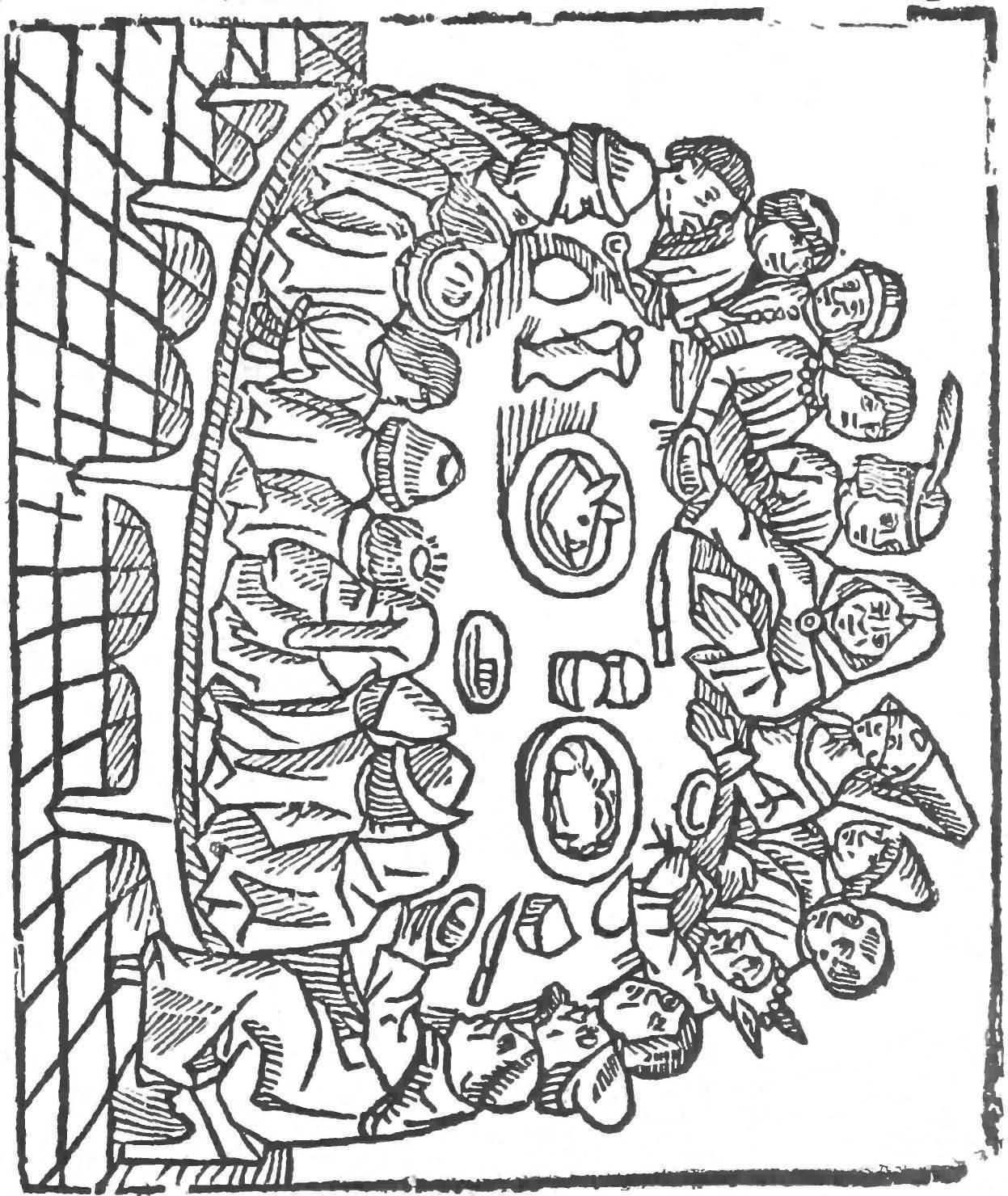
Mr Sayle remarks that the woodcut illustration is taken from Caxton's second edition (ab. 1483-4) of Chaucer's Canterbury Tales.
FRANCIS JENKINSON
1906 March 5.
I certify that I have printed 250 copies only of this facsimile, that the impressions have been rubbed off the plates and the negatives destroyed.
P. DUJARDIN
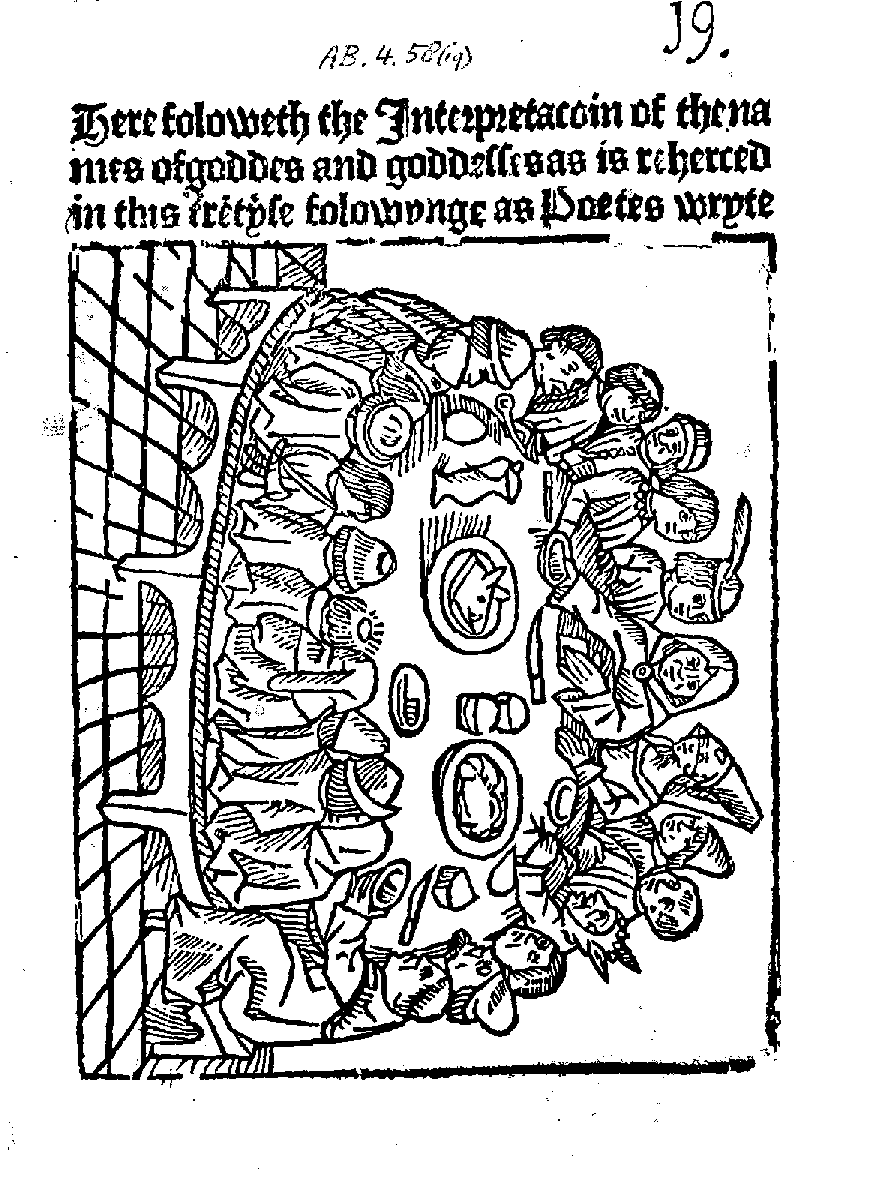 Here foloweth the
Interpretacoin of the names
Here foloweth the
Interpretacoin of the namesof goddes and goddesses as is reherced
in this tretyse folowynge as Poetes wryte
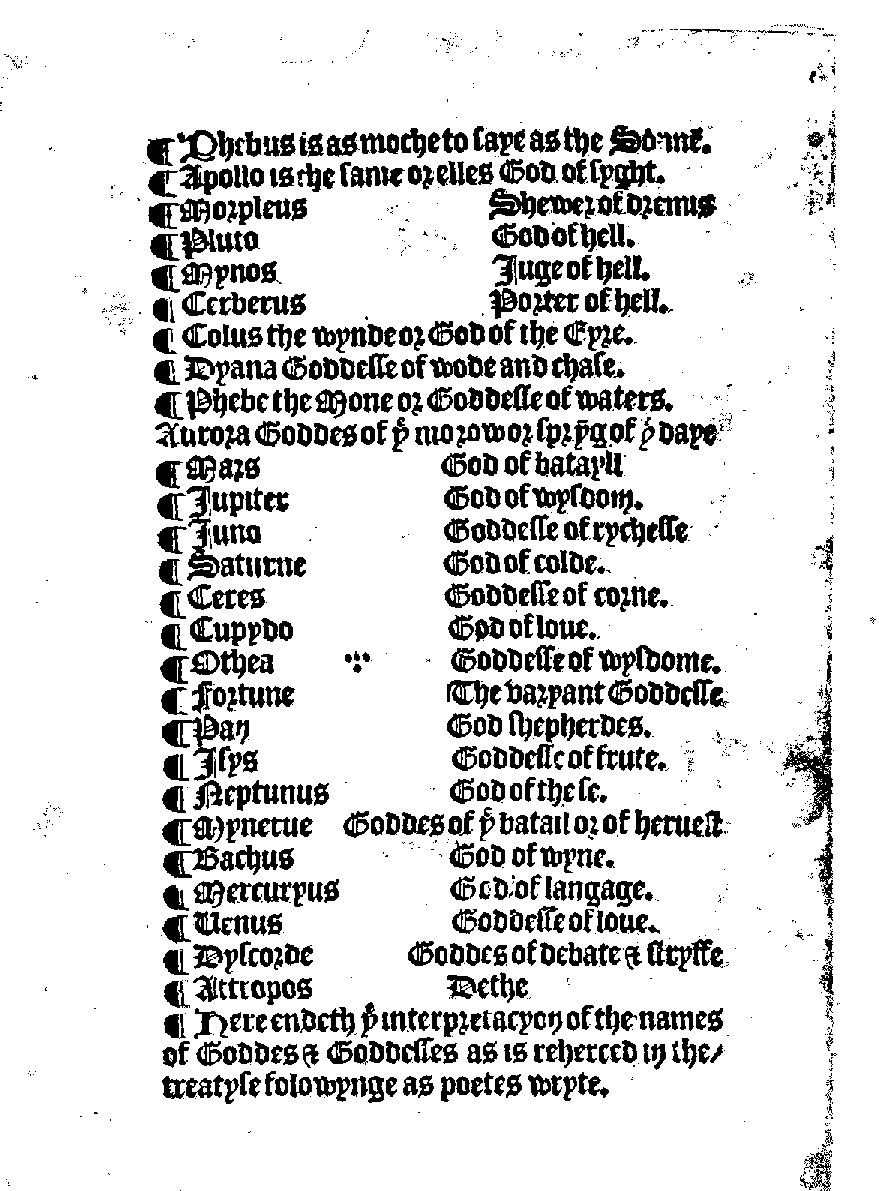 Phebus is as moche to saye as the
Sonne. Phebus is as moche to saye as the
Sonne. |
||||
| Apollo is the same or elles God of syght. | ||||
| Morpleus | Shewer of dremis | |||
| Pluto | God of hell. | |||
| Mynos | Iuge of hell. | |||
| Cerberus | Porter of hell. | |||
| Colus the wynde or God of the Eyre. | ||||
| Dyana Goddesse of wode and chase. | ||||
| Phebe the Mone or Goddesse of waters. | ||||
| Aurora Goddes of the morow or spryng of the daye | ||||
| Mars | God of batyll | |||
| Iupiter | God of wysdom. | |||
| Iuno | Goddesse of rychesse | |||
| Saturne | God of colde. | |||
| Ceres | Goddesse of corne. | |||
| Cupydo | God of loue. | |||
| Othea | Goddesse of wysdome. | |||
| Fortune | The varyant Goddesse | |||
| Pan | God shepherdes. | |||
| Isys | Goddesse of frute. | |||
| Neptunus | God of the se. | |||
| Mynerue | Goddes of the batail or of heruest | |||
| Bachus | God of wyne. | |||
| Mercuryus | God of langage. | |||
| Venus | Goddesse of loue. | |||
| Dyscorde | Goddes of debate & stryffe | |||
| Attropos | Dethe | |||
| Here endeth the interpretacyon of the names | ||||
| of Goddes & Goddesses as is reherced in the | ||||
| treatyse folowynge as poetes wryte. | ||||
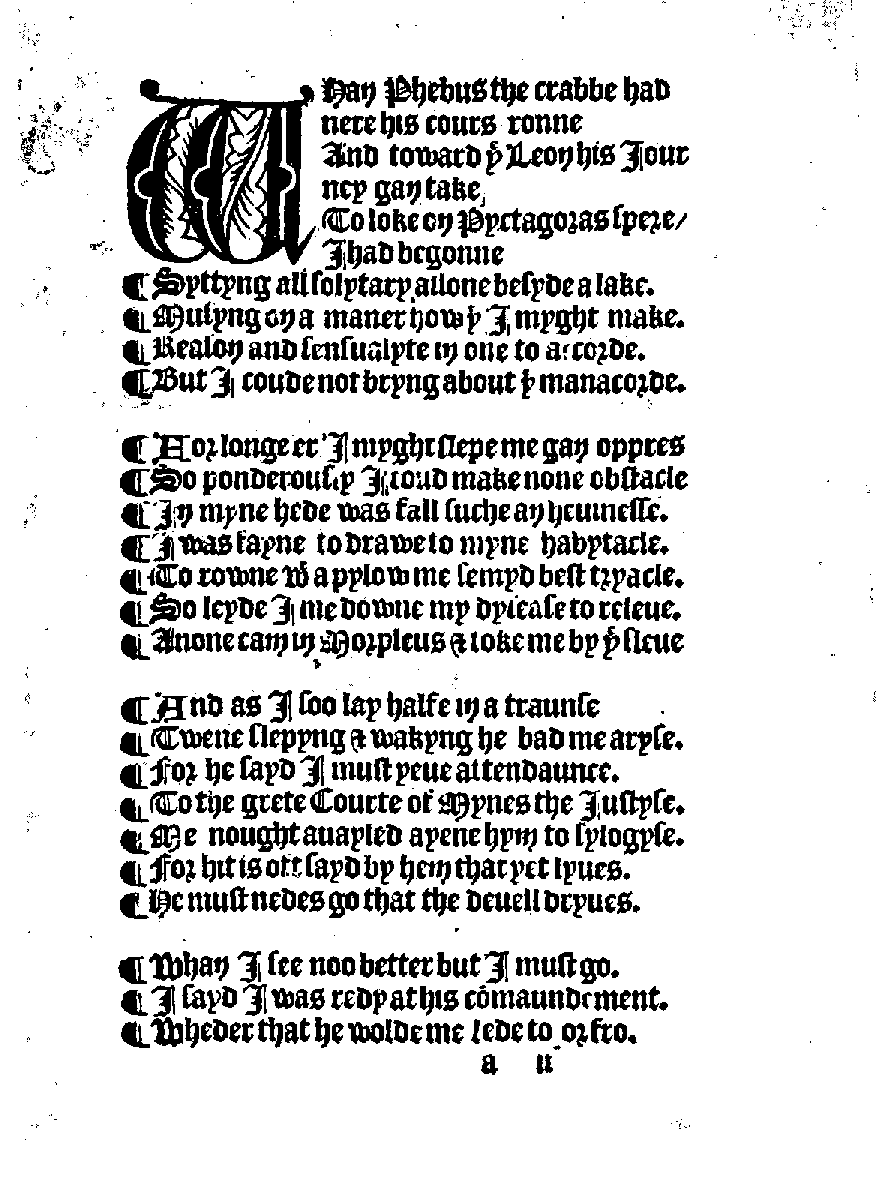
han Phebus the crabbe had nere his cours ronne
And toward the Leon his Iourney gan take
To loke on Pyctagoras spere / I had begonne
Syttyng all solytary allone besyde a lake.
Musyng on a maner how that I myght make.
Reason and sensualyte in one to accorde.
But I coude not bryng about the manacorde.
So ponderously I coud make none obstacle
In myne hede was fall suche an heuinesse.
I was fayne to drawe to myne habytacle.
To rowne with a pylow me semyd best tryacle.
So leyde I me downe my dysease to releue.
Anone cam in Morpleus & toke me by the sleue
Twene slepyng & wakyng he bad me aryse.
For he sayd I must yeue attendaunce.
To the grete Courte of Mynes the Iustyse.
Me nought auayled ayene hym to sylogyse.
For hit is oft sayd by hem that yet lyues.
He must nedes go that the deuell dryues.
I sayd I was redy at his commaundement.
Wheder that he wolde me lede to or fro.
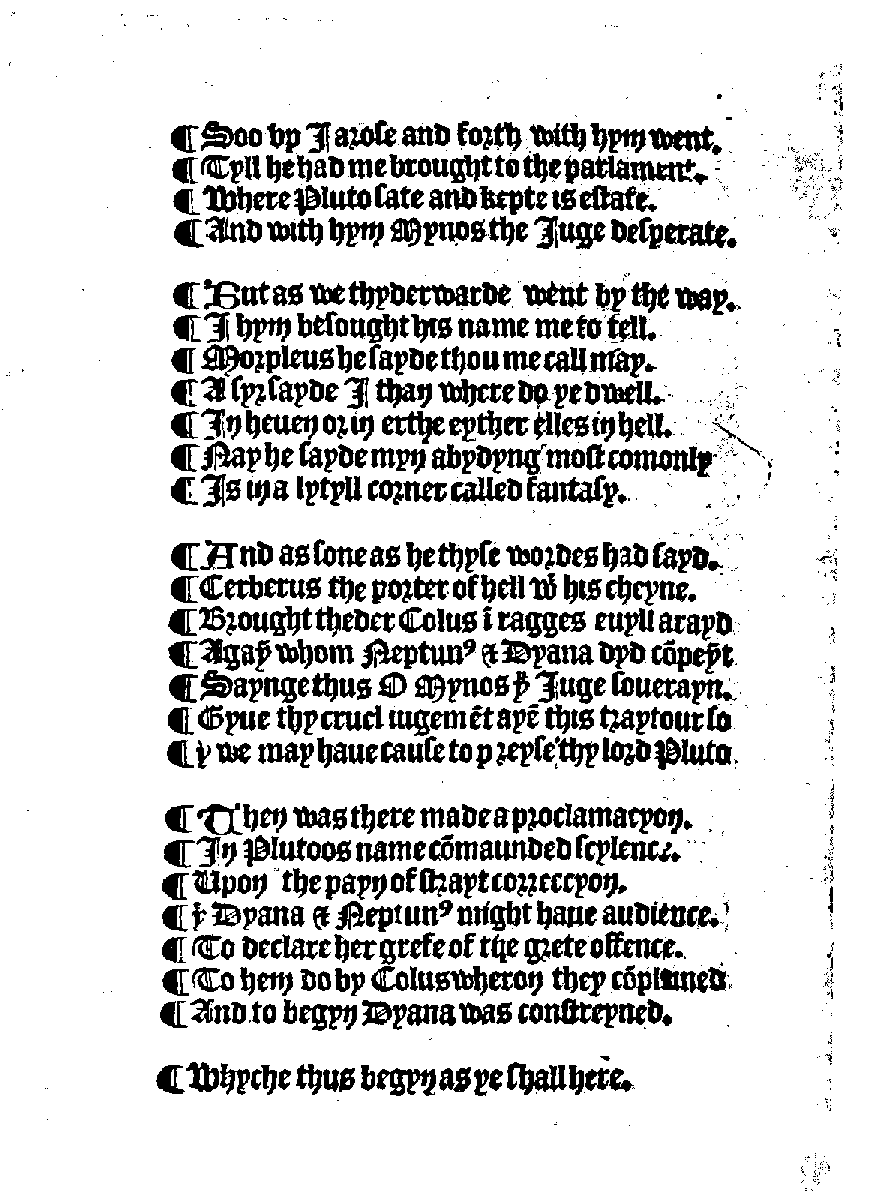 Soo vp I
arose and forth with hym went.
Soo vp I
arose and forth with hym went.Tyll he had me brought to the parlament.
Where Pluto sate and kepte is estate.
And with hym Mynos the Iuge desperate.
I hym besought his name me to tell.
Morpleus he sayde thou me call may.
A syr sayde I than where do ye dwell.
In heuen or in erthe eyther elles in hell.
Nay he sayde myn abydyng most commonly
Is in a lytyll corner called fantasy.
Cerberus the porter of hell with his cheyne.
Brought theder Colus in ragges euyll arayd
Agayn whom Neptunus & Dyana dyd compleynt
Saynge thus O Mynos thou Iuge souerayn.
Gyue thy cruel iugement ayen this traytour so
That we may haue cause to preyse thy lord Pluto
In Plutoos name commaunded scylence.
Vpon the payn of strayt correccyon.
That Dyana & Neptunus might haue audience.
To declare her grefe of the grete offence.
To hem do by Colus wheron they compleined
And to begyn Dyana was constreyned.
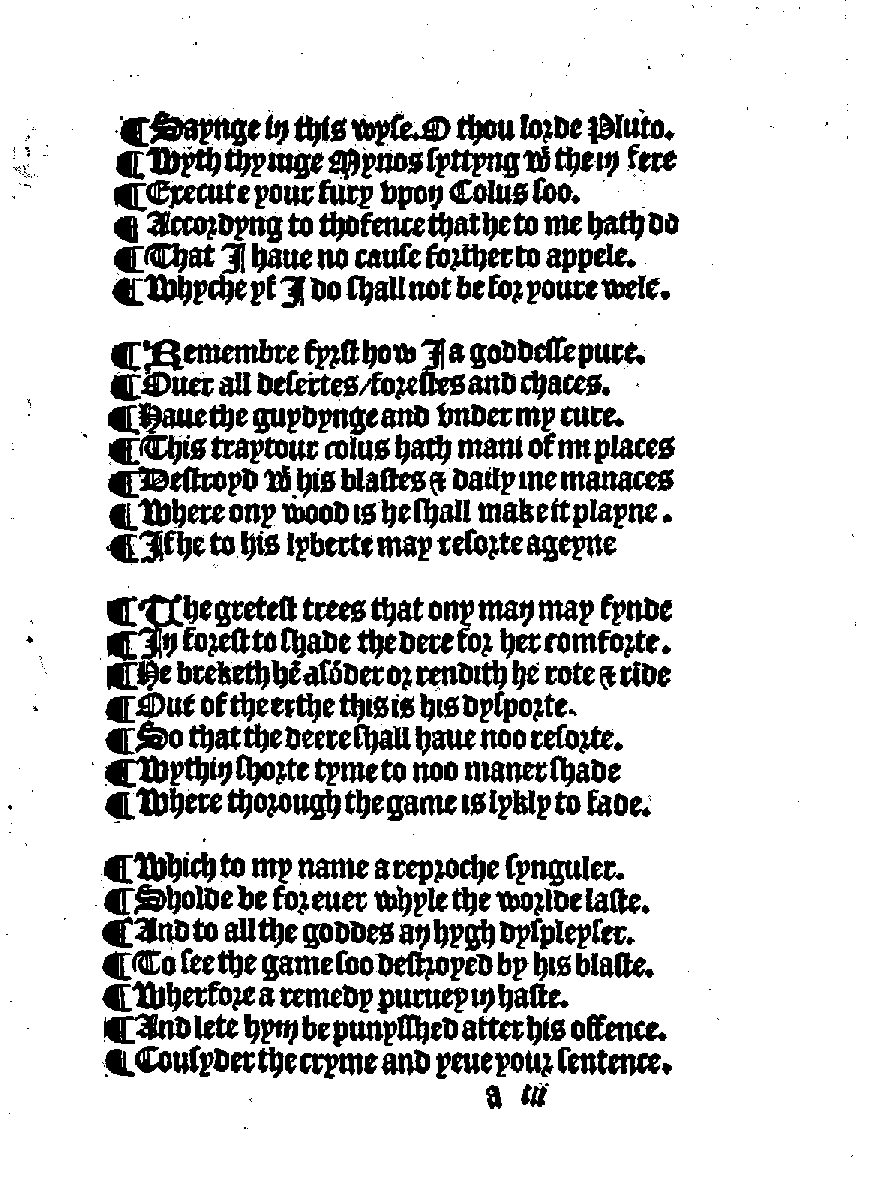 Saynge in this wyse. O
thou lorde Pluto.
Saynge in this wyse. O
thou lorde Pluto.Wyth thy iuge Mynos syttyng with the in fere
Execute your fury vpon Colus soo.
Accordyng to thofence that he to me hath do
That I haue no cause forther to appele.
Whyche yf I do shall not be for youre wele.
Ouer all desertes / forestes and chaces.
Haue the guydynge and vnder my cure.
This traytour colus hath mani of mi places
Destroyd with his blastes & daily me manaces
Where ony wood is he shall make it playne.
If he to his lyberte may resorte ageyne
In forest to shade the dere for her comforte.
He breketh hem asonder or rendith he rote & rinde
Out of the erthe this is his dysporte.
So that the deere shall haue noo resorte.
Wythin shorte tyme to noo maner shade
Where thorough the game is lykly to fade.
Sholde be foreuer whyle the worlde laste.
And to all the goddes an hygh dyspleyser.
To see the game soo destroyed by his blaste.
Wherfore a remedy puruey in haste.
And lete hym be punysshed after his offence.
Cousyder the cryme and yeue your sentence.
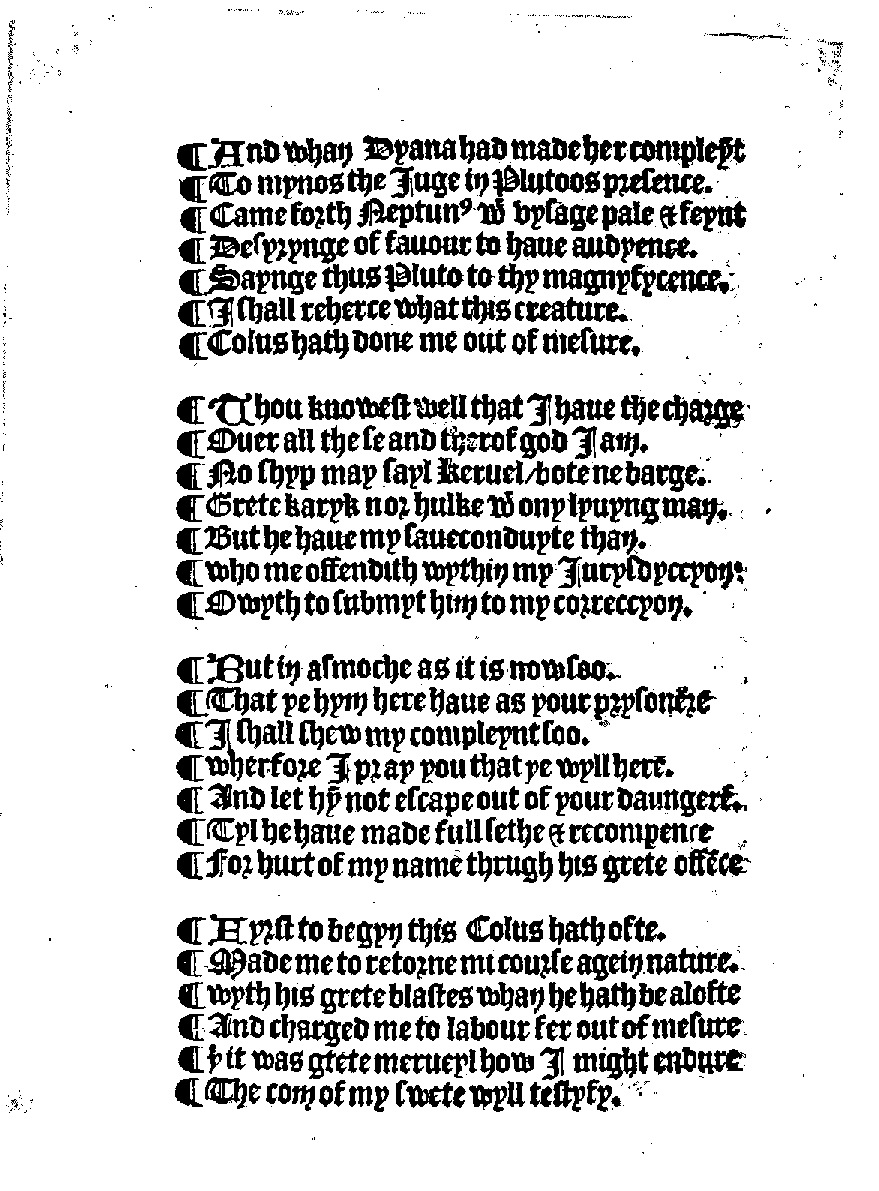 And whan Dyana had made
her compleynt
And whan Dyana had made
her compleyntTo mynos the Iuge in Plutoos presence.
Came forth Neptunus with vysage pale & feynt
Desyrynge of fauour to haue audyence.
Saynge thus Pluto to thy magnyfycence.
I shall reherce what this creature.
Colus hath done me out of mesure.
Ouer all the se and therof god I am.
No shyp may sayl Keruel / bote ne barge.
Grete karyk nor hulke with ony lyuyng man.
But he haue my saue conduyte than.
who me offendith wythin my Iurysdyccyon
Owyth to submyt him to my correccyon.
That ye hym here haue as your prysonere
I shall shew my compleynt soo.
wherfore I pray you that ye wyll here.
And let hym not escape out of your daungere.
Tyl he haue made full sethe & recompence
For hurt of my name thrugh his grete offence
Made me to retorne mi course agein nature.
wyth his grete blastes whan he hath be alofte
And charged me to labour fer out of mesure
that it was grete merueyl how I might endure
The com of my swete wyll testyfy.
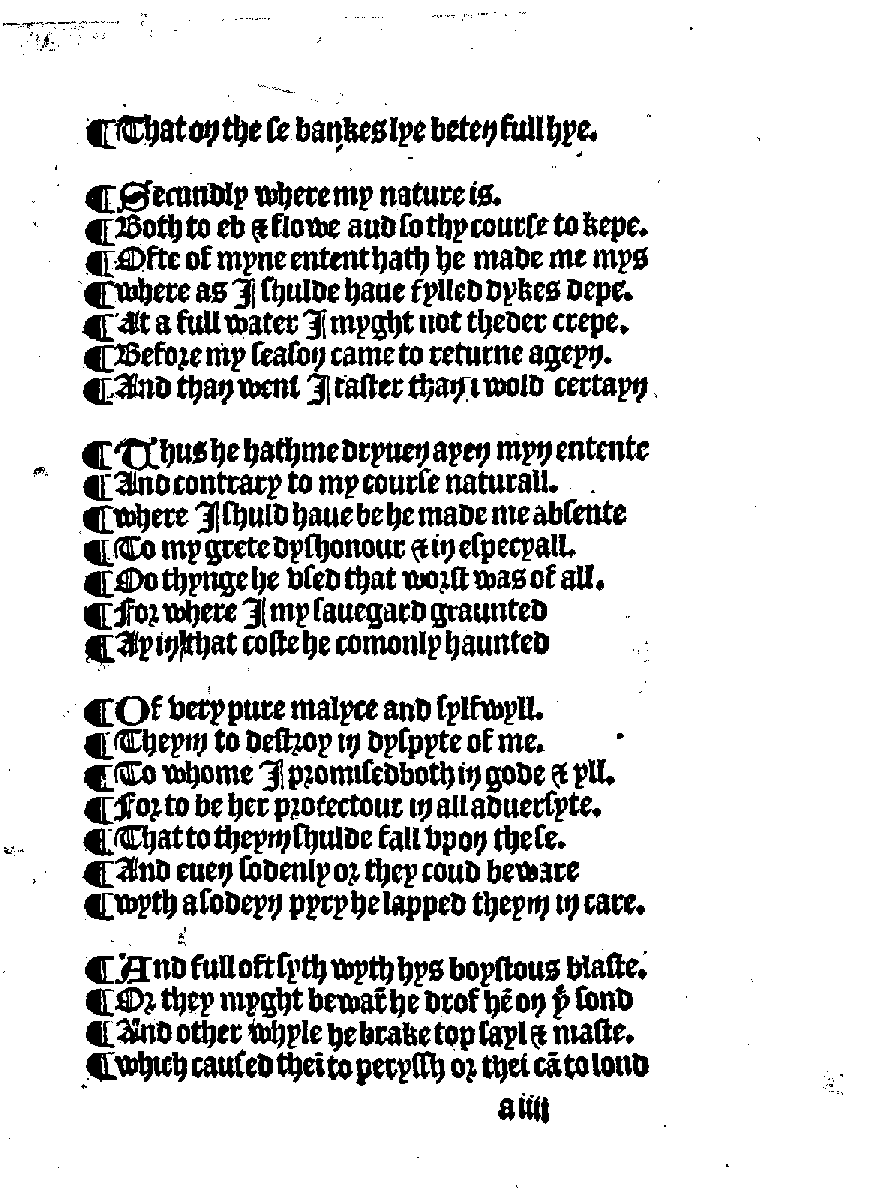 That on the se bankes lye
beten full hye.
That on the se bankes lye
beten full hye.Both to eb & flowe a[n]d so thy course to kepe.
Ofte of myne entent hath he made me mys
where as I shulde haue fylled dykes depe.
At a full water I myght not theder crepe.
Before my season came to returne ageyn.
And than went I faster than i wold certayn
And contrary to my course naturall.
where I shuld haue be he made me absente
To my grete dyshonour & in especyall.
Do thynge he vsed that worst was of all.
For where I my sauegard graunted
Ay in that coste he comonly haunted
Theym to destroy in dyspyte of me.
To whome I promised both in gode & yll.
For to be her protectour in all aduersyte.
That to theym shulde fall vpon the se.
And euen sodenly or they coud beware
wyth a sodeyn pyry he lapped theym in care.
Or they myght be ware he drof hem on the sond
And other whyle he brake top sayl & maste.
which caused theim to peryssh or thei cam to lond
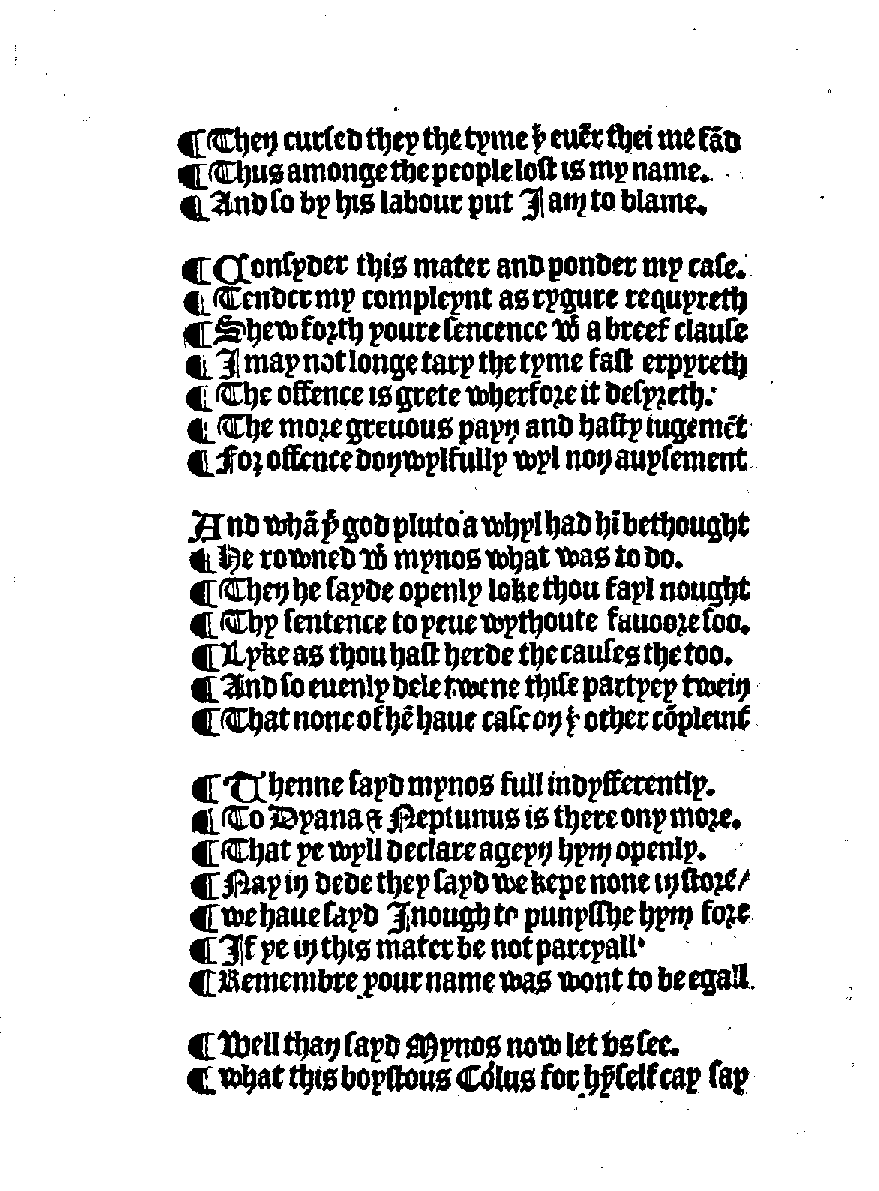 Then
cursed they the tyme that euer thei me
fand
Then
cursed they the tyme that euer thei me
fandThus amonge the people lost is my name.
And so by his labour put I am to blame.
Tender my compleynt as rygure requyreth
Shew forth youre sentence with a breef clause
I may not longe tary the tyme fast expyreth
The offence is grete wherfore it desyreth.
The more greuous payn and hasty iugement
For offence don wylfully wyl non auysement
He rowned with mynos what was to do.
Then he sayde openly loke thou fayl nought
Thy sentence to yeue wythoute fauoore soo.
Lyke as thou hast herde the causes the too.
And so euenly dele twene thise partyey twein
That none of hem haue case on the other compleint
To Dyana & Neptunus is there ony more.
That ye wyll declare ageyn hym openly.
Nay in dede they sayd we kepe none in store /
we haue sayd Inough to punysshe hym fore
If ye in this mater be not parcyall·
Remembre your name was wont to be egall.
what this boystous Colus for hymself cay say
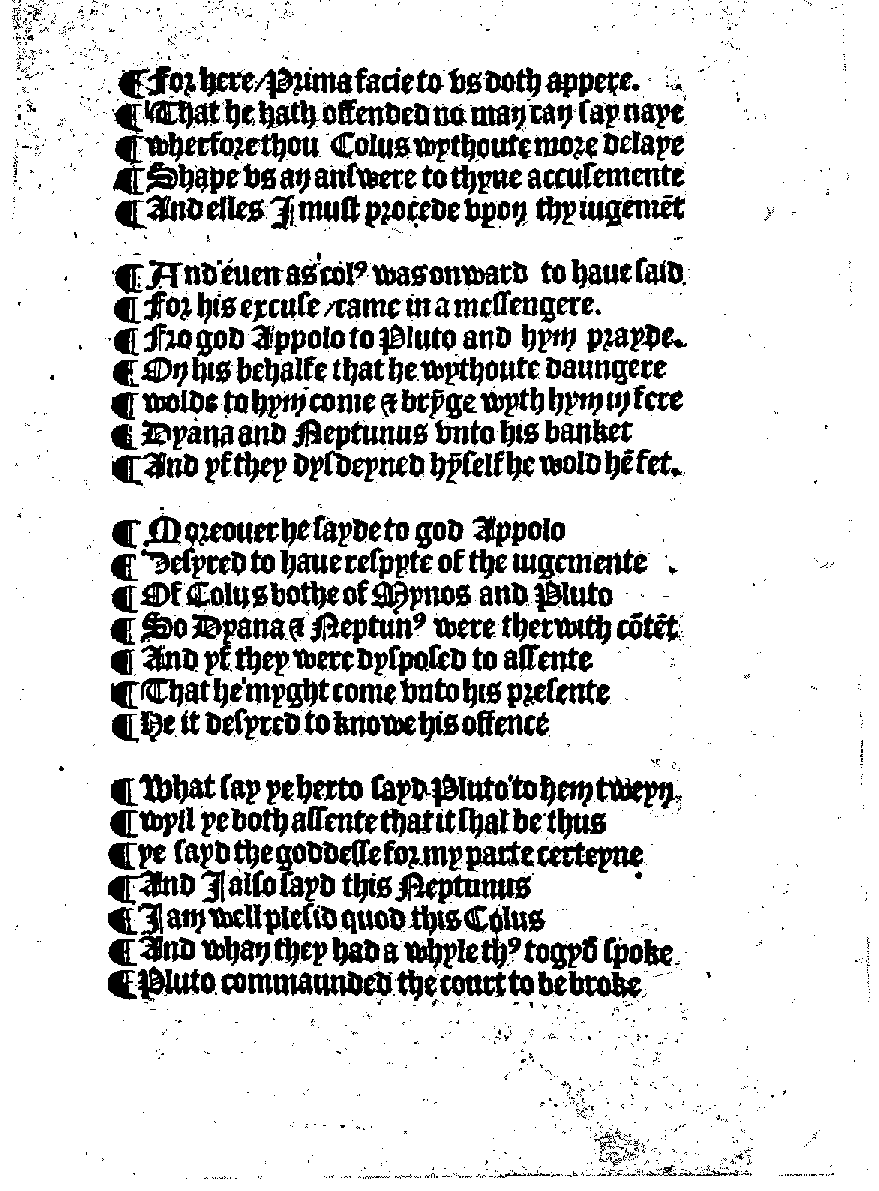 For here
Prima facie to vs doth appere.
For here
Prima facie to vs doth appere.That he hath offended no man can say naye
wherfore thou Colus wythoute more delaye
Shape vs an answere to thyne accusemente
And elles I must procede vpon thy iugement
For his excuse / came in a messengere.
Fro god Appolo to Pluto and hym prayde.
On his behalfe that he wythoute daungere
wolde to hym come & brynge wyth hym in fere
Dyana and Neptunus vnto his banket
And yf they dysdeyned hymself he wold hem fet.
Desyred to haue respyte of the iugemente
Of Colus bothe of Mynos and Pluto
So Dyana & Neptunus were therwith content
And yf they were dysposed to assente
That he myght come vnto his presente
He it desyred to knowe his offence
wyll ye both assente that it shal be thus
ye sayd the goddesse for my parte certeyne
And I also sayd this Neptunus
I am well plesid quod this Colus
And whan they had a whyle thus togyder spoke
Pluto commaunded the court to be broke
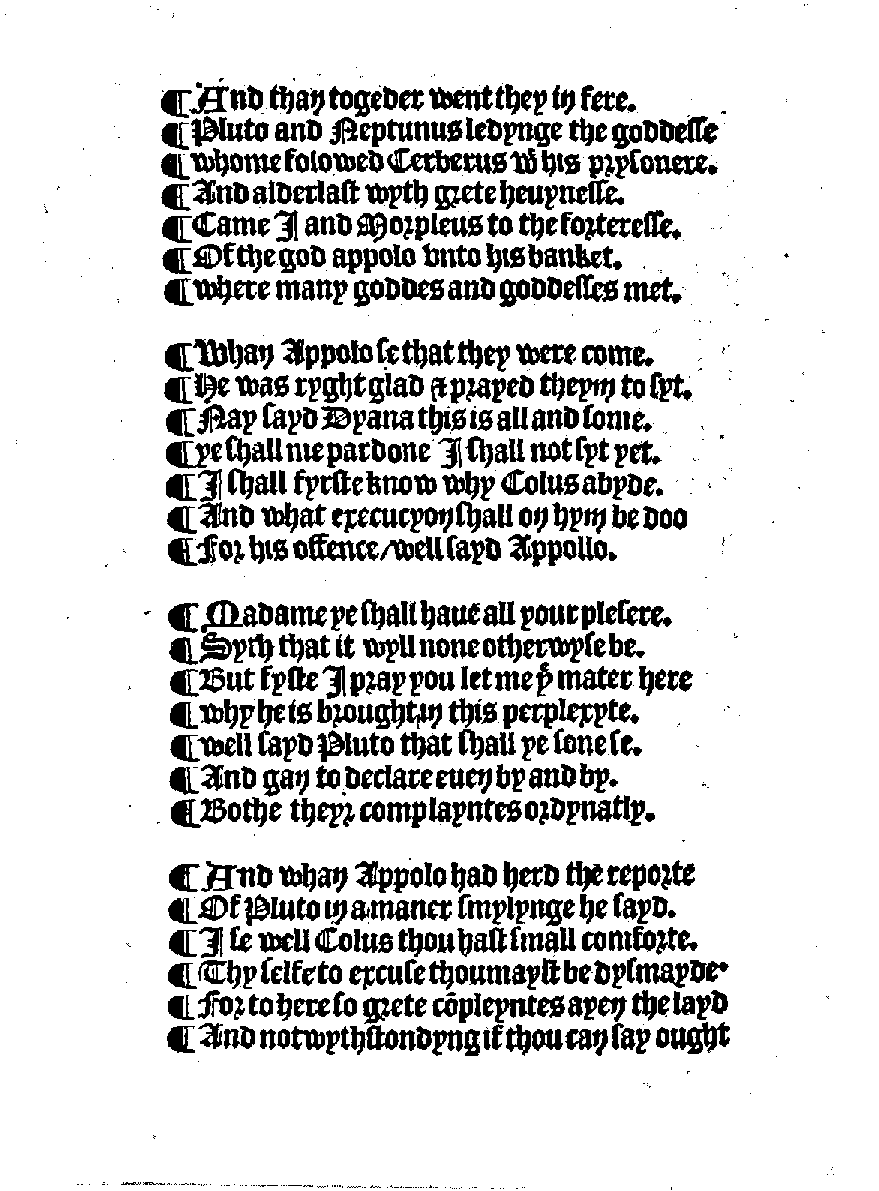 And than togeder went
they in fere.
And than togeder went
they in fere.Pluto and Neptunus ledynge the goddesse
whome folowed Cerberus with his prysonere.
And alderlast wyth grete heuynesse.
Came I and Morpleus to the forteresse.
Of the god appolo vnto his banket.
where many goddes and goddesses met.
He was ryght glad & prayed theym to syt.
Nay sayd Dyana this is all and some.
ye shall me pardone I shall not syt yet.
I shall fyrste know why Colus abyde.
And what execucyon shall on hym be doo
For his offence / well sayd Appollo.
Syth that it wyll none otherwyse be.
But fyste I pray you let me the mater here
why he is brought in this perplexyte.
well sayd Pluto that shall ye sone se.
And gan to declare euen by and by.
Bothe theyr complayntes ordynatly.
Of Pluto in a maner smylynge he sayd.
I se well Colus thou hast small comforte.
Thy selfe to excuse thou mayst be dysmayde·
For to here so grete compleyntes ayen the layd
And notwythstondyng if thou can say ought
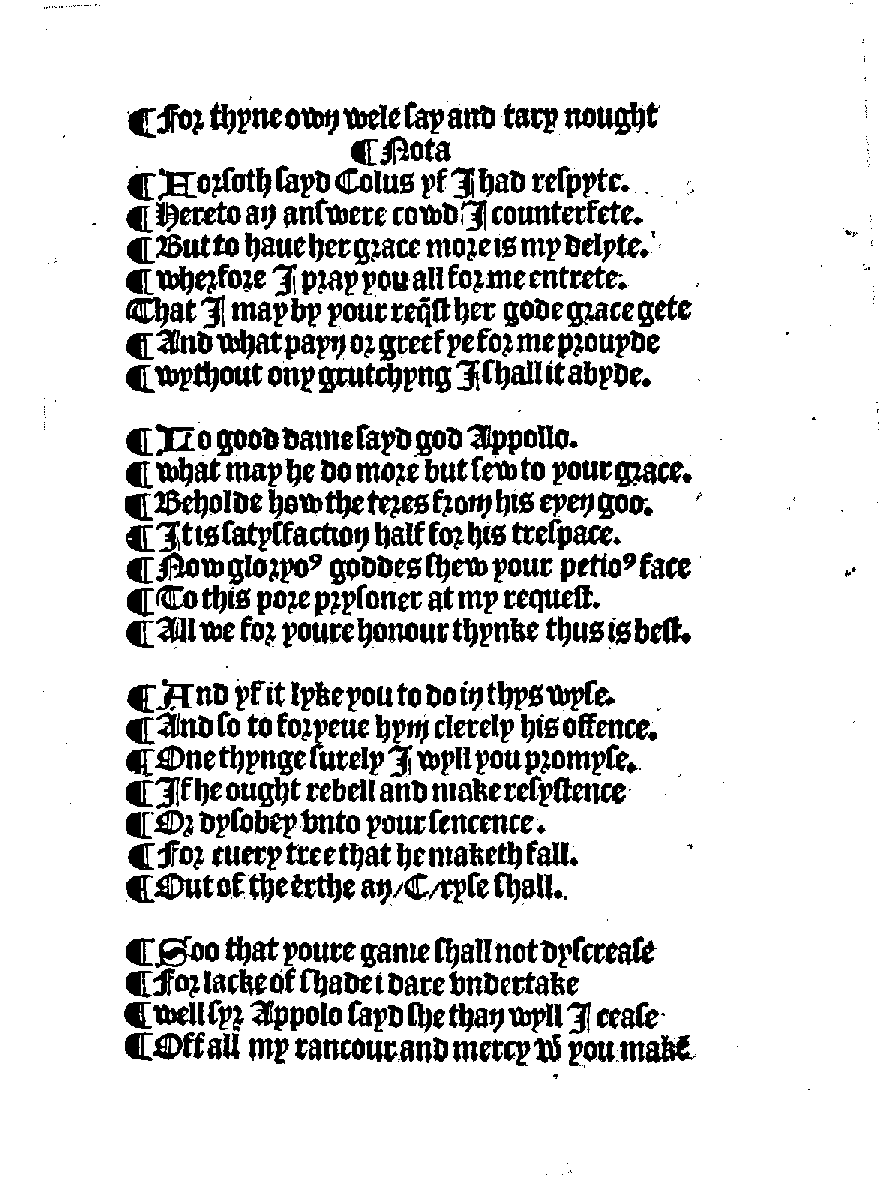 For thyne own wele say
and tary nought
For thyne own wele say
and tary noughtHereto an answere cowd I counterfete.
But to haue her grace more is my delyte.
wherfore I pray you all for me entrete.
That I may by your request her gode grace gete
And what payn or greef ye for me prouyde
wythout ony grutchyng I shall it abyde.
what may he do more but sew to your grace.
Beholde how the teres from his eyen goo.
It is satysfaction half for his trespace.
Now gloryous goddes shew your petious face
To this pore prysoner at my request.
All we for youre honour thynke thus is best.
And so to foryeue hym clerely his offence.
One thynge surely I wyll you promyse.
If he ought rebell and make resystence
Or dysobey vnto your sentence.
For euery tree that he maketh fall.
Out of the erthe an /C/ ryse shall.
For lacke of shade i dare vndertake
well syr Appolo sayd she than wyll I cease
Off all my rancour and mercy with you make
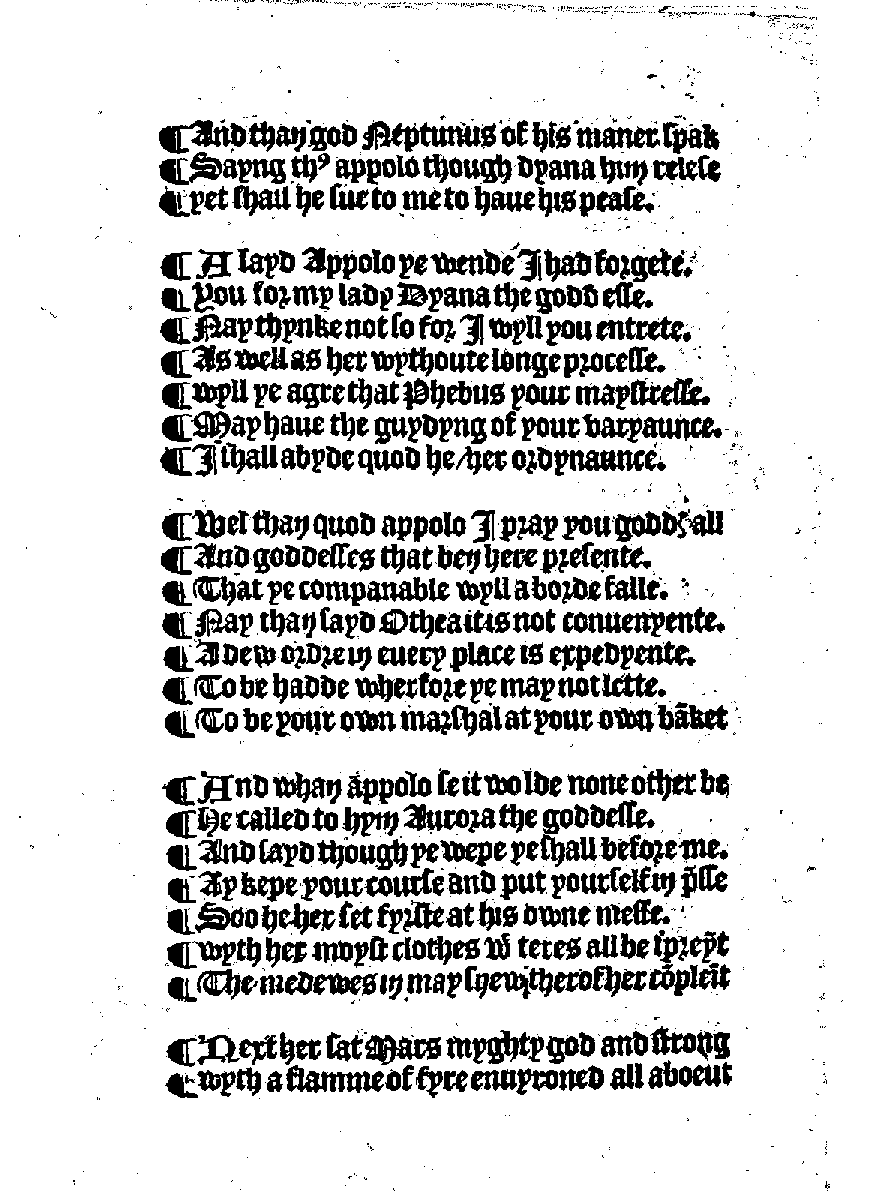 And than
god Neptunus of his maner spak
And than
god Neptunus of his maner spakSaying thus appolo though dyana him relese
yet shall he sue to me to haue his pease.
You for my lady Dyana the goddesse.
Nay thynke not so for I wyll you entrete.
As well as her wythoute longe processe.
wyll ye agre that Phebus your maystresse.
May haue the guydyng of your varyaunce.
I shall abyde quod he / her ordynaunce.
And goddesses that ben here presente.
That ye companable wyll aborde falle.
Nay than sayd Othea it is not conuenyente.
A dew ordre in euery place is expedyente.
To be hadde wherfore ye may not lette.
To be your own marshal at your own banket
He called to hym Aurora the goddesse.
And sayd though ye wepe ye shall before me.
Ay kepe your course and put yourself in presse
Soo he her set fyrste at his owne messe.
wyth her moyst clothes with teres all be spreynt
The medewes in may shew therof her compleint
wyth a flamme of fyre enuyroned all about
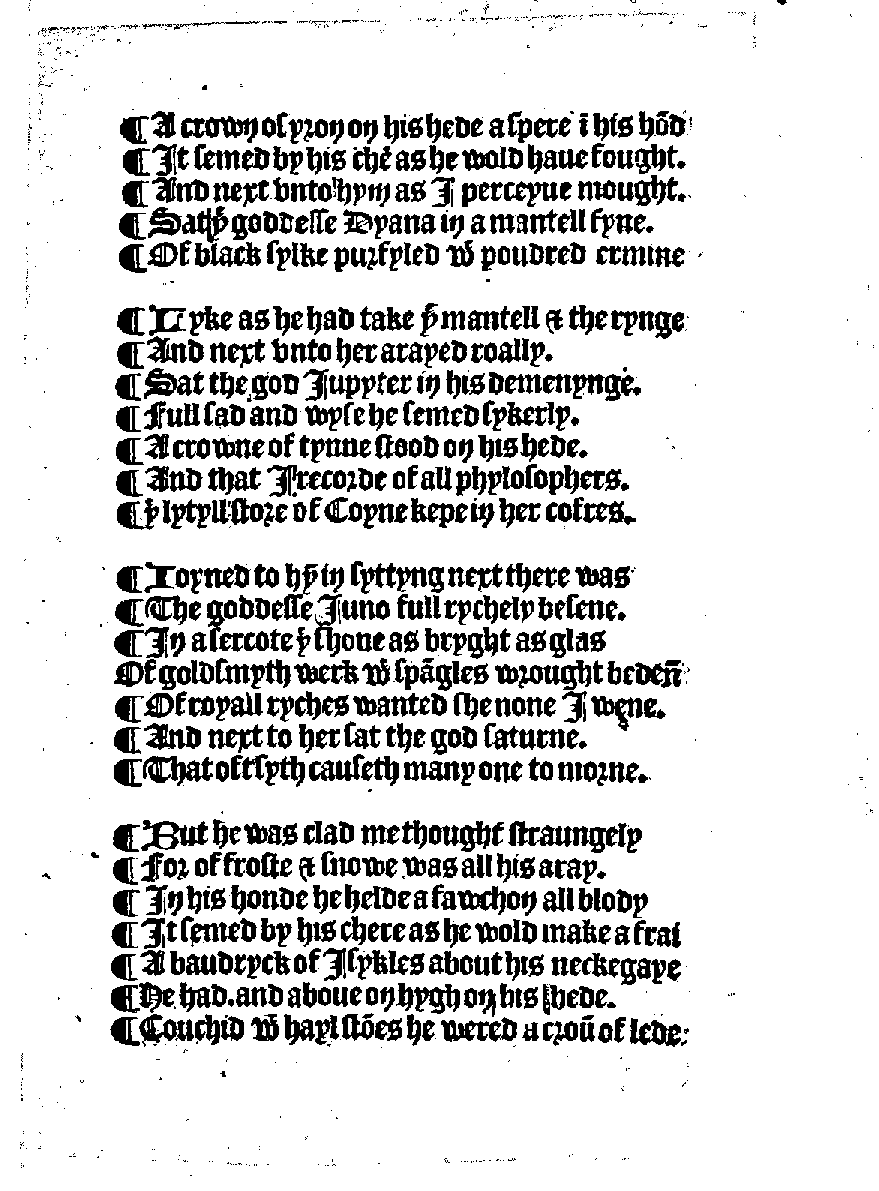 A crown
of yron on his hede a spere in his
hond
A crown
of yron on his hede a spere in his
hondIt semed by his chere as he wold haue fought.
And next vnto hym as I perceyue mought.
Sat the goddesse Dyana in a mantell fyne.
Of black sylke purfyled with poudred ermine
And next vnto her arayed roally.
Sat the god Iupyter in his demenynge.
Full sad and wyse he semed sykerly.
A crowne of tynne stood on his hede.
And that I recorde of all phylosophers.
that lytyll store of Coyne kepe in her cofres.
The goddesse Iuno full rychely besene.
In a sercote that shone as bryght as glas
Of goldsmyth werk with spangles wrought bedene
Of royall ryches wanted she none I wene.
And next to her sat the god saturne.
That oft syth causeth many one to morne.
For of froste & snowe was all his aray.
In his honde he helde a fawchon all blody
It semed by his chere as he wold make a frai
A baudryck of Isykles about his necke gaye
He had and aboue on hygh on his hede.
Couchid with hayl stones he wered a croun of lede
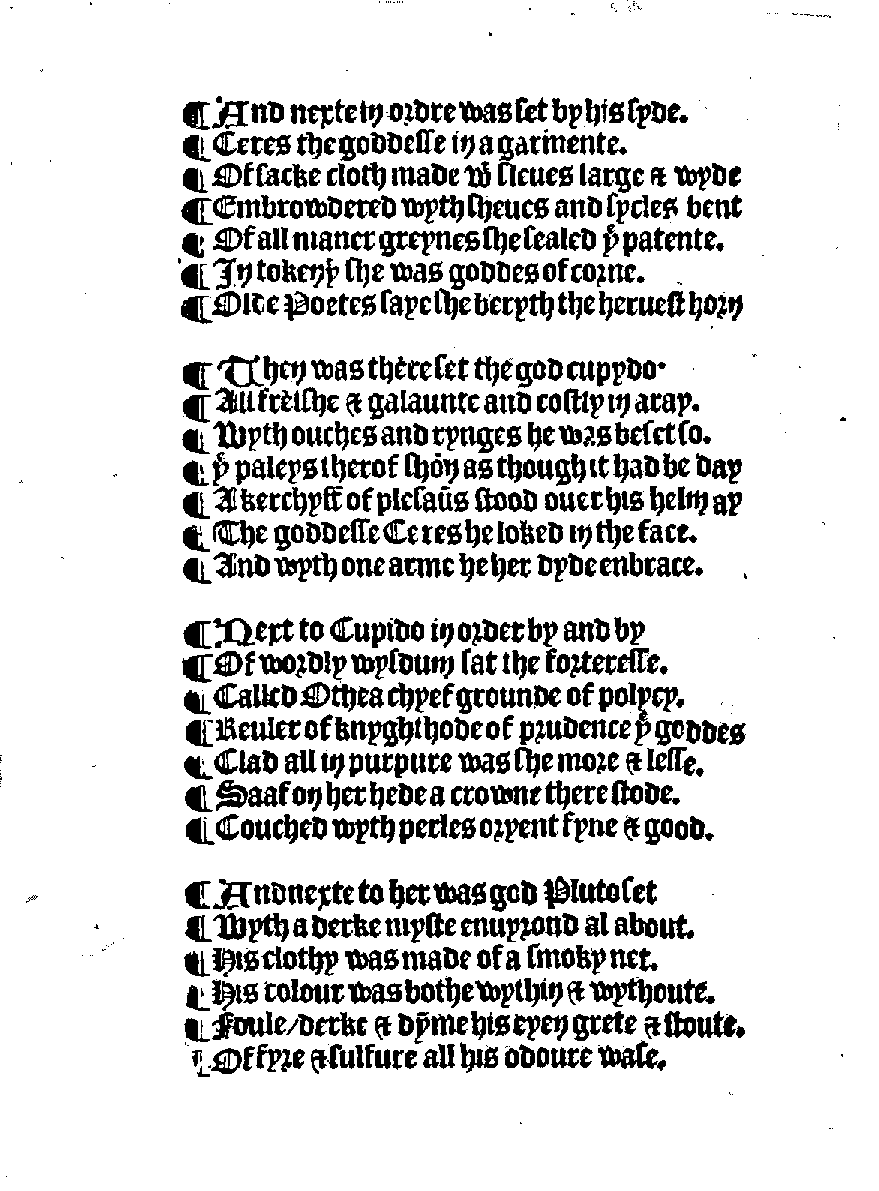 And nexte in ordre was
set by his syde.
And nexte in ordre was
set by his syde.Ceres the goddesse in a garmente.
Of sacke cloth made with sleues large & wyde
Embrowdered wyth sheues and sycles bent
Of all maner greynes she sealed the patente.
In token that she was goddes of corne.
Olde Poetes saye she beryth the heruest horn
All fresshe & galaunte and costly in aray.
Wyth ouches and rynges he was beset so.
the paleys therof shon as though it had be day
A kerchyff of plesauns stood ouer his helm ay
The goddesse Ceres he loked in the face.
And wyth one arme he her dyde enbrace.
Of wordly wysdum sat the forteresse.
Called Othea chyef grounde of polycy.
Reuler of knyghthode of prudence the goddes
Clad all in purpure was she more & lesse.
Saaf on her hede a crowne there stode.
Couched wyth perles oryent fyne & good.
Wyth a derke myste enuyrond al about.
His clothy was made of a smoky net.
His colour was bothe wythin & wythoute.
Foule / derke & dymme his eyen grete & stoute.
Of fyre & sulfure all his odoure wase.
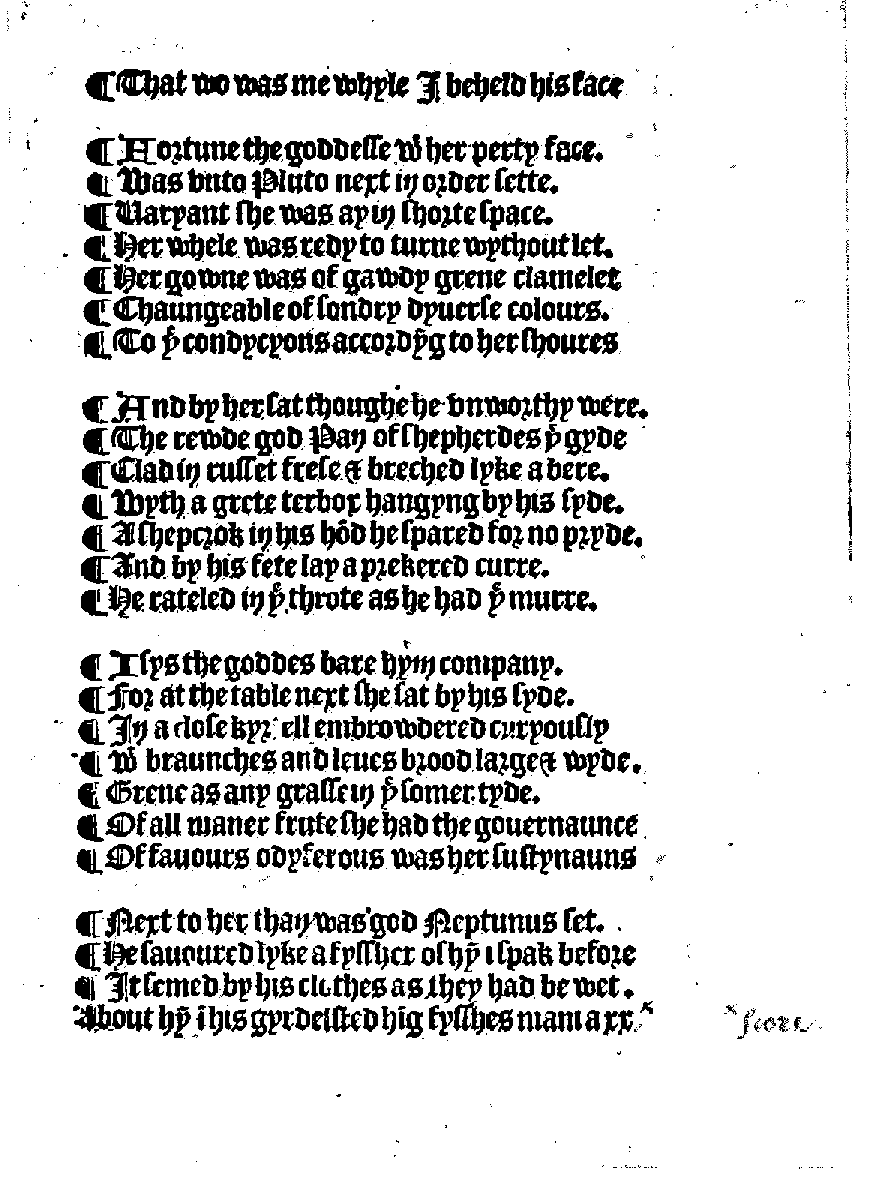 That wo was me whyle I
beheld his face
That wo was me whyle I
beheld his faceWas vnto Pluto next in order sette.
Varyant she was ay in shorte space.
Her whele was redy to turne wythout let.
Her gowne was of gawdy grene clamelet.
Chaungeable of sondry dyuerse colours.
To the condycyons accordyng to her shoures
The rewde god Pan of shepherdes that gyde
Clad in russet frese & breched lyke a bere.
Wyth a grete terbox hangyng by his syde.
A shepcrok in his hond he spared for no pryde.
And by his fete lay a prekered curre.
He rateled in the throte as he had the murre.
For at the table next she sat by his syde.
In a close kyrtell embrowdered curyously
with braunches and leues brood large & wyde.
Grene as any grasse in the somer tyde.
Of all maner frute she had the gouernaunce
Of fauours odyferous was her sustynauns
He sauoured lyke a fyssher of hym i spak before
It semed by his clothes as they had be wet.
About hym in his gyrdelsted hing fysshes mani a xx
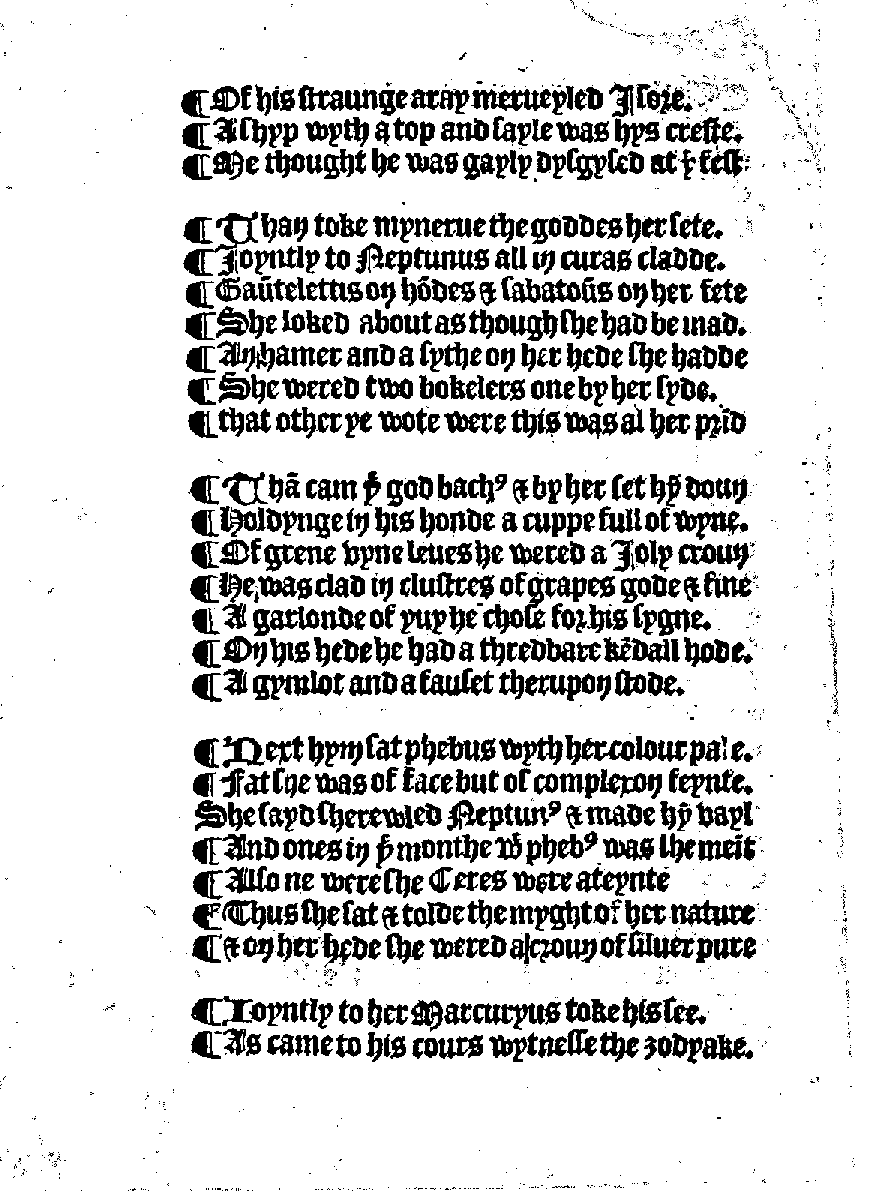 Of his
straunge aray merueyled I sore.
Of his
straunge aray merueyled I sore.A shyp wyth a top and sayle was hys creste.
Me thought he was gayly dysgysed at the fest.
Ioyntly to Neptunus all in curas cladde.
Gauntelettis on hondes & sabatouns on her fete
She loked about as though she had be mad.
An hamer and a sythe on her hede she hadde
She wered two bokelers one by her syde.
that other ye wote were this was al her prid
Holdynge in his honde a cuppe full of wyne.
Of grene vyne leues he wered a Ioly croun
He was clad in clustres of grapes gode & fine
A garlonde of yuy he chose for his sygne.
On his hede he had a thredbare kendall hode.
A gymlot and a fauset therupon stode.
Fat she was of face but of complexon feynte.
She sayd she rewled Neptunus & made hym bayl
And ones in the monthe with phebus was she meint
Also ne were she Ceres were ateynte
Thus she sat & tolde the myght of her nature
& on her hede she wered a croun of siluer pure
As came to his cours wytnesse the zodyake.
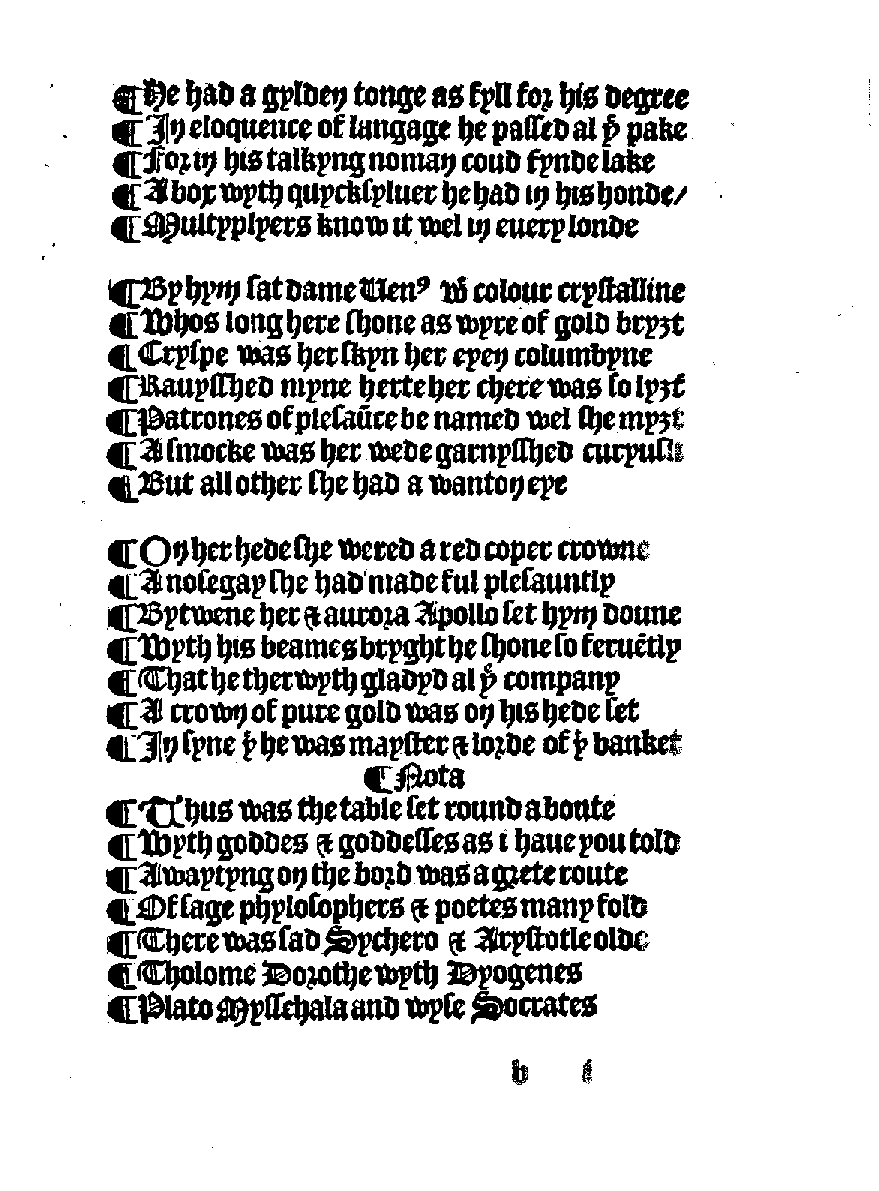 He had a gylden tonge as
fyll for his degree
He had a gylden tonge as
fyll for his degreeIn eloquence of langage he passed al the pake
For in his talkyng no man coud fynde lake
A box wyth quycksyluer he had in his honde /
Multyplyers know it wel in euery londe
Whos long here shone as wyre of gold bryght
Cryspe was her skyn her eyen columbyne
Rauysshed myne herte her chere was so lyght
Patrones of plesaunce be named wel she myght
A smocke was her wede garnysshed curyusli
But all other she had a wanton eye
A nosegay she had made ful plesauntly
Bytwene her & aurora Apollo set hym doune
Wyth his beames bryght he shone so feruently
That he therwyth gladyd al the company
A crown of pure gold was on his hede set
In syne that he was mayster & lorde of that banket
Nota
Thus was the table set round aboute
Wyth goddes & goddesses as i haue you told
Awaytyng on the bord was a grete route
Of sage phylosophers & poetes many fold
There was sad Sychero & Arystotle olde
Tholome Dorothe wyth Dyogenes
Plato Myssehala and wyse Socrates
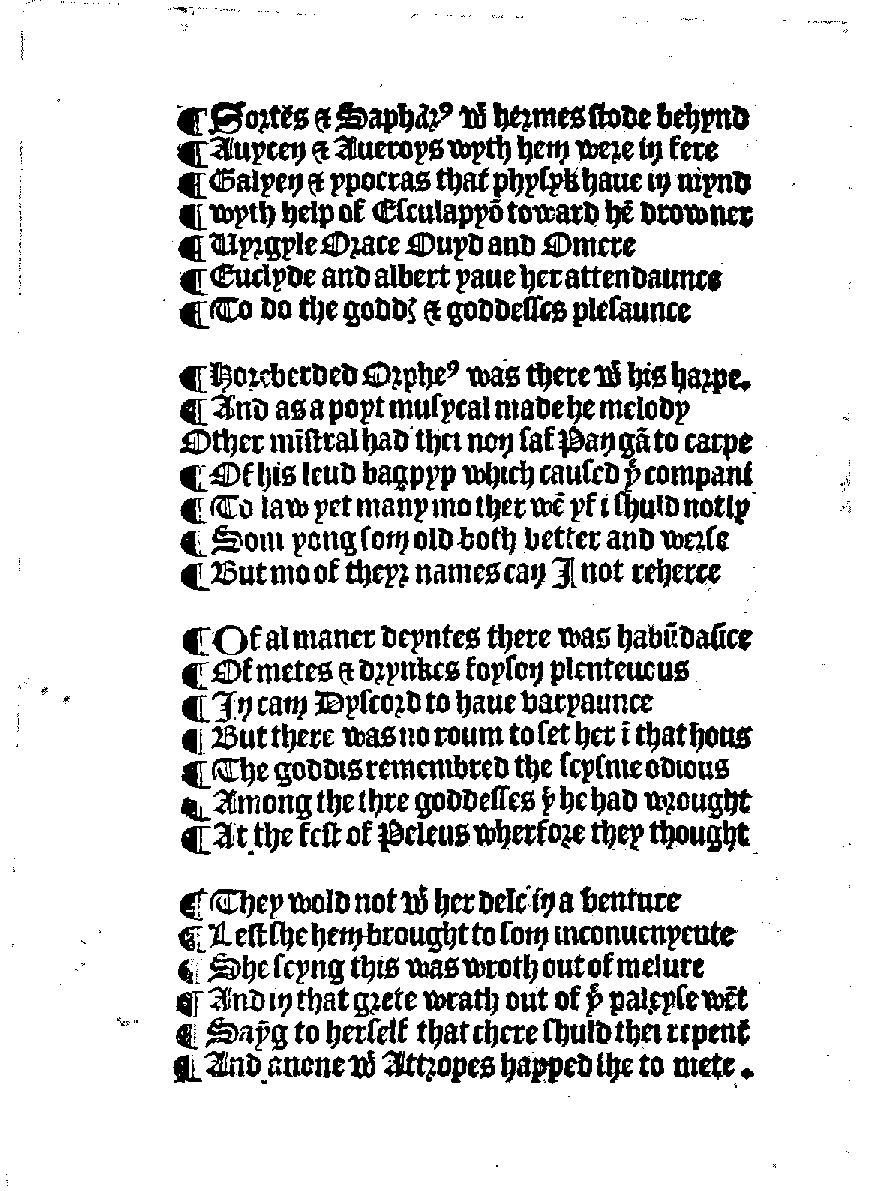 Sortes &
Saph[y]rus with hermes stode behynd
Sortes &
Saph[y]rus with hermes stode behyndAuycen & Aueroys wyth hem were in fere
Galyen & ypocras that physyk haue in mynd
wyth help of Esculapyon toward hem drow ner
Vyrgyle Orace Ouyd and Omere
Euclyde and albert yaue her attendaunce
To do the godds & goddesses plesaunce
And as a poyt musycal made he melody
Other minstral had ther non saf Pan gan to carpe
Of his leud bagpyp which caused the compani
To law yet many mo ther were yf i shuld not ly
Som yong som old both better and werse
But mo of theyr names can I not reherce
Of metes & drynkes foyson plenteuous
In cam Dyscord to haue varyaunce
But there was no roum to set her in that hous
The goddis remembred the scysme odious
Among the thre goddesses that she had wrought
At the fest of Peleus wherfore they thought
Lest she hem brought to som inconuenyente
She seyng this was wroth out of mesure
And in that grete wrath out of the paleyse went
Sayng to herself that chere shuld thei repent
And anone with Attropes happed she to mete.
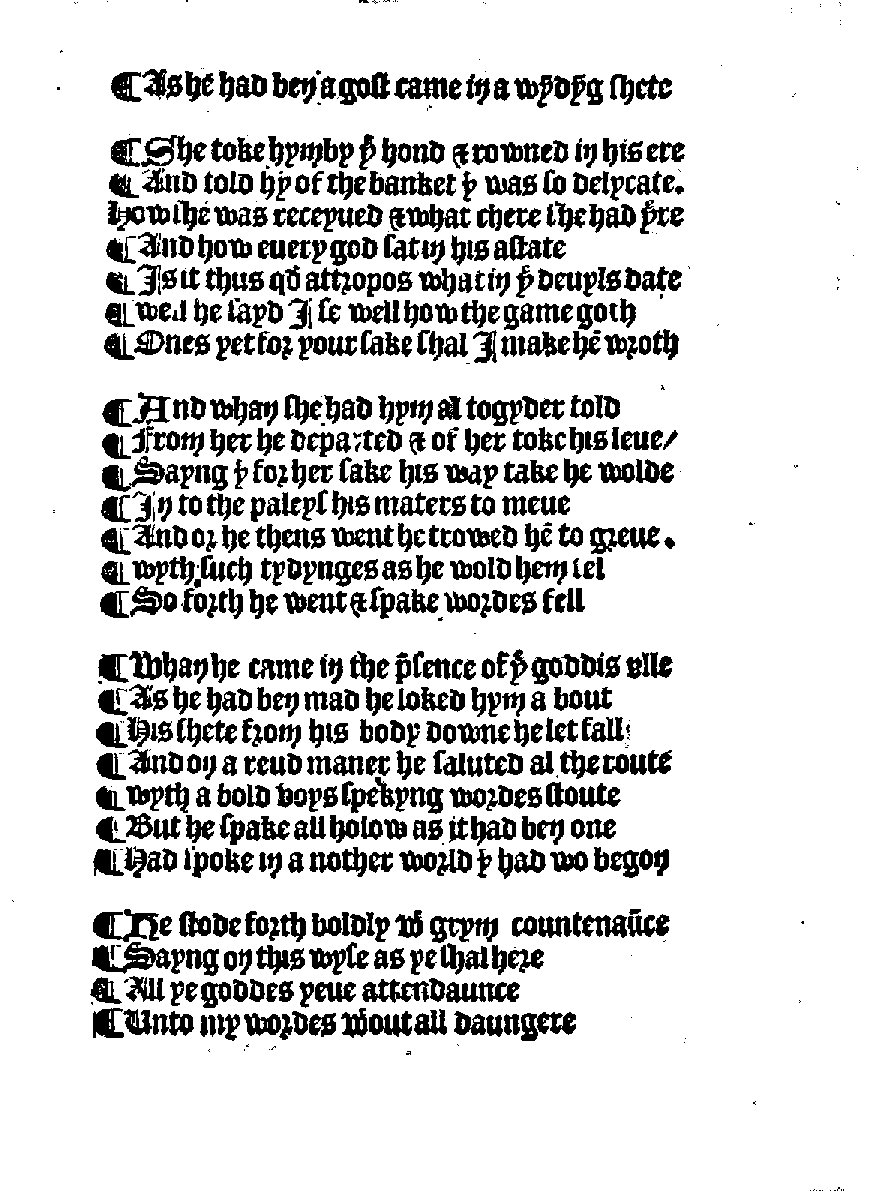 As he had ben a gost came in a
wyndyng shete
As he had ben a gost came in a
wyndyng sheteAnd told hym of the banket that was so delycate.
How she was receyued & what chere she had there
And how euery god sat in his astate
Is it thus quod attropos what in the deuyls date
Well he sayd I se well how the game goth
Ones yet for your sake shal I make hem wroth
From her he departed & of her toke his leue /
Sayng that for her sake his way take he wolde
In to the paleys his maters to meue
And or he thens went he trowed hem to greue.
Wyth such tydynges as he wold hem tel
So forth he went & spake wordes fell
As he had ben mad he loked hym a bout
His shete from his body downe he let fall
And on a reud maner he saluted al the route
Wyth a bold voys spekyng wordes stoute
But he spake all holow as it had ben one
Had spoke in a nother world that had wo begon
Sayng on this wyse as ye shal here
All ye goddes yeue attendaunce
Vnto my wordes without all daungere
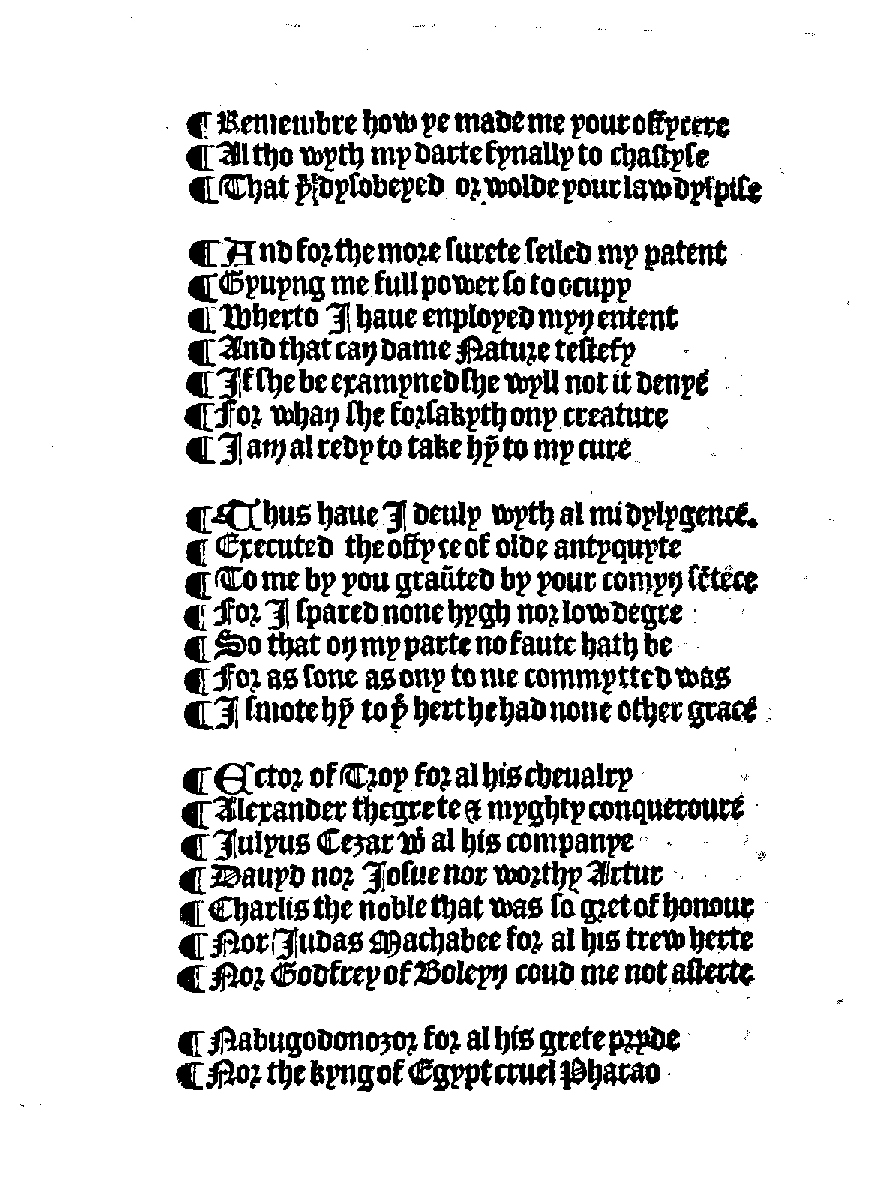 Remembre how ye made me your
offycere
Remembre how ye made me your
offycereAl tho wyth my darte fynally to chastyse
That thou dysobeyed or wolde your law dyspise
Gyuyng me full power so to ocupy
Wherto I haue enployed myn entent
And that can dame Nature testefy
If she be examyned she wyll not it denye
For whan she forsakyth ony creature
I am al redy to take hym to my cure
Executed the offyce of olde antyquyte
To me by you graunted by your comyn sentece
For I spared none hygh nor low degre
So that on my parte no faute hath be
For as sone as ony to me commytted was
I smote hym to the hert he had none other grace
Alexander the grete & myghty conqueroure
Iulyus Cezar with al his companye
Dauyd nor Iosue nor worthy Artur
Charlis the noble that was so gret of honour
Nor Iudas Machabee for al his trew herte
Nor Godfrey of Boleyn coud me not asterte
Nor the kyng of Egypt cruel Pharao
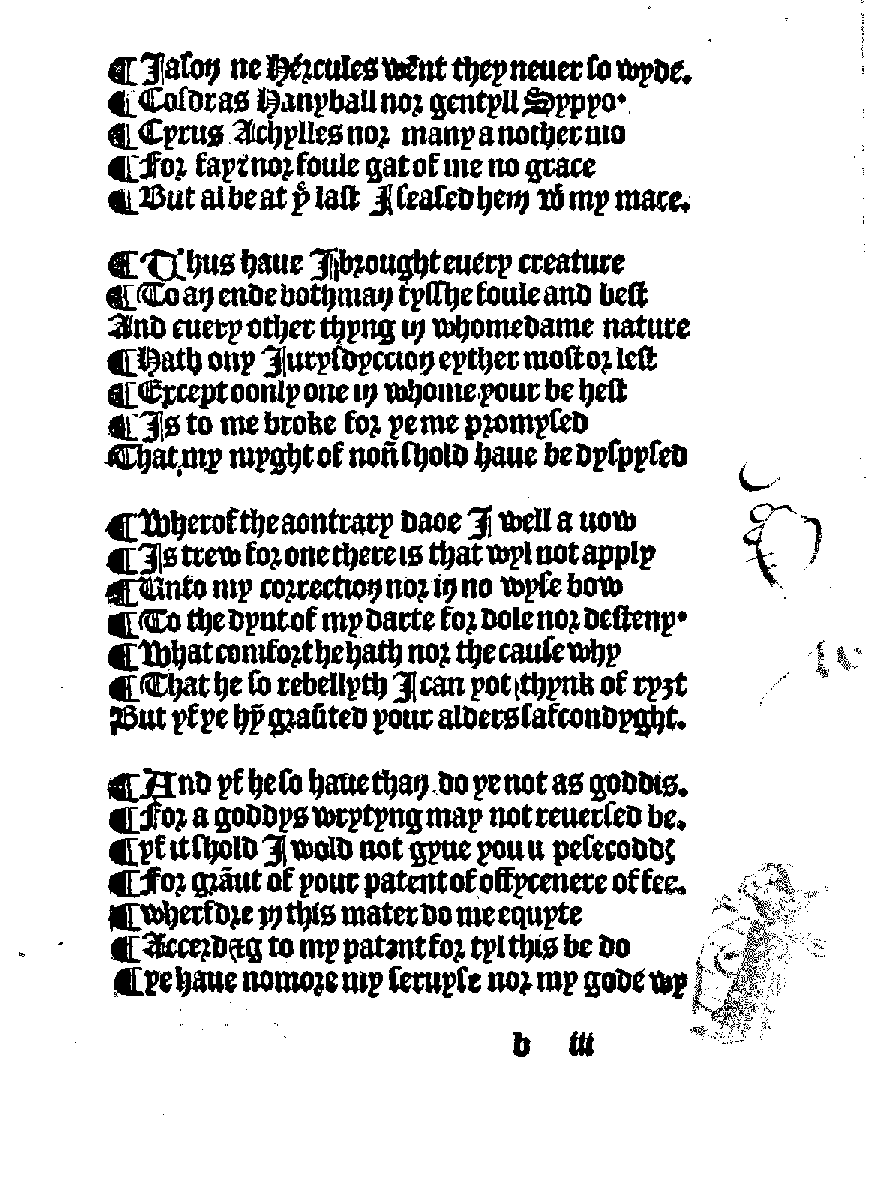 Iason ne Hercules went
they neuer so wyde.
Iason ne Hercules went
they neuer so wyde.Cosdras Hanyball nor gentyll Sypyo·
Cyrus Achylles nor many another mo
For fayr nor foule gat of me no grace
But al be at the last I seased hem with my mace.
To an ende both man fysshe foule and best
And euery other thyng in whome dame nature
Hath ony Iurysdyccion eyther most or lest
Except oonly one in whome your be hest
Is to me broke for ye me promysed
That my myght of none shold haue be dyspysed
Is trew for one there is that wyl not apply
Vnto my correction nor in no wyse bow
To the dynt of my darte for dole nor desteny·
What comfort he hath nor the cause why
That he so rebellyth I can not thynk of ryght
But yf ye hym graunted your alders saf condyght.
For a goddys wrytyng may not reuersed be.
Yf it shold I wold not gyue you ii pesecoddis
For graunt of your patent of offyce nere of fee.
Wherefore in this mater do me equyte
Accerding to my patent for tyl this be do
Ye haue no more my seruyse nor my gode wyl
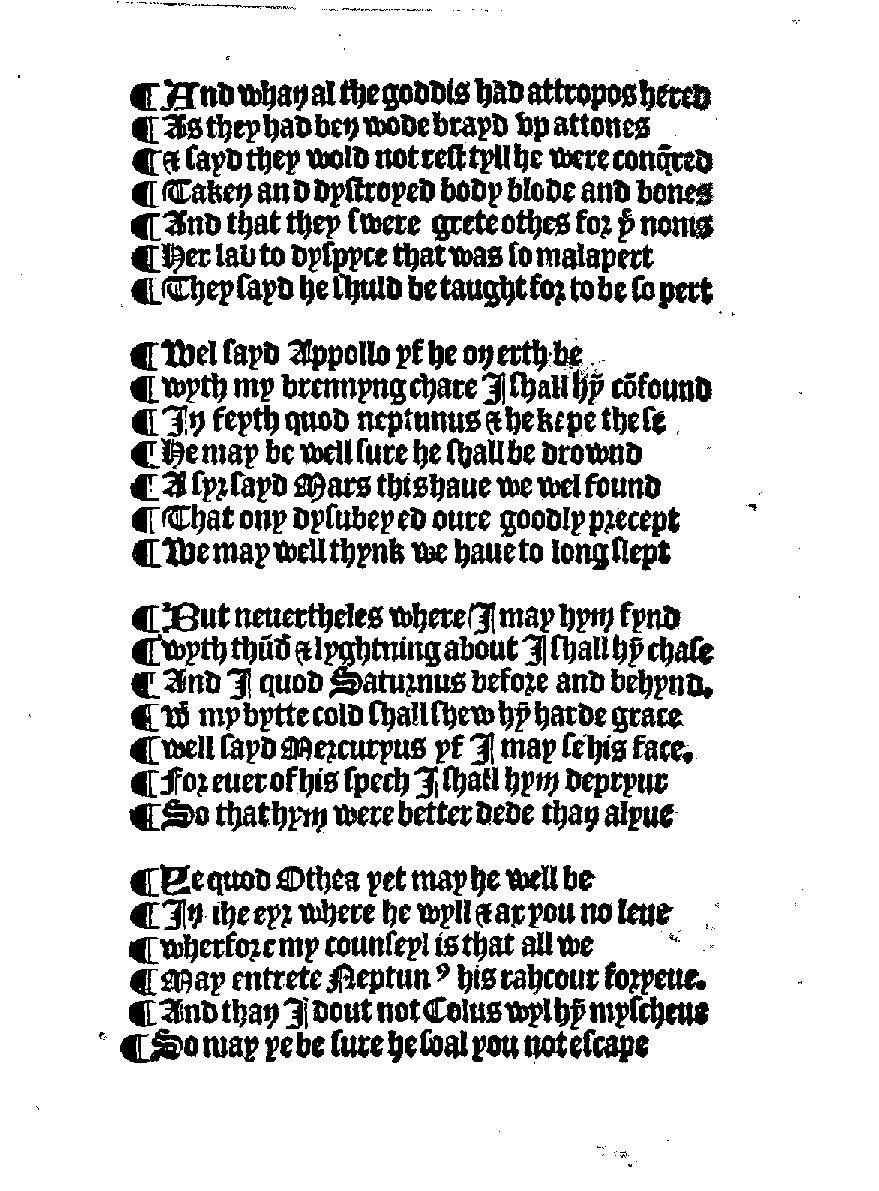 And whan al the goddis
had attropos hered
And whan al the goddis
had attropos heredAs they had ben wode brayd vp attones
& sayd they wold not rest tyll he were conquered
Taken and dystroyed body blode and bones
And that they swere grete othes for the nonis
Her lav to dyspyce that was so malapert
They sayd he shuld be taught for to be so pert
wyth my brennyng chare I shall hym confound
In feyth quod neptunus & he kepe these
He may be well sure he shall be drownd
A syr sayd Mars this haue we wel found
That ony dysubeyed oure goodly precept
We may well thynk we haue to long slept
wyth thunder & lyghtning about I shall hym chase
And I quod Saturnus before and behynd.
with my bytte cold shall shew hym harde grace
well sayd Mercuryus yf I may se his face.
For euer of his spech I shall hym depryue
So that hym were better dede than alyue
In the eyr where he wyll & ax you no leue
wherfore my counseyl is that all we
May entrete Neptunus his rancour foryeue.
And than I dout not Colus wyl hym myscheue
So may ye be sure he soal you not escape
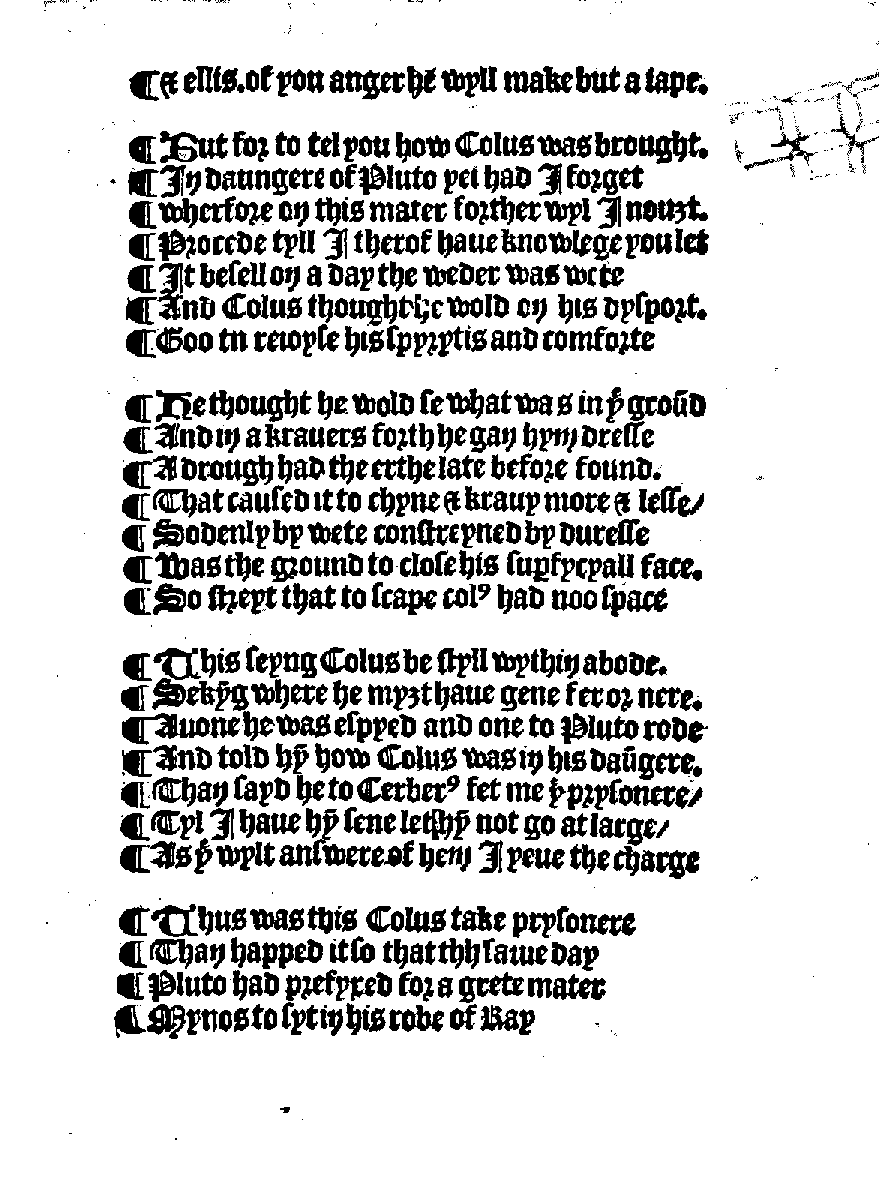 & ellis of you anger
he wyll make but a iape.
& ellis of you anger
he wyll make but a iape.In daungere of Pluto yet had I forget
wherfore on this mater forther wyl I nought.
Procede tyll I therof haue knowlege you let
It befell on a day the weder was wete
And Colus thought he wold on his dysport.
Goo t[u] reioyse his spyrytis and comforte
And in a krauers forth he gan hym dresse
A drough had the erthe late before found.
That caused it to chyne & krauy more & lesse /
Sodenly by wete constreyned by duresse
Was the ground to close his superfycyall face.
So streyt that to scape colus had noo space
Sekyng where he myght haue gene fer or nere.
A[n]one he was espyed and one to Pluto rode
And told hym how Colus was in his daungere.
Than sayd he to Cerberus fet me that prysonere /
Tyl I haue hym sene let hym not go at large /
As the wylt answere of hem I yeue the charge
Than happed it so that the sa[m]e day
Pluto had prefyxed for a grete mater
Mynos to syt in his robe of Ray
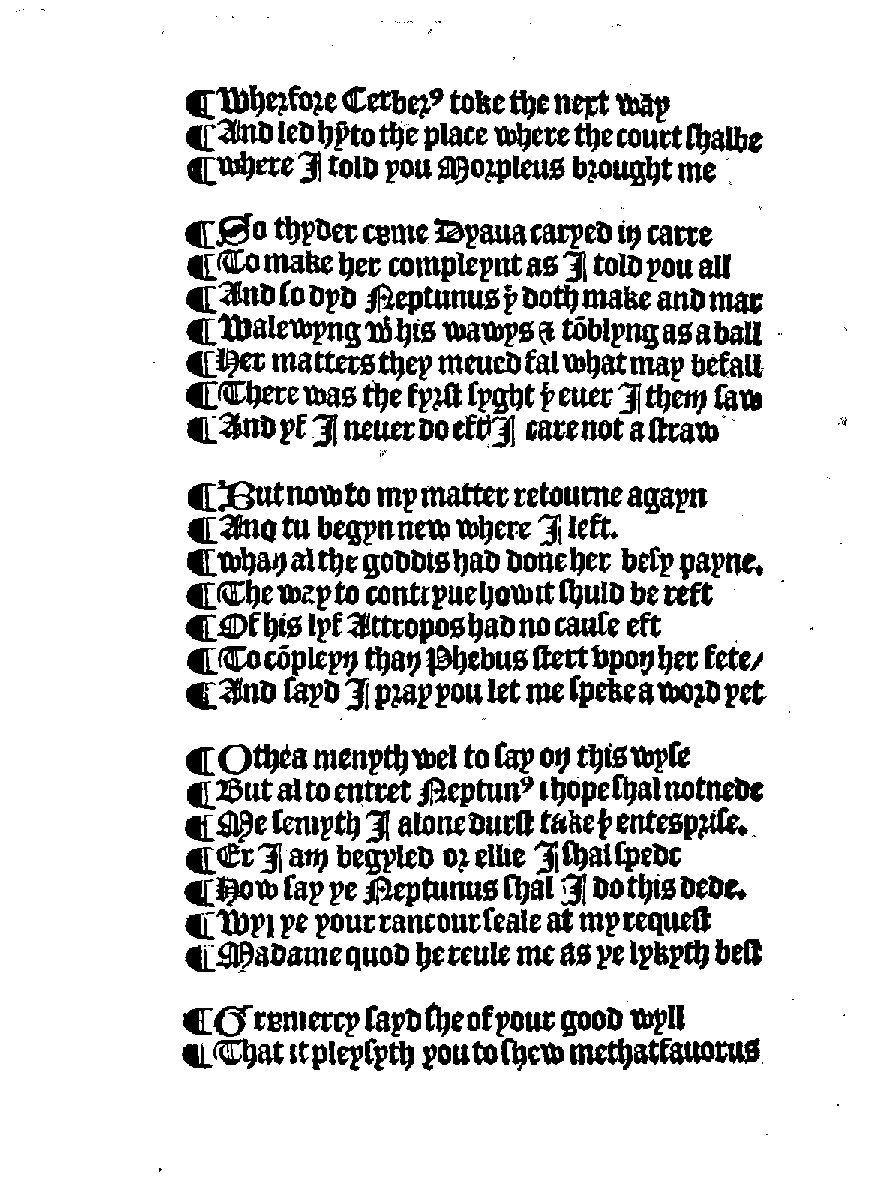 Wherfore Cerberus
toke the next way
Wherfore Cerberus
toke the next wayAnd led hym to the place where the court shalbe
where I told you Morpleus brought me
To make her compleynt as I told you all
And so dyd Neptunus that doth make and mar
Walewyng with his wawys & tomblyng as a ball
Her matters they meued fal what may befall
There was the fyrst syght that euer I them saw
And yf I neuer do eft I care not a straw
And tu begyn new where I left.
whan al the goddis had done her besy payne.
The way to contryue how it shuld be reft
Of his lyf Attropos had no cause eft
To compleyn than Phebus stert vpon her fete /
And sayd I pray you let me speke a word yet
But al to entret Neptunus i hope shal not nede
Me semyth I alone durst take that entesprise.
Er I am begyled or ellis I shal spede
How say ye Neptunus shal I do this dede.
Wy[l] ye your rancour seale at my request
Madame quod he reule me as ye lykyth best
That it pleysyth you to shew me that fauorus
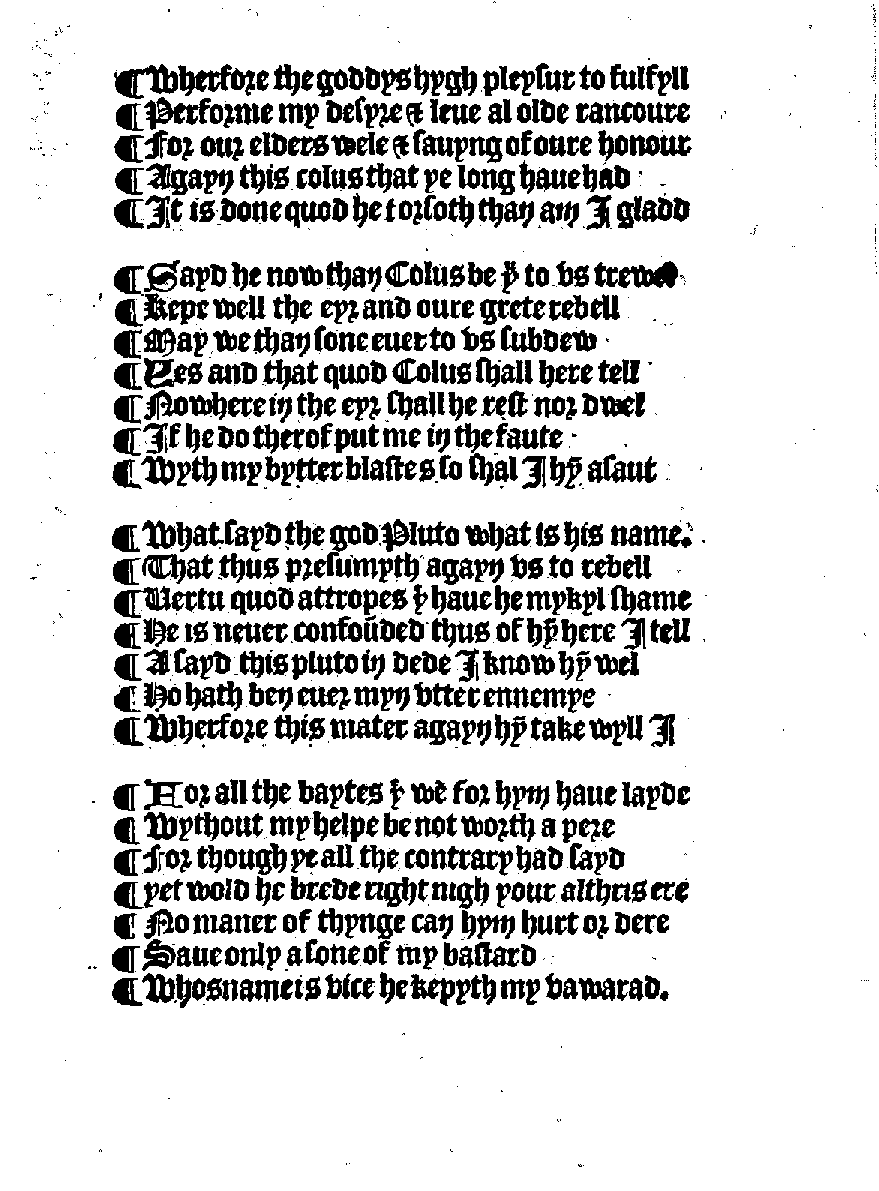 Wherfore the goddys hygh
pleysur to fulfyll
Wherfore the goddys hygh
pleysur to fulfyllPerforme my desyre & leue al olde rancoure
For our elders wele & sauyng of oure honour
Agayn this colus that ye long haue had
It is done quod he forsoth than am I gladd
Kepe well the eyr and oure grete rebell
May we than sone euer to vs subdew
Yes and that quod Colus shall here tell
Nowhere in the eyr shall he rest nor dwel
If he do therof put me in the faute
Wyth my bytter blastes so shal I hym asaut
That thus presumyth agayn vs to rebell
Vertu quod attropes that haue he mykyl shame
He is neuer confounded thus of hym here I tell
A sayd this pluto in dede I know hym wel
He hath ben euer myn vtter ennemye
Wherfore this mater agayn hym take wyll I
Wythout my helpe be not worth a pere
For though ye all the contrary had sayd
yet wold he brede right nigh your althris ere
No maner of thynge can hym hurt or dere
Saue only a sone of my bastard
Whos name is vice he kepyth my vawarad.
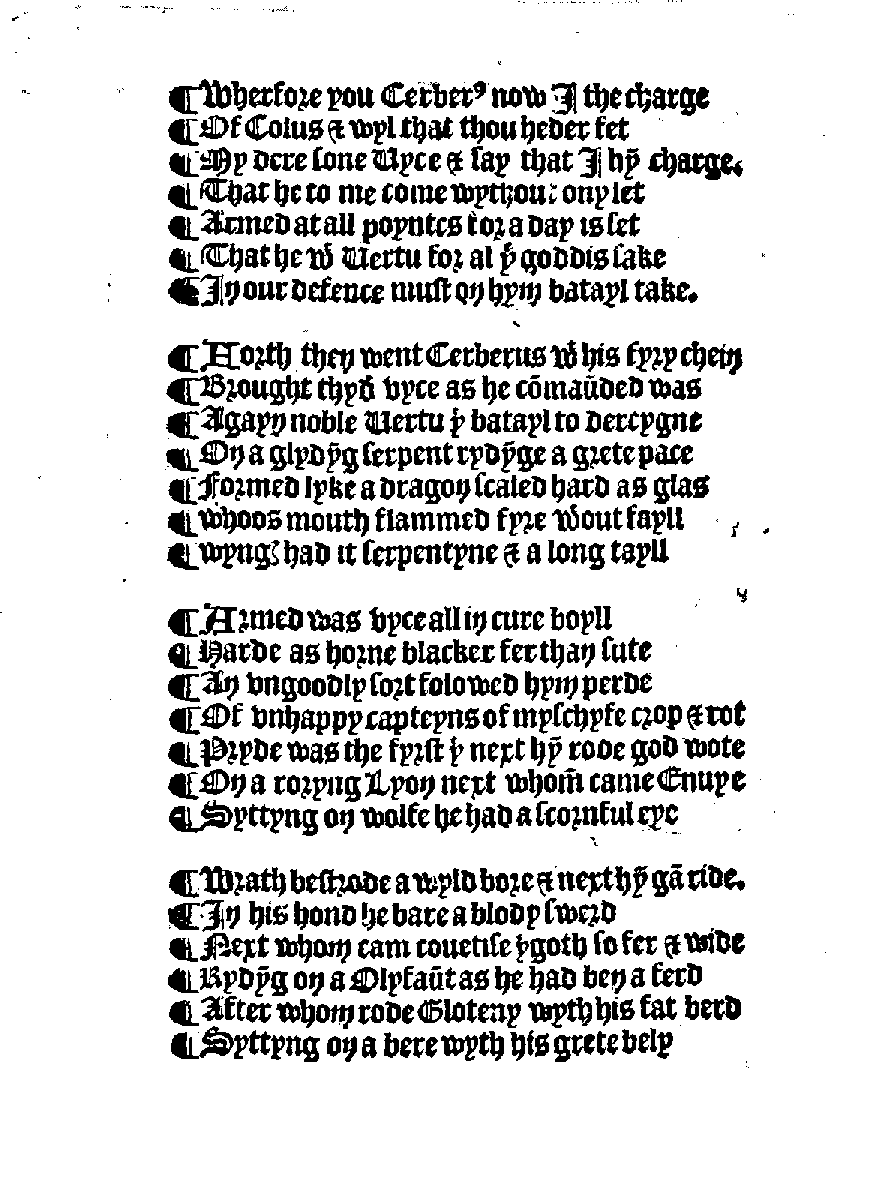 Wherfore you
Cerberus now I the charge
Wherfore you
Cerberus now I the chargeOf Colus & wyl that thou heder fet
My dere sone Vyce & say that I hym charge.
That he to me come without ony let
Armed at all poyntes for a day is set
That he with Vertu for al the goddis sake
In our defence must on hym batayl take.
Brought thyder vyce as he commaunded was
Agayn noble Vertu that batayl to dercygne
On a glydyng serpent rydynge a grete pace
Formed lyke a dragon scaled hard as glas
whoos mouth flammed fyre without fayll
wyngis had it serpentyne & a long tayll
Harde as horne blacker fer than sute
An vngoodly sort folowed hym perde
Of vnhappy capteyns of myschyfe crop & rot
Pryde was the fyrst that next hym rode god wote
On a roryng Lyon next whome came Enuye
Syttyng on wolfe he had a scornful eye
In his hond he bare a blody swerd
Next whom cam couetise that goth so fer & wide
Rydyng on a Olyfaunt as he had ben a ferd
After whom rode Gloteny wyth his fat berd
Syttyng on a bere wyth his grete bely
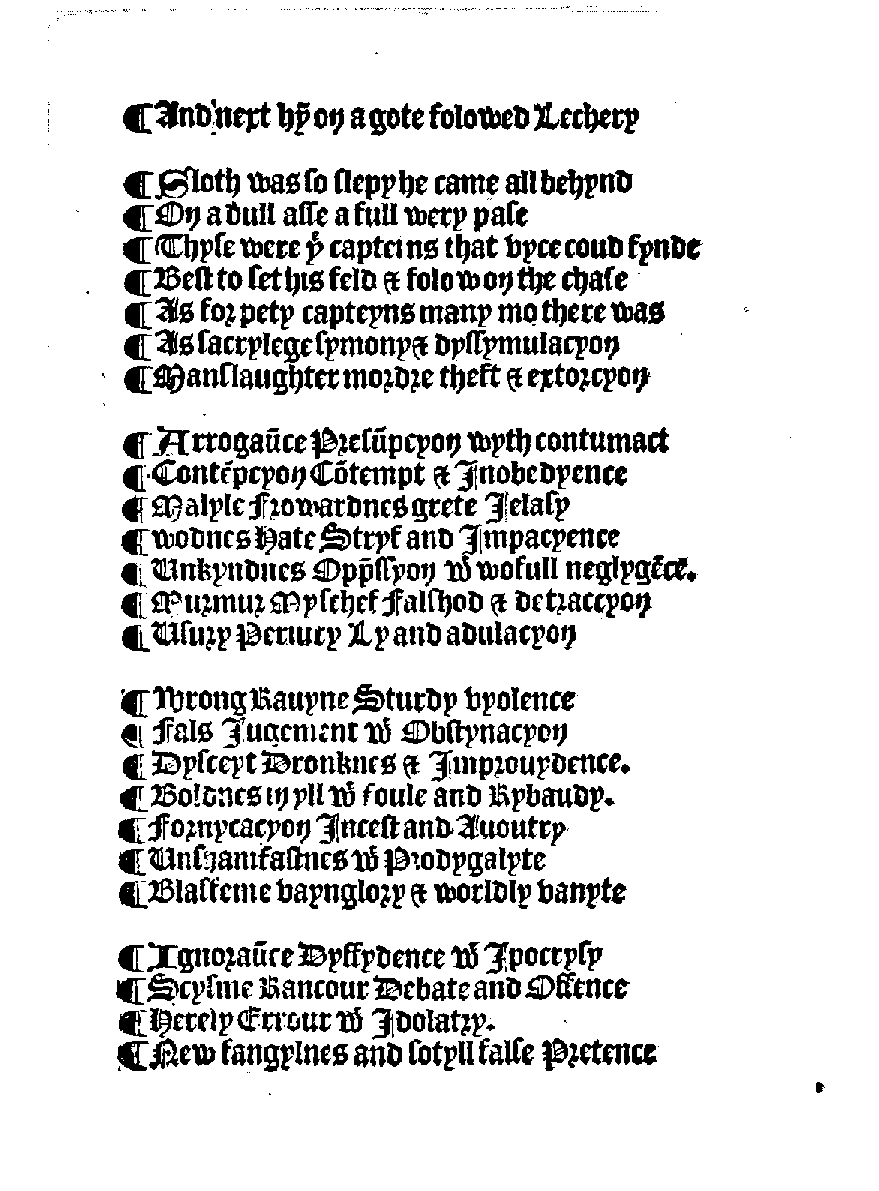 And next hym on a
gote folowed Lechery
And next hym on a
gote folowed LecheryOn a dull asse a full wery pase
Thyse were the capteins that vyce coud fynde
Best to set his feld & folow on the chase
As for pety capteyns many mo there was
As sacrylege symony & dyssymulacyon
Manslaughter mordre theft & extorcyon
Contempcyon Contempt & Inobedyence
Maly[s]e Frowardnes grete Ielasy
wodnes Hate Stryf and Impacyence
Vnkyndnes Oppressyon with wofull neglygence.
Murmur Myschef Falshod & detraccyon
Vsury Periury Ly and adulacyon
Fals Iugement with Obstynacyon
Dysceyt Dronknes & Improuydence.
Boldnes in yll with foule and Rybaudy.
Fornycacyon Incest and Auoutry
Vnshamfastnes with Prodygalyte
Blasfeme vaynglory & worldly vanyte
Scysme Rancour Debate and Offence
Heresy Errour with Idolatry.
New fangylnes and sotyll false Pretence
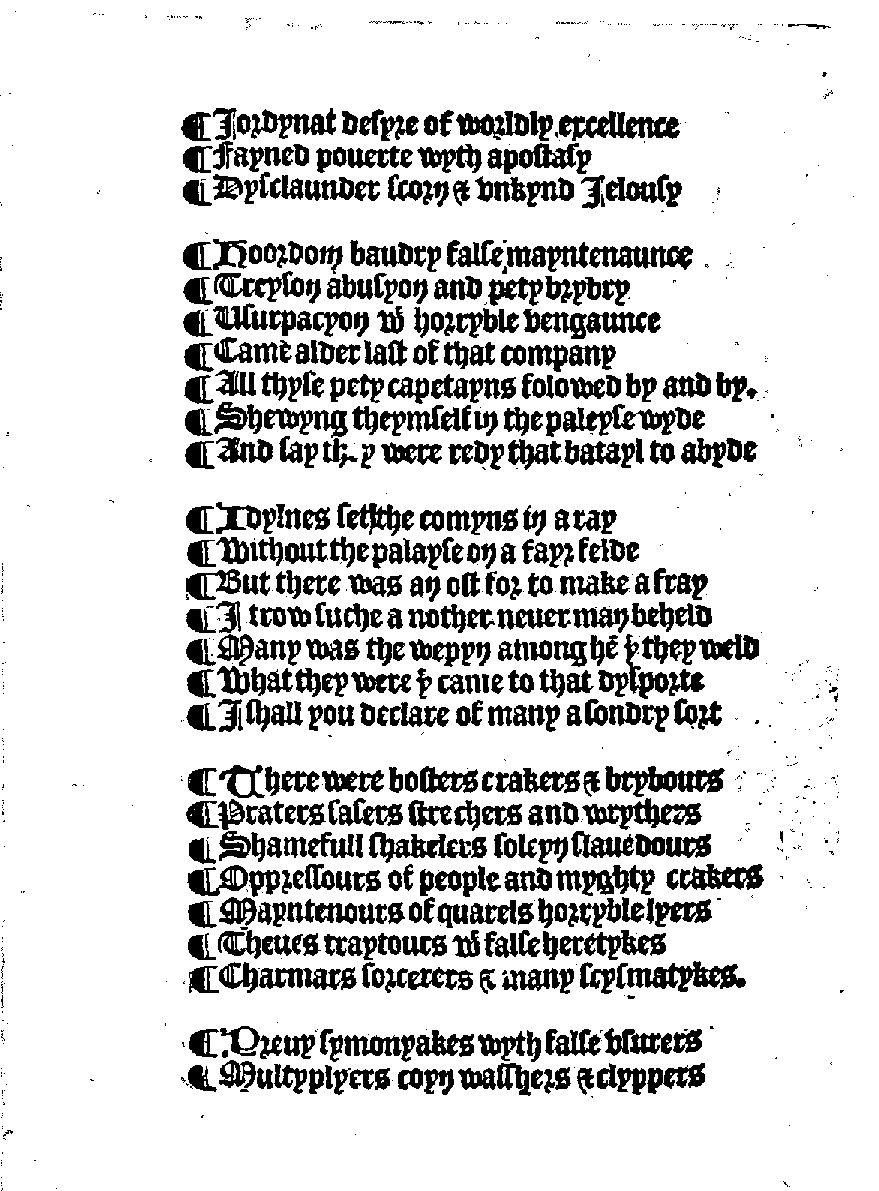 Inordynat desyre of worldly excellence
Fayned pouerte wyth apostasy
Dysclaunder scorn & vnkynd Ielousy
Treyson abusyon and pety brybry
Vsurpacyon with horryble vengaunce
Came alder last of that company
All thyse pety capetayns folowed by and by.
Shewyng theymself in the paleyse wyde
And say they were redy that batayl to abyde
Without the palayse on a fayr felde
But there was an ost for to make a fray
I trow suche a nother neuer man beheld
Many was the wepyn among hem that they weld
What they were that came to that dysporte
I shall you declare of many a sondry sort
Praters sasers strechers and wrythers
Shamefull shakelers soleyn slauedours
Oppressours of people and myghty crakers
Mayntenours of quarels horryble lyers
Theues traytours with false heretykes
Charmars sorcerers & many scysmatykes.
Multyplyers coyn wasshers & clyppers
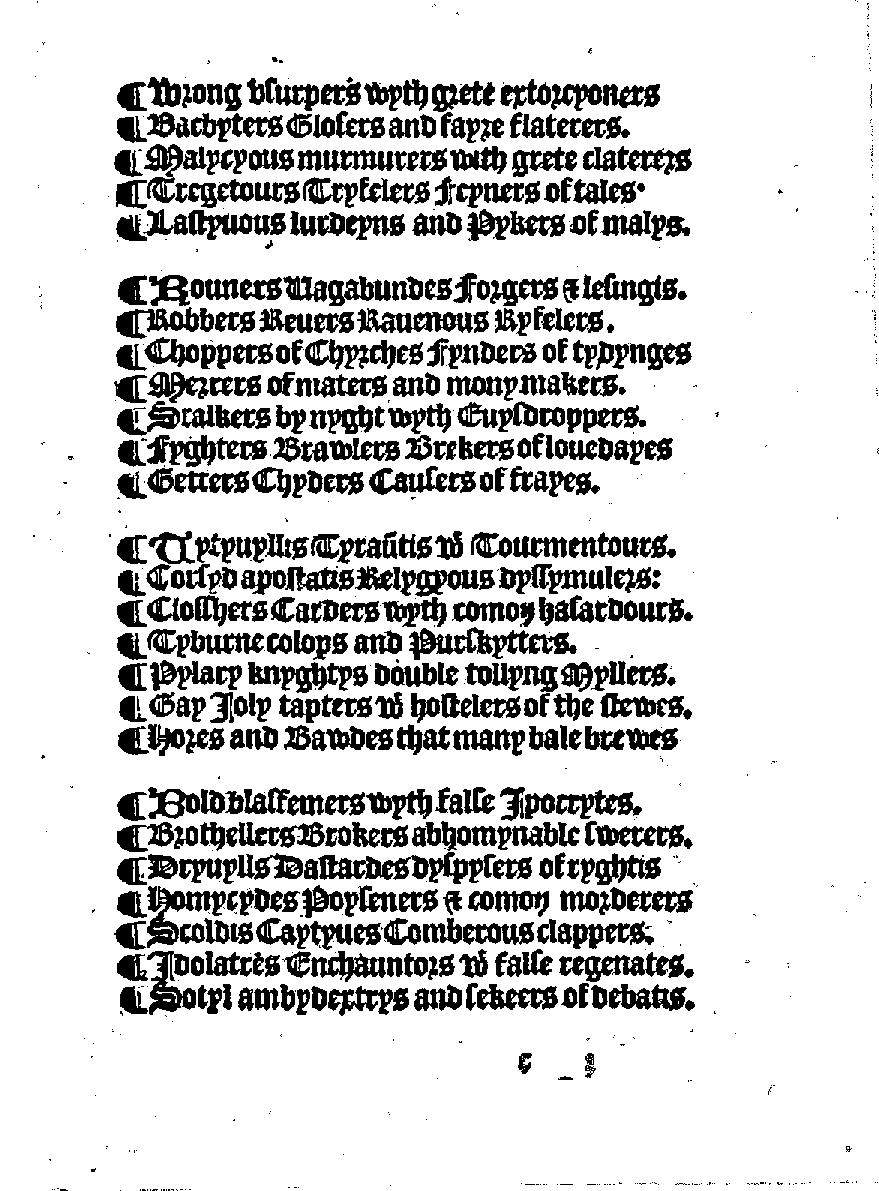 Wrong vsurpers wyth
grete extorcyoners
Wrong vsurpers wyth
grete extorcyonersBacbyters Glosers and fayre flaterers.
Malycyous murmurers with grete claterers
Tregetours Tryfelers Feyners of tales·
Lastyuous lurdeyns and Pykers of malys.
Robbers Reuers Rauenous Ryfelers.
Choppers of Chyrches Fynders of tydynges
Merrers of maters and mony makers.
Stalkers by nyght wyth Euysdroppers.
Fyghters Brawlers Brekers of louedayes
Getters Chyders Causers of frayes.
Corsyd apostatis Relygyous dyssymulers:
Closshers Carders wyth comon hasardours.
Tyburne colops and Purskytters.
Pylary knyghtys double tollyng Myllers.
Gay Ioly tapters with hostelers of the stewes.
Hores and Bawdes that many bale brewes
Brothellers Brokers abhomynable swerers.
Dryuylls Dastardes dyspysers of ryghtis
Homycydes Poyseners & comon morderers
Scoldis Caytyues Comberous clappers.
Idolatres Enchauntors with false regenates.
Sotyl ambydextrys and sekeers of debatis.
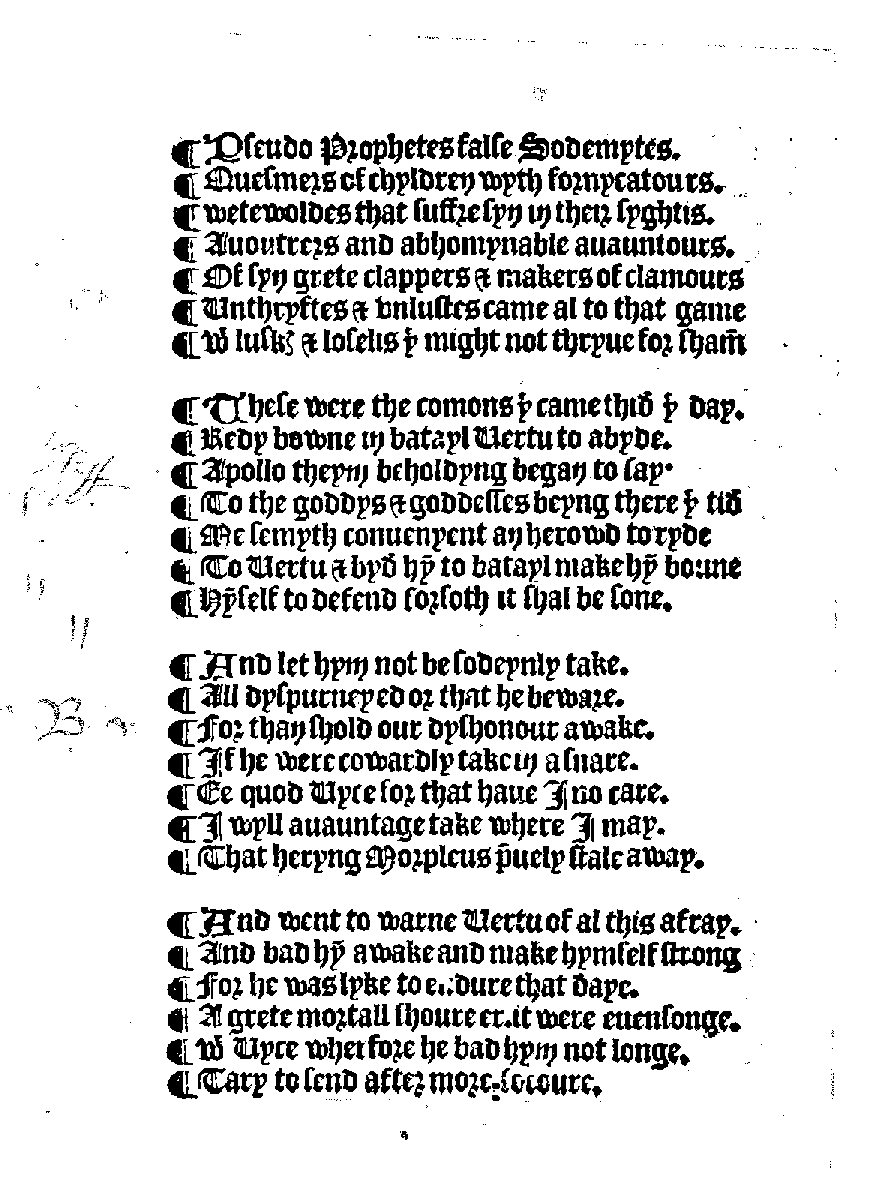 Pseudo Prophetes false
Sodemytes.
Pseudo Prophetes false
Sodemytes.Quesmers of chyldren wyth fornycatours.
wetewoldes that suffre syn in their syghtis.
Auoutrers and abhomynable auauntours.
Of syn grete clappers & makers of clamours
Vnthryftes & vnlustes came al to that game
with luskis & loselis that might not thryue for shame
Redy bowne in batayl Vertu to abyde.
Apollo theym beholdyng began to say·
To the goddys & goddesses beyng there that tide
Me semyth conuenyent an herowd to ryde
To Vertu & byde hym to batayl make hym boune
Hymself to defend forsoth it shal be sone.
All dyspur[u]eyed or that he beware.
For than shold our dyshonour awake.
If he were cowardly take in a snare.
Ee quod Vyce for that haue I no care.
I wyll auauntage take where I may.
That heryng Morpleus preuely stale away.
And bad hym awake and make hymself strong
For he was lyke to endure that daye.
A grete mortall shoure er it were euensonge.
with Vyce wherfore he bad hym not longe.
Tary to send after more socoure.
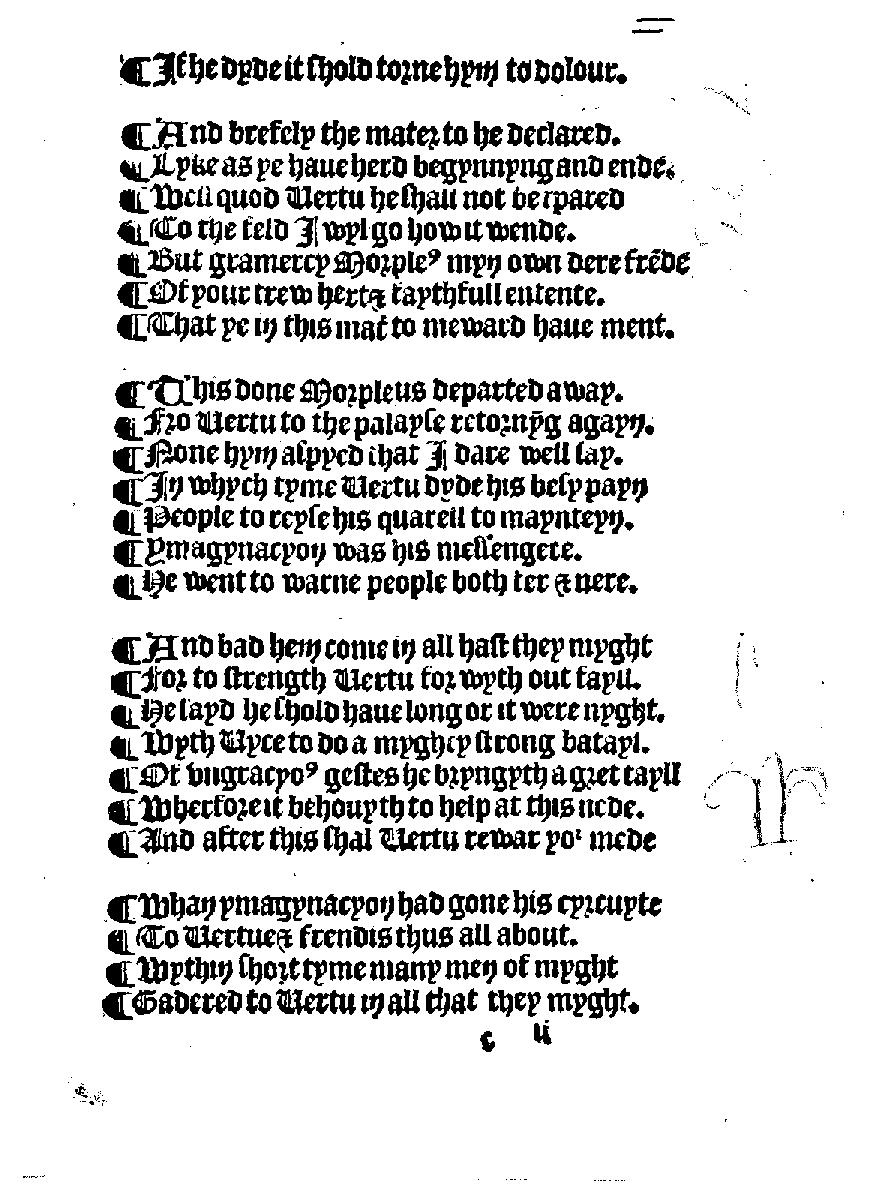 If he dyde it shold
torne hym to dolour.
If he dyde it shold
torne hym to dolour.Lyke as ye haue herd begynnyng and ende.
Well quod Vertu he shall not be spared
To the feld I wyl go how it wende.
But gramercy Morpleus myn own dere frende
Of your trew hert & faythfull entente.
That ye in this mater to meward haue ment.
Fro Vertu to the palayse retornyng agayn.
None hym aspyed that I dare well say.
In whych tyme Vertu dyde his besy payn
People to reyse his quarell to maynteyn.
Ymagynacyon was his messengere.
He went to warne people both fer & nere.
For to strength Vertu for wyth out fayll.
He sayd he shold haue long or it were nyght.
Wyth Vyce to do a myghty strong batayl.
Of vngracyous gestes he bryngyth a gret tayll
Wherfore it behouyth to help at this nede.
And after this shal Vertu rewar yore mede
To Vertue & frendis thus all about.
Wythin short tyme many men of myght
Gadered to Vertu in all that they myght.
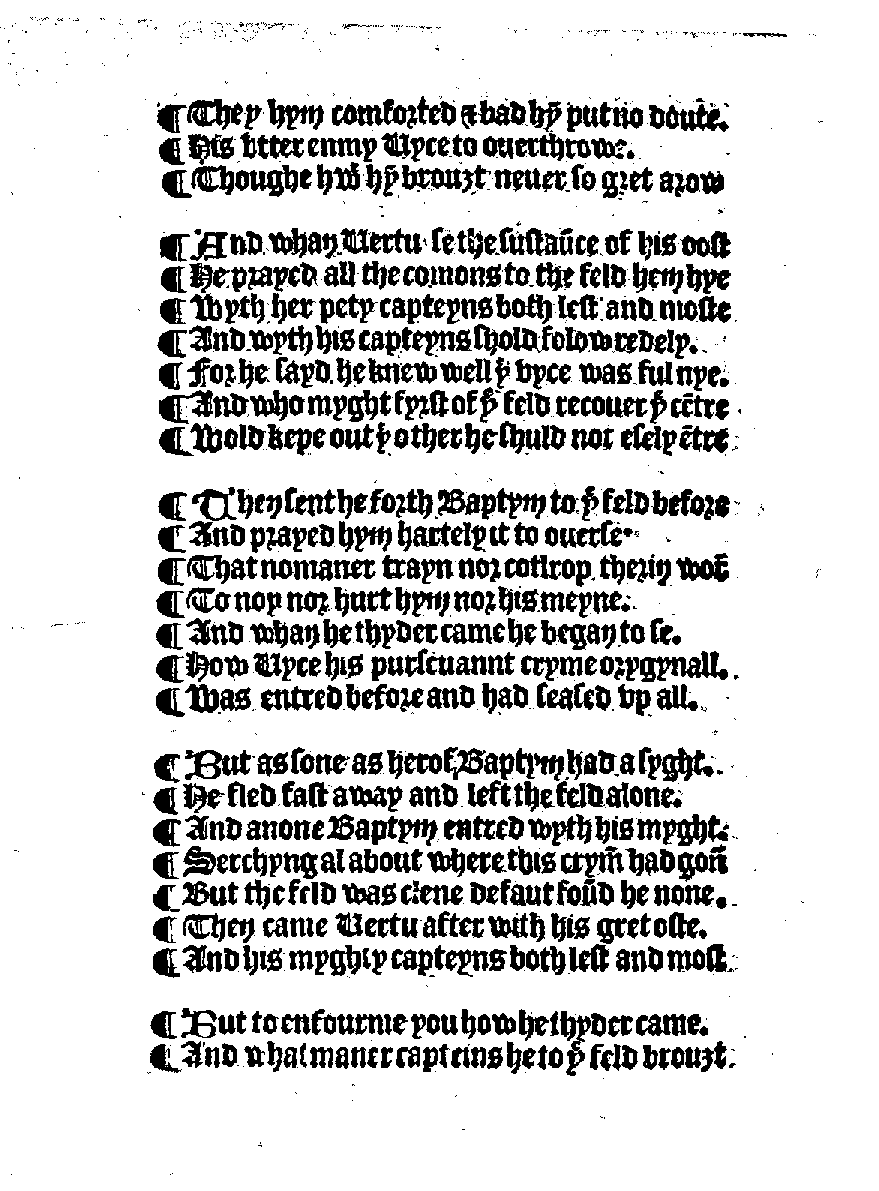 They hym comforted & bad hym put no
doute.
They hym comforted & bad hym put no
doute.His vtter enmy Vyce to ouerthrowe.
Thoughe he with hym brought neuer so gret arow
He prayed all the comons to the feld hem hye
Wyth her pety capteyns both lest and moste
And wyth his capteyns shold folow redely.
For he sayd he knew well that vyce was ful nye.
And who myght fyrst of the feld recouer the centre
Wold kepe out that other he shuld not esely entre
And prayed hym hartely it to ouerse·
That no maner trayn nor coltrop therin wore
To noy nor hurt hym nor his meyne.
And whan he thyder came he began to se.
How Vyce his purseua[u]nt cryme orygynall.
Was entred before and had seased vp all.
He fled fast away and left the feld alone.
And anone Baptym entred wyth his myght.
Serchyng al about where this cryme had gone
But the feld was clene defaut found he none.
Then came Vertu after with his gret oste.
And his myghty capteyns both lest and most
And what maner capteins he to the feld brought
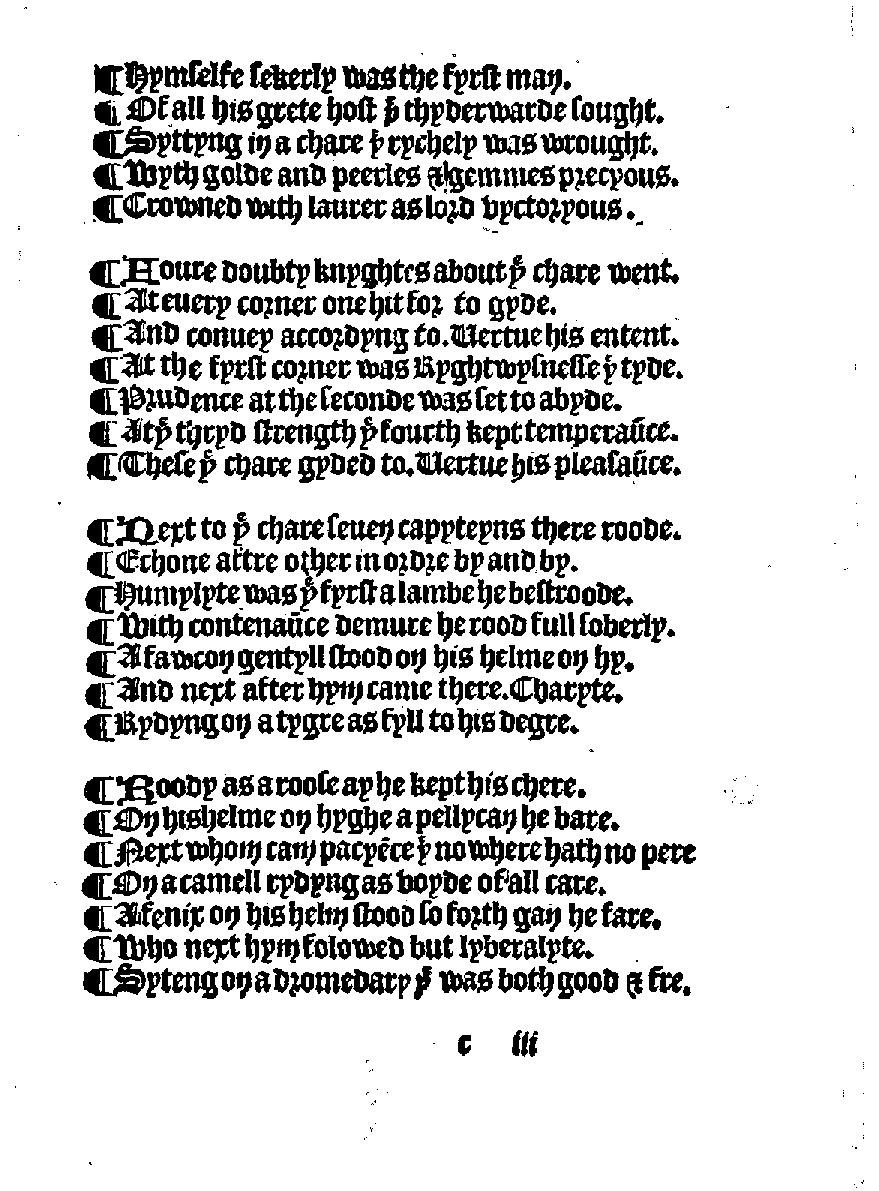 Hymselfe sekerly was the fyrst man.
Of all his grete host that thyderwarde sought.
Syttyng in a chare that rychely was wrought.
Wyth golde and peerles & gemmes precyous.
Crowned with laurer as lord vyctoryous.
At euery corner one hit for to gyde.
And conuey accordyng to Vertue his entent.
At the fyrst corner was Ryghtwysnesse that tyde.
Prudence at the seconde was set to abyde.
At the thryd strength the fourth kept temperaunce.
These the chare gyded to Vertue his pleasaunce.
Echone aftre other in ordre by and by.
Humylyte was the fyrst a lambe he bestroode.
With contenaunce demure he rood full soberly.
A fawcon gentyll stood on his helme on hy.
And next after hym came there Charyte.
Rydyng on a tygre as fyll to his degre.
On his helme on hyghe a pellycan he bare.
Next whom cam pacyence that no where hath no pere
On a camell rydyng as voyde of all care.
A fenix on his helm stood so forth gan he fare.
Who next hym folowed but lyberalyte.
Syteng on a dromedary that was both good & fre.
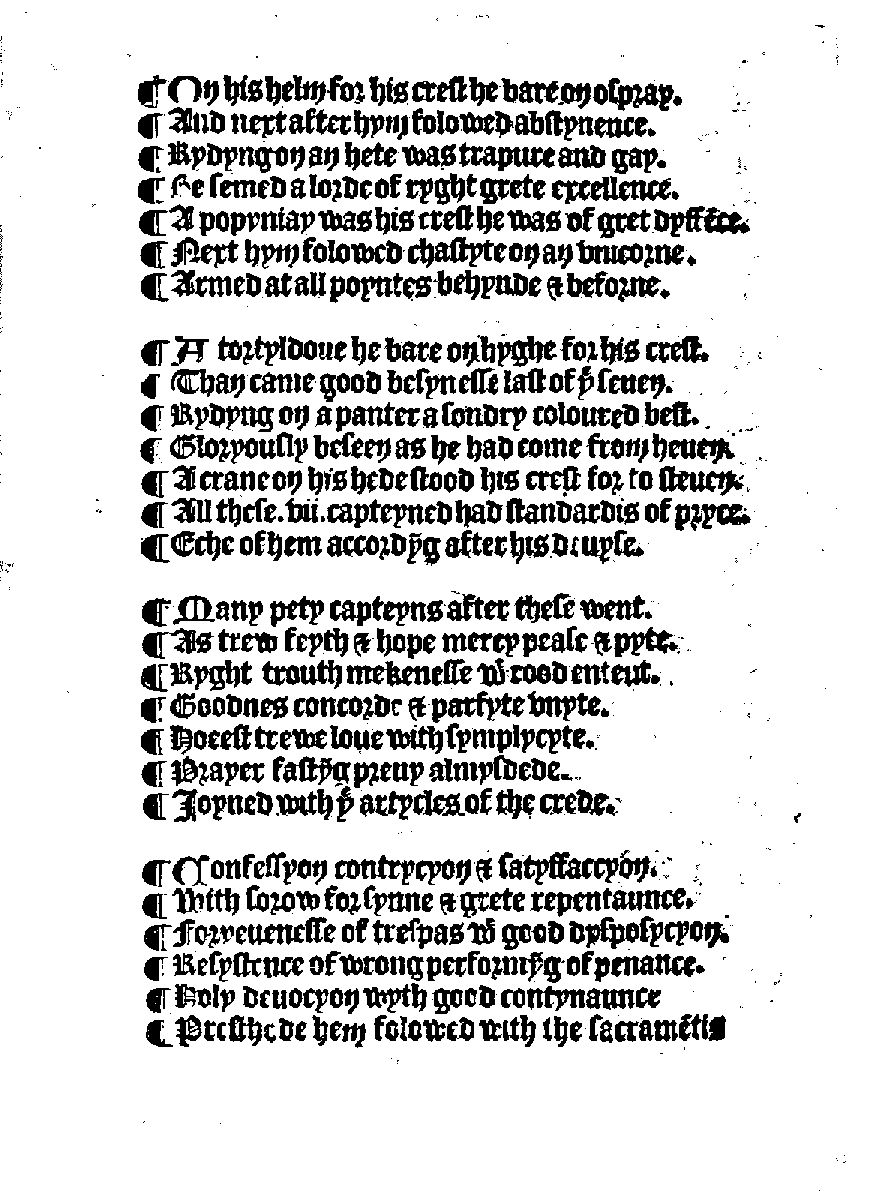 On his helm for his
crest he bare on ospray.
On his helm for his
crest he bare on ospray.And next after hym folowed abstynence.
Rydyng on an hete was trapure and gay.
He semed a lorde of ryght grete excellence.
A popyniay was his crest he was of gret dyfferece.
Next hym folowed chastyte on an vnicorne.
Armed at all poyntes behynde & beforne.
Than came good besynesse last of the seuen.
Rydyng on a panter a sondry coloured best.
Gloryously beseen as he had come from heuen.
A crane on his hede stood his crest for to steuen.
All these .vii. capteyned had standardis of pryce.
Eche of hem accordyng after his deuyse.
As trew feyth & hope mercy pease & pyte.
Ryght trouth mekenesse with rood ente[n]t.
Goodnes concorde & parfyte vnyte.
Honest trewe loue with symplycyte.
Prayer fastyng preuy almysdede.
Ioyned with the artycles of the crede.
With sorow for synne & grete repentaunce.
Foryeuenesse of trespas with good dysposycyon.
Resystence of wrong performyng of penance.
Holy deuocyon wyth good contynaunce
Presthode hem folowed with the sacramentis
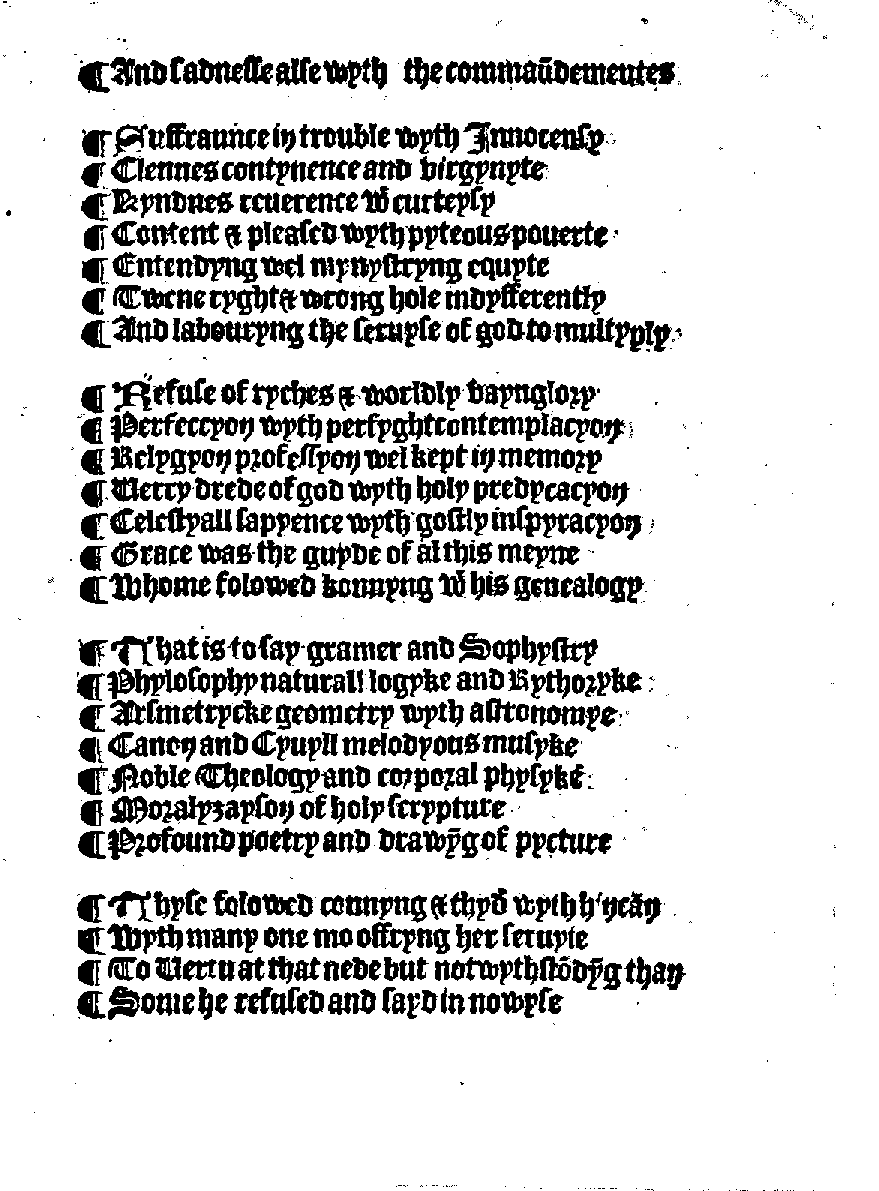 And sadnesse alse wyth
the commaundementes
And sadnesse alse wyth
the commaundementesClennes contynence and virgynyte
Kyndnes reuerence with curteysy
Content & pleased wyth pyteous pouerte
Entendyng wel mynystryng equyte
Twene ryght & wrong hole indyfferently
And labouryng the seruyse of god to multyply
Perfeccyon wyth perfyght contemplacyon
Relygyon professyon wel kept in memory
Verry drede of god wyth holy predycacyon
Celestyall sapyence wyth gostly inspyracyon
Grace was the guyde of al this meyne
Whome folowed konnyng with his genealogy
Phylosophy naturall logyke and Rythoryke
Arsmetrycke geometry wyth astronomye
Canon and Cyuyll melodyous musyke
Noble Theology and corporal physyke
Moralyzayson of holy scrypture
Profound poetry and drawyng of pycture
Wyth many one mo offryng her seruyse
To Vertu at that nede but notwythstondyng than
Some he refused and sayd in nowyse
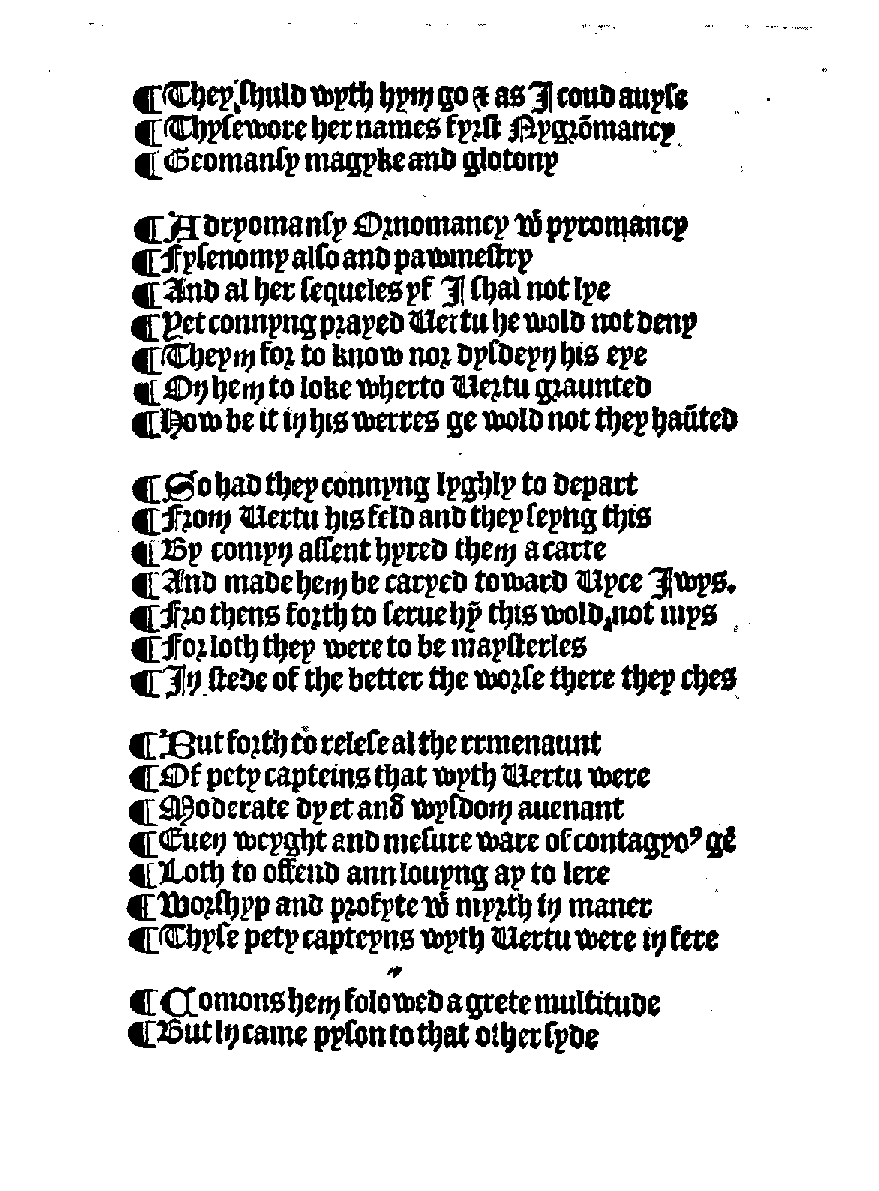 They shuld wyth hym go
& as I coud auyse
They shuld wyth hym go
& as I coud auyseThyse wore her names fyrst Nygrommancy
Geomansy magyke and glotony
Fysenomy also and pawmestry
And al her sequeles yf I shal not lye
Yet connyng prayed Vertu he wold not deny
Theym for to know nor dysdeyn his eye
On hem to loke wherto Vertu graunted
How be it in his werres ge wold not they haunted
From Vertu his feld and they seyng this
By comyn assent hyred them a carte
And made hem be caryed toward Vyce Iwys.
Fro thens forth to serue hym this wold not mys
For loth they were to be maysterles
In stede of the better the worse there they ches
Of pety capteins that wyth Vertu were
Moderate dyet and wysdom auenant
Euen weyght and mesure ware of contagyous gere
Loth to offend and louyng ay to lere
Worshyp and profyte with myrth in maner
Thyse pety capteyns wyth Vertu were in fere
But in came pyson to that other syde
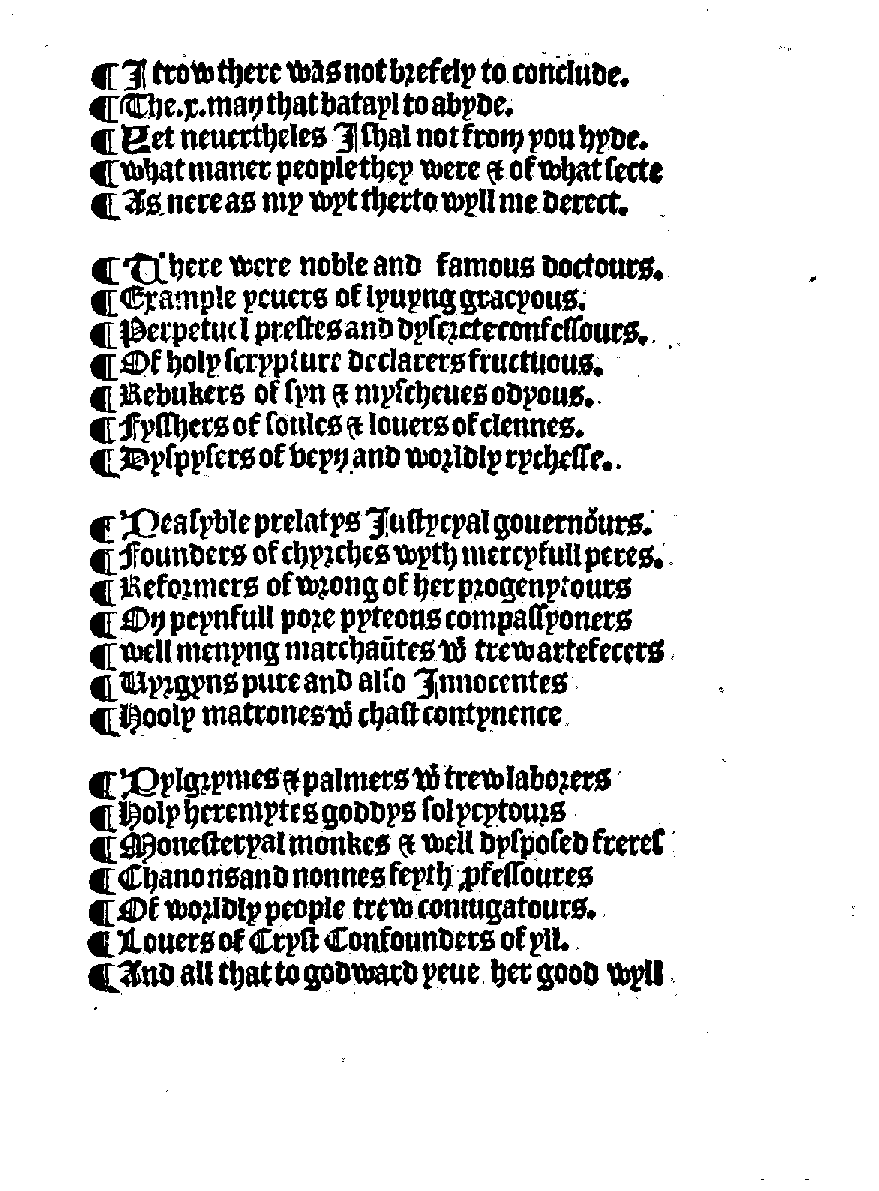 I trow there was not
brefely to conclude.
I trow there was not
brefely to conclude.The .x. man that batayl to abyde.
Yet neuertheles I shal not from you hyde.
what maner people they were & of what secte
As nere as my wyt therto wyll me derect.
Example yeuers of lyuyng gracyous.
Perpetuel prestes and dyscrete confessours.
Of holy scrypture declarers fructuous.
Rebukers of syn & myscheues odyous.
Fysshers of soules & louers of clennes.
Dyspysers of veyn and worldly rychesse.
Founders of chyrches wyth mercyfull peres.
Reformers of wrong of her progenytours
On peynfull pore pyteous compassyoners
well menyng marchauntes with trew artefecers
Vyrgyns pure and also Innocentes
Hooly matrones with chast contynence
Holy heremytes goddys solycytours
Monesteryal monkes & well dysposed freres
Chanons and nonnes feyth professoures
Of worldly people trew coniugatours.
Louers of Cryst Confounders of yll.
And all that to godward yeue her good wyll
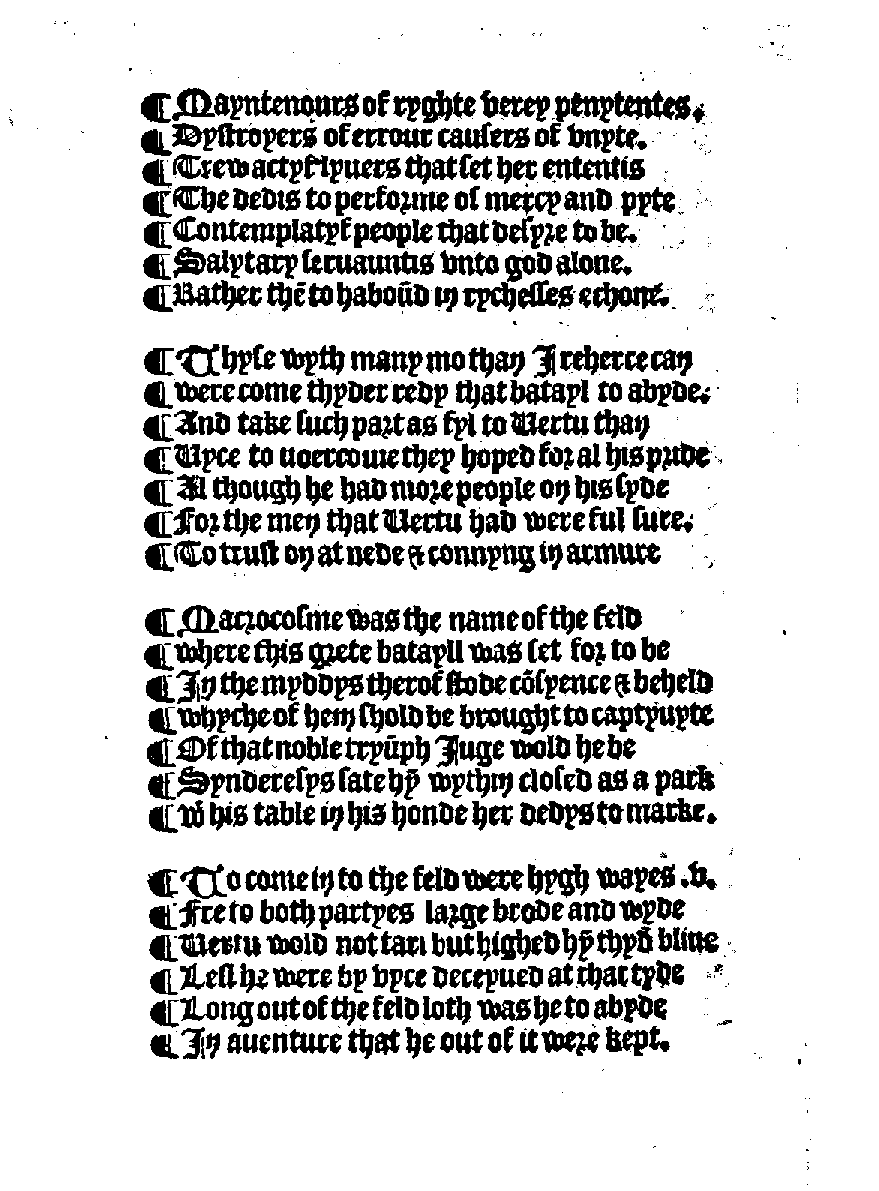 Mayntenours of ryghte
verey penytentes.
Mayntenours of ryghte
verey penytentes.Dystroyers of errour causers of vnyte.
Trew actyf lyuers that set her ententis
The dedis to performe of mercy and pyte
Contemplatyf people that desyre to be.
Salytary seruauntis vnto god alone.
Rather then to habound in rychesses echone.
were come thyder redy that batayl to abyde.
And take such part as fyl to Vertu than
Vyce to ouerco[m]e they hoped for al his pride
Al though he had more people on his syde
For the men that Vertu had were ful sure.
To trust on at nede & connyng in armure
where this grete batayll was set for to be
In the myddys therof stode consyence & beheld
whyche of hem shold be brought to captyuyte
Of that noble tryumph Iuge wold he be
Synderesys sate hym wythin closed as a park
with his table in his honde her dedys to marke.
Fre to both partyes large brode and wyde
Vertu wold not tari but highed hym thyder bliue
Lest he were by vyce deceyued at that tyde
Long out of the feld loth was he to abyde
In auenture that he out of it were kept.
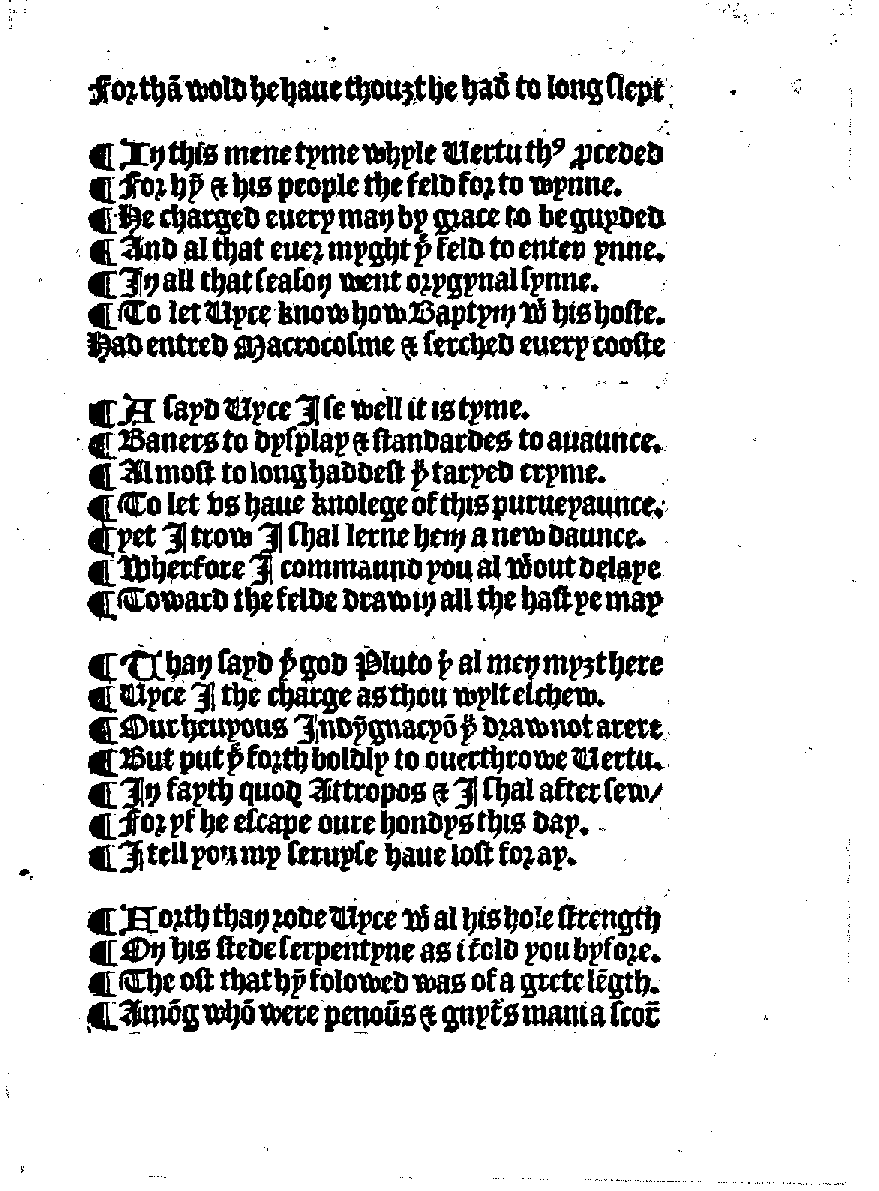 For than wold he
haue thought he hade to long
slept
For than wold he
haue thought he hade to long
sleptFor hym & his people the feld for to wynne.
He charged euery man by grace to be guyded
And al that euer myght the feld to enter ynne.
In all that season went orygynal synne.
To let Vyce know how Baptym with his hoste.
Had entred Macrocosme & serched euery cooste
Baners to dysplay & standardes to auaunce.
Al most to long haddest thou taryed cryme.
To let vs haue knolege of this purueyaunce.
yet I trow I shal lerne hem a new daunce.
Wherfore I commaund you al without delaye
Toward the felde draw in all the hast ye may
Vyce I the charge as thou wylt eschew.
Our heuyous Indyngnacyon thou draw not arere
But put the forth boldly to ouerthrowe Vertu.
In fayth quod Attropos & I shal after sew /
For yf he escape oure hondys this day.
I tell you my seruyse haue lost for ay.
On his stede serpentyne as i told you byfore.
The ost that hym folowed was of a grete length.
Among whom were penouns & g[u]yters mani a score[1]
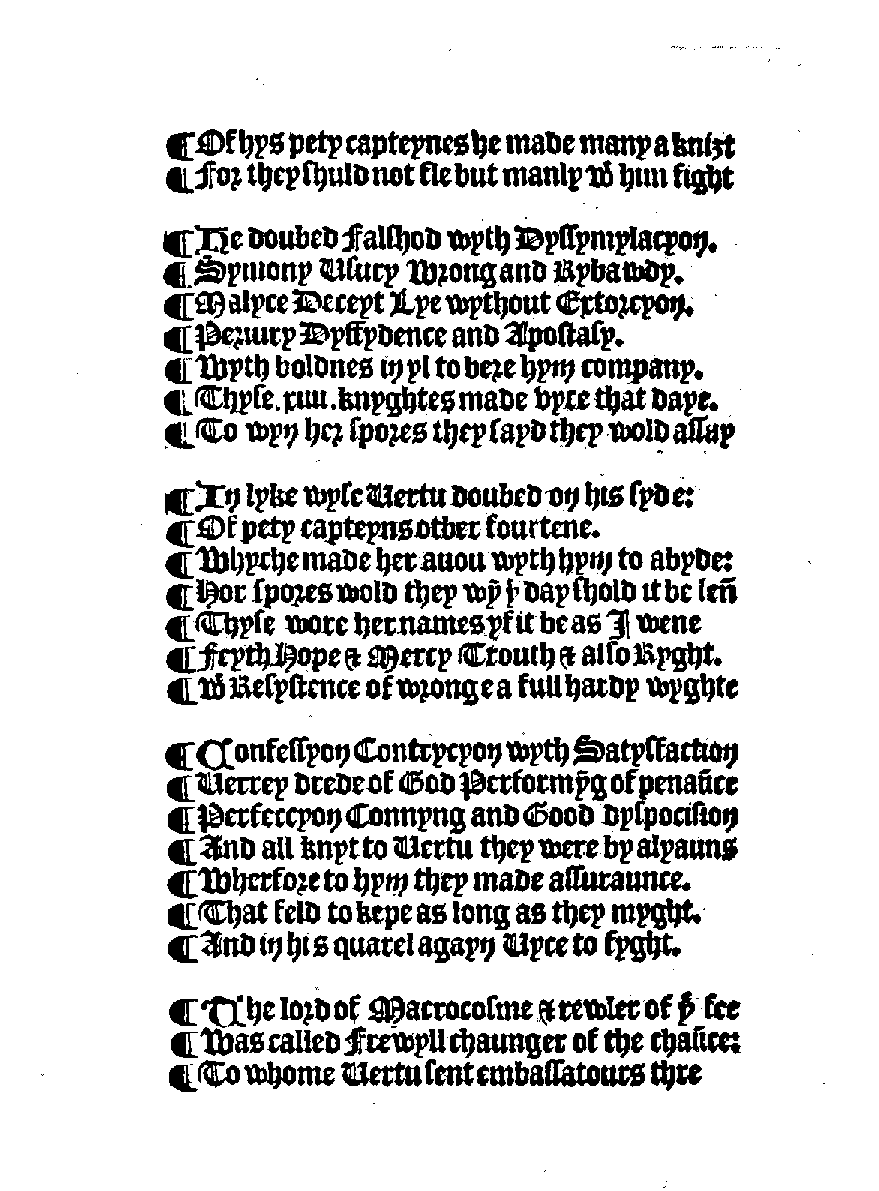 Of hys pety capteynes he made many a
knight
Of hys pety capteynes he made many a
knightFor they shuld not fle but manly with him fight
Symony Vsury Wrong and Rybawdy.
Malyce Deceyt Lye wythout Extorcyon.
Periury Dyffydence and Apostasy.
Wyth boldnes in yl to bere hym company.
Thyse .xiiii. knyghtes made vyce that daye.
To wyn her spores they sayd they wold assay
Of pety capteyns other fourtene.
Whyche made her auou wyth hym to abyde:
Her spores wold they wyn that day shold it be sene
Thyse wore her names yf it be as I wene
Feyth Hope & Mercy Trouth & also Ryght.
with Resystence of wronge a full hardy wyghte
Verrey drede of God Performyng of penaunce
Perfeccyon Connyng and Good dyspocision
And all knyt to Vertu they were by alyauns
Wherfore to hym they made assuraunce.
That feld to kepe as long as they myght.
And in his quarel agayn Vyce to fyght.
Was called Frewyll chaunger of the chaunce:
To whome Vertu sent embassatours thre
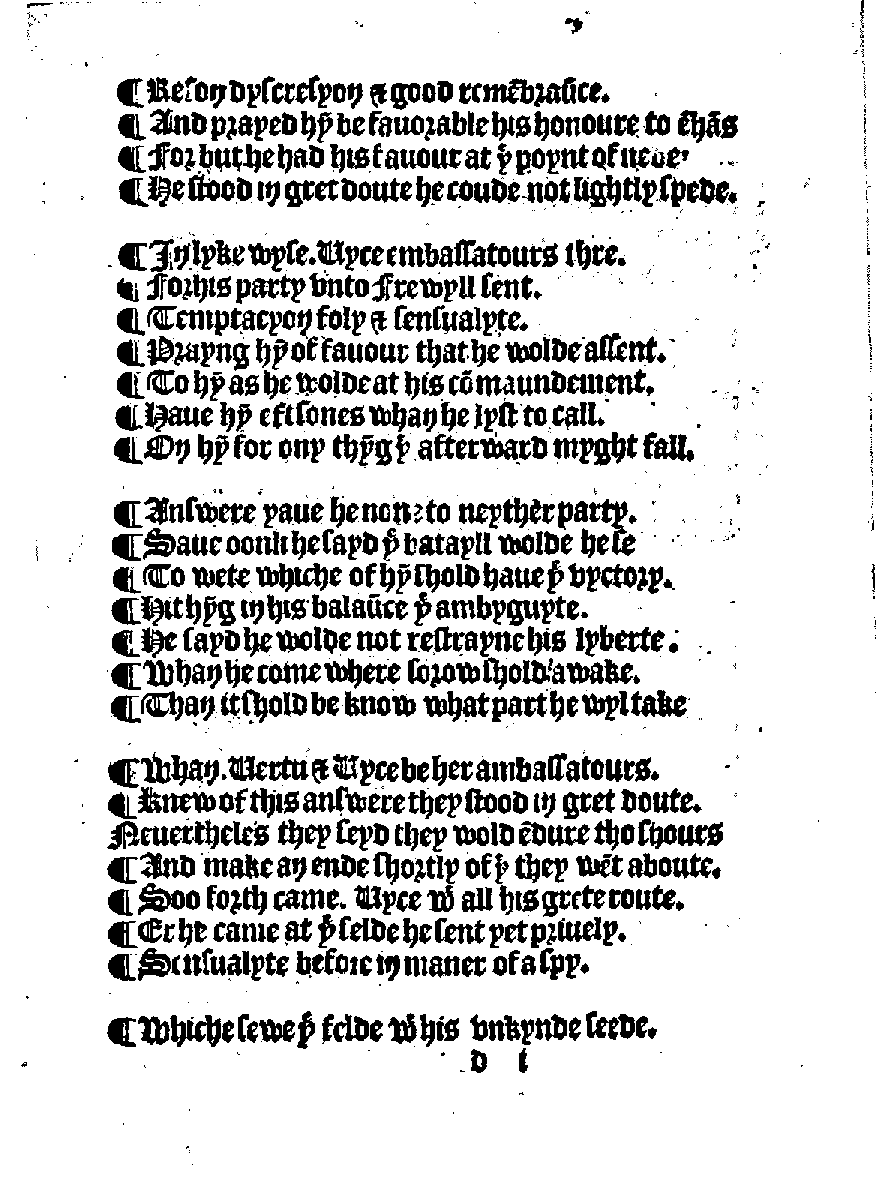 Reson dyscresyon & good
remembraunce.
Reson dyscresyon & good
remembraunce.And prayed hym be fauorable his honoure to enhans
For but he had his fauour at the poynt of nede·
He stood in gret doute he coude not lightly spede.
For his party vnto Frewyll sent.
Temptacyon foly & sensualyte.
Prayng hym of fauour that he wolde assent.
To hym as he wolde at his commaundement.
Haue hym eftsones whan he lyst to call.
On hym for ony thyng that afterward myght fall.
Saue oonli he sayd the batayll wolde he se
To wete whiche of hym shold haue the vyctory.
Hit hyng in his balaunce the ambyguyte.
He sayd he wolde not restrayne his lyberte.
Whan he come where sorow shold awake.
Than it shold be know what part he wyl take
Knew of this answere they stood in gret doute.
Neuertheles they seyd they wold endure tho shours
And make an ende shortly of that they went aboute.
Soo forth came Vyce with all his grete route.
Er he came at the felde he sent yet priuely.
Sensualyte before in maner of a spy.
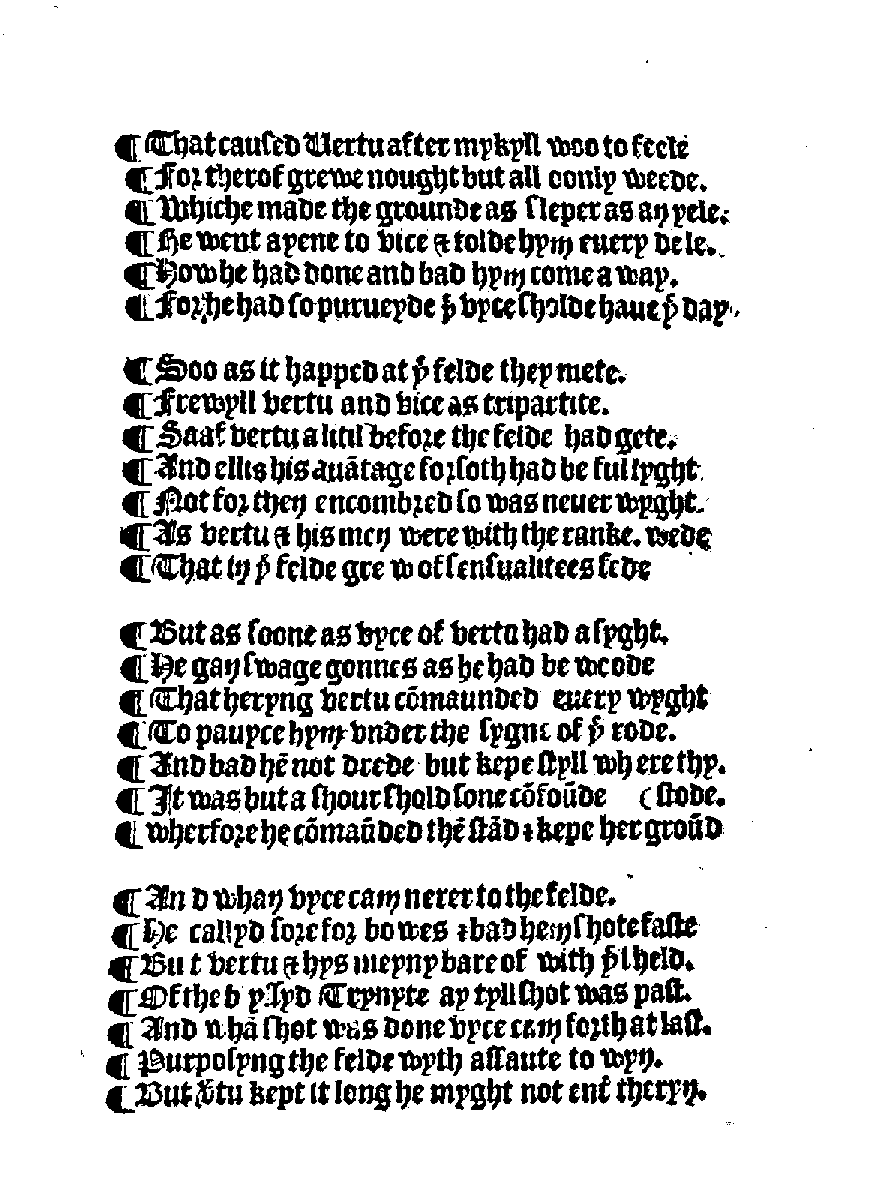 That
caused Vertu after mykyll woo to feele
That
caused Vertu after mykyll woo to feeleFor therof grewe nought but all oonly weede.
Whiche made the grounde as sleper as an yele.
He went ayene to vice & tolde hym euery dele.
How he had done and bad hym come a way.
For he had so purueyde that vyce sholde haue the day
Frewyll vertu and vice as tripartite.
Saaf vertu a litil before the felde had gete.
And ellis his auantage forsoth had be ful lyght
Not for then encombred so was neuer wyght.
As vertu & his men were with the ranke wede
That in the felde grew of sensualitees sede
He gan swage gonnes as he had be woode
That heryng vertu commaunded euery wyght
To pauyce hym vnder the sygne of the rode.
And bad hem not drede but kepe styll where thy stode.
It was but a shour shold sone confounde
wherfore he commaunded them stand & kepe her ground
He callyd sore for bowes & bad hem shote faste
But vertu & hys meyny bare of with the sheld.
Of the blyssyd Trynyte ay tyll shot was past.
And whan shot was done vyce cam forth at last.
Purposyng the felde wyth assaute to wyn.
But vertu kept it long he myght not enter theryn.
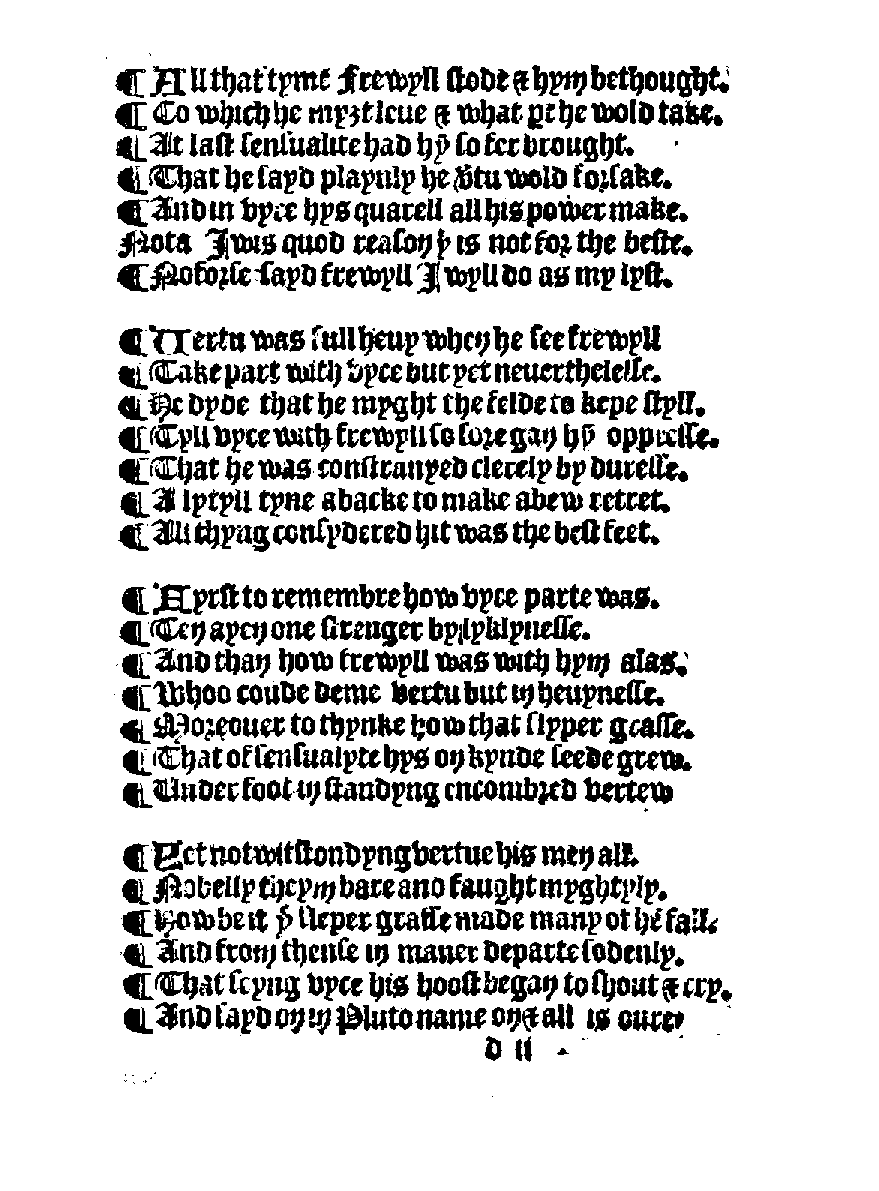 All that tyme Frewyll
stode & hym bethought.
All that tyme Frewyll
stode & hym bethought.To which he myght leue & what part he wold take.
At last sensualite had hym so fer brought.
That he sayd playnly he vertu wold forsake.
And in vyce hys quarell all his power make.
Nota Iwis quod reason that is not for the beste.
Noforse sayd frewyll I wyll do as my lyst.
Take part with vyce but yet neuerthelesse.
He dyde that he myght the felde to kepe styll.
Tyll vyce with frewyll so sore gan hym oppresse.
That he was constrayned clerely by duresse.
A lytyll tyne abacke to make abew retret.
All thyng consydered hit was the best feet.
Ten ayen one strenger by lyklynesse.
And than how frewyll was with hym alas.
Whoo coude deme vertu but in heuynesse.
Moreouer to thynke how that slyper grasse.
That of sensualyte hys onkynde seede grew.
Vnder foot in standyng encombred vertew
Nobelly theym bare and faught myghtyly.
How be it the sleper grasse made many of hem fall.
And from thense in maner departe sodenly.
That seyng vyce his hoost began to shout & cry.
And sayd on in Pluto name on & all is oure·
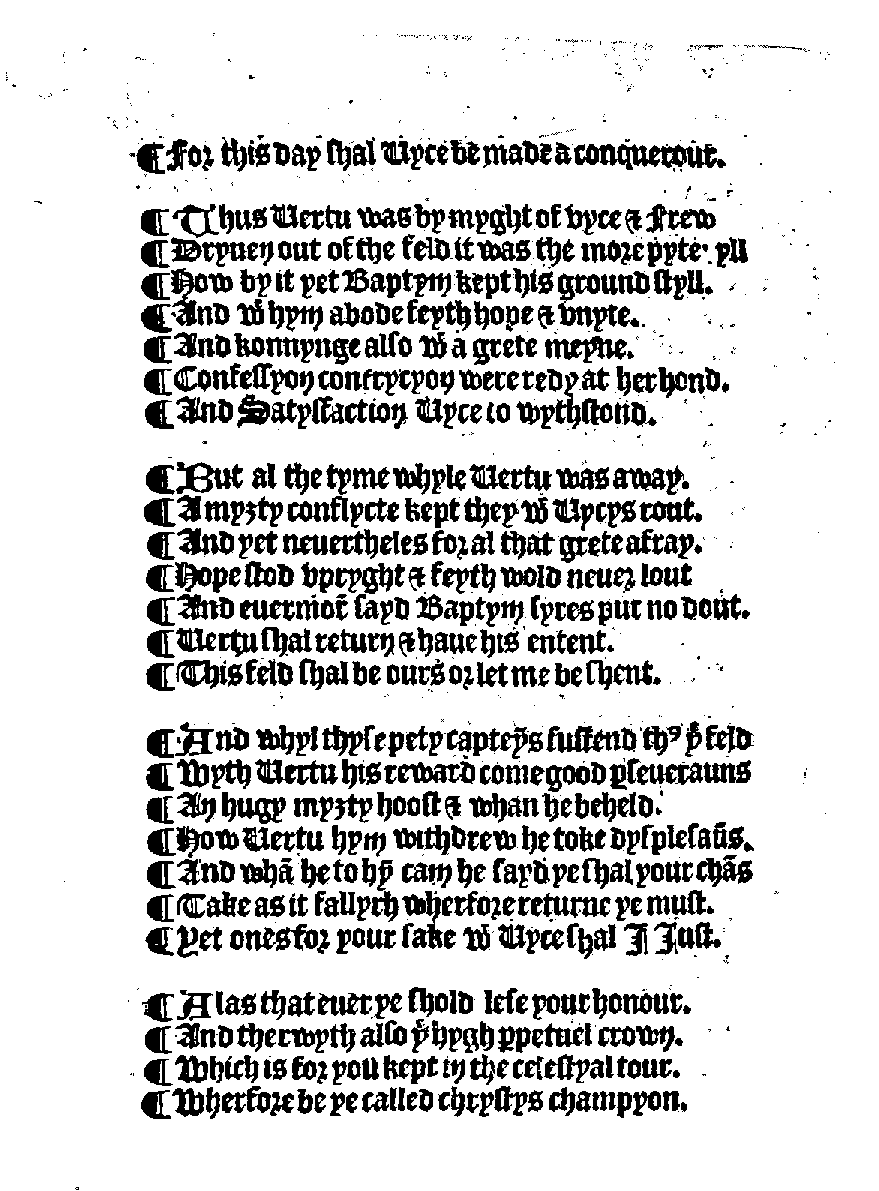 For this day shal Vyce
be made a conquerour.
For this day shal Vyce
be made a conquerour.Dryuen out of the feld it was the more pyte·
How by it yet Baptym kept his ground styll.
And with hym abode feyth hope & vnyte.
And konnynge also with a grete meyne.
Confessyon contrycyon were redy at her hond.
And Satysfaction Vyce to wythstond.
A myghty conflycte kept they with Vycys rout.
And yet neuertheles for al that grete afray.
Hope stod vpryght & feyth wold neuer lout
And euermore sayd Baptym syres put no dout.
Vertu shal return & haue his entent.
This feld shal be ours or let me be shent.
Wyth Vertu his reward come good perseuerauns
An hugy myghty hoost & whan he beheld.
How Vertu hym withdrew he toke dysplesauns.
And whan he to hym cam he sayd ye shal your chans
Take as it fallyth wherfore returne ye must.
Yet ones for your sake with Vyce shal I Iust.
And therwyth also the hygh perpetuel crown.
Which is for you kept in the celestyal tour.
Wherfore be ye called chrystys champyon.
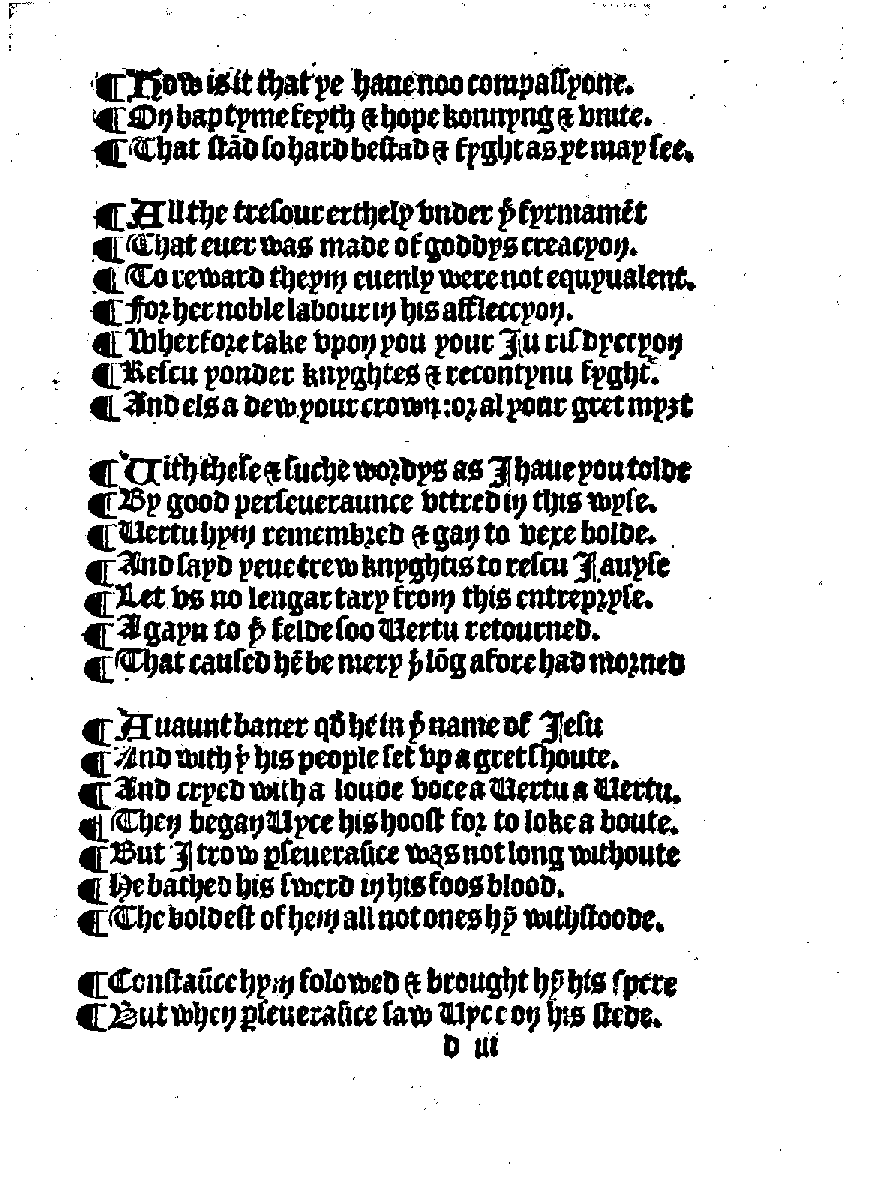 How is it that ye haue
noo compassyone.
How is it that ye haue
noo compassyone.On baptyme feyth & hope konnyng & vnite.
That stand so hard bestad & fyght as ye may see.
That euer was made of goddys creacyon.
To reward theym euenly were not equyualent.
For her noble labour in his affleccyon.
Wherfore take vpon you your Iurisdyccyon
Rescu yonder knyghtes & recontynu fyght.
And els a dew your crown for al your gret myght
By good perseueraunce vttred in this wyse.
Vertu hym remembred & gan to vexe bolde.
And sayd yeue trew knyghtis to rescu I auyse
Let vs no lengar tary from this entrepryse.
Agayn to the felde soo Vertu retourned.
That caused hem be mery that long afore had morned
And with that his people set vp a gret shoute.
And cryed with a loude voce a Vertu a Vertu.
Then began Vyce his hoost for to loke a boute.
But I trow perseueraunce was not long withoute
He bathed his swerd in his foos blood.
The boldest of hem all not ones hym withstoode.
But when perseueraunce saw Vyce on his stede.
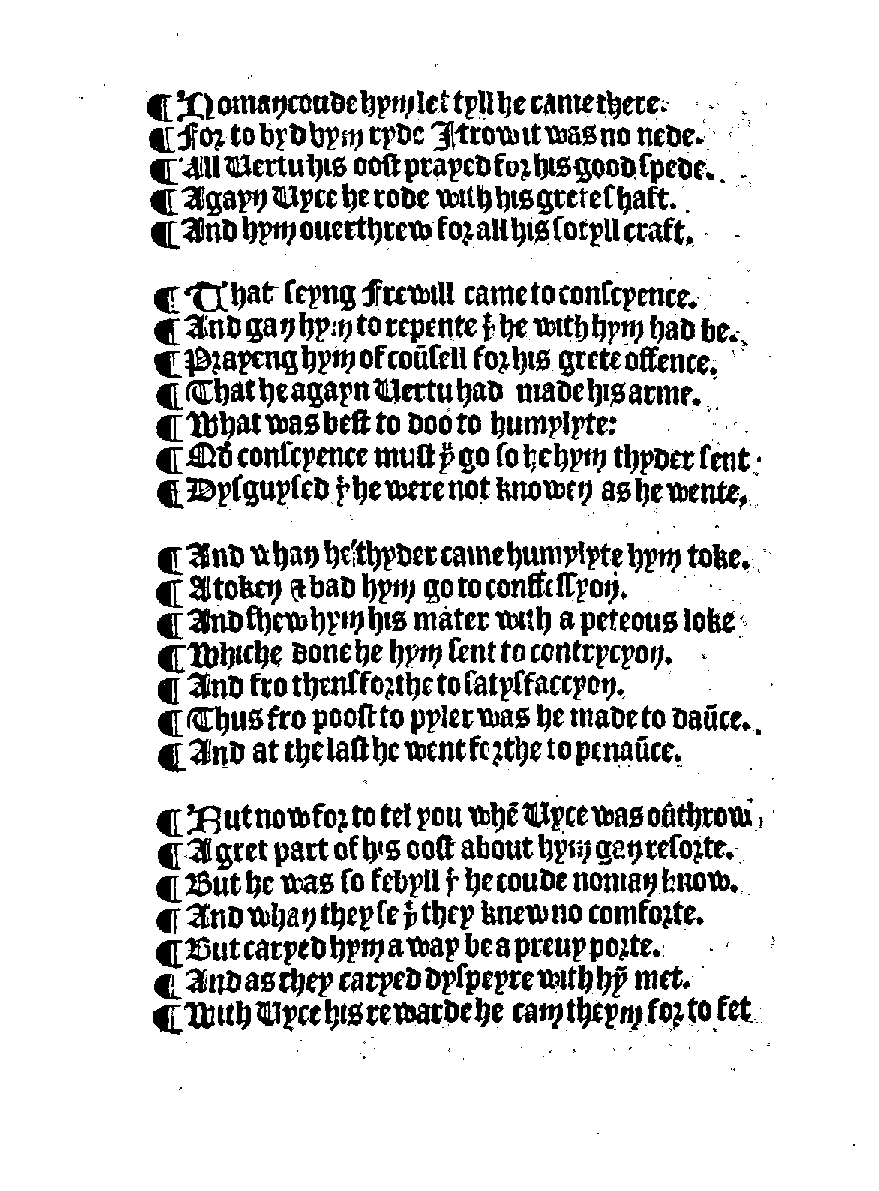 No man coude hym let
tyll he came there.
No man coude hym let
tyll he came there.For to byd hym ryde I trow it was no nede.
All Vertu his oost prayed for his good spede.
Agayn Vyce he rode with his grete shaft.
And hym ouerthrew for all his sotyll craft.
And gan hym to repente that he with hym had be.
Prayeng hym of counsell for his grete offence.
That he agayn Vertu had made his arme.
What was best to doo to humylyte:
Quod conscyence must thou go so he hym thyder sent
Dysguysed that he were not knowen as he wente.
A token & bad hym go to conffessyon.
And shew hym his mater with a peteous loke
Whiche done he hym sent to contrycyon.
And fro thensforthe to satysfaccyon.
Thus fro poost to pyler was he made to daunce.
And at the last he went forthe to penaunce.
A gret part of his oost about hym gan resorte.
But he was so febyll that he coude noman know.
And whan they se that they knew no comforte.
But caryed hym away be a preuy porte.
And as they caryed dyspeyre with hym met.
With Vyce his rewarde he cam theym for to fet
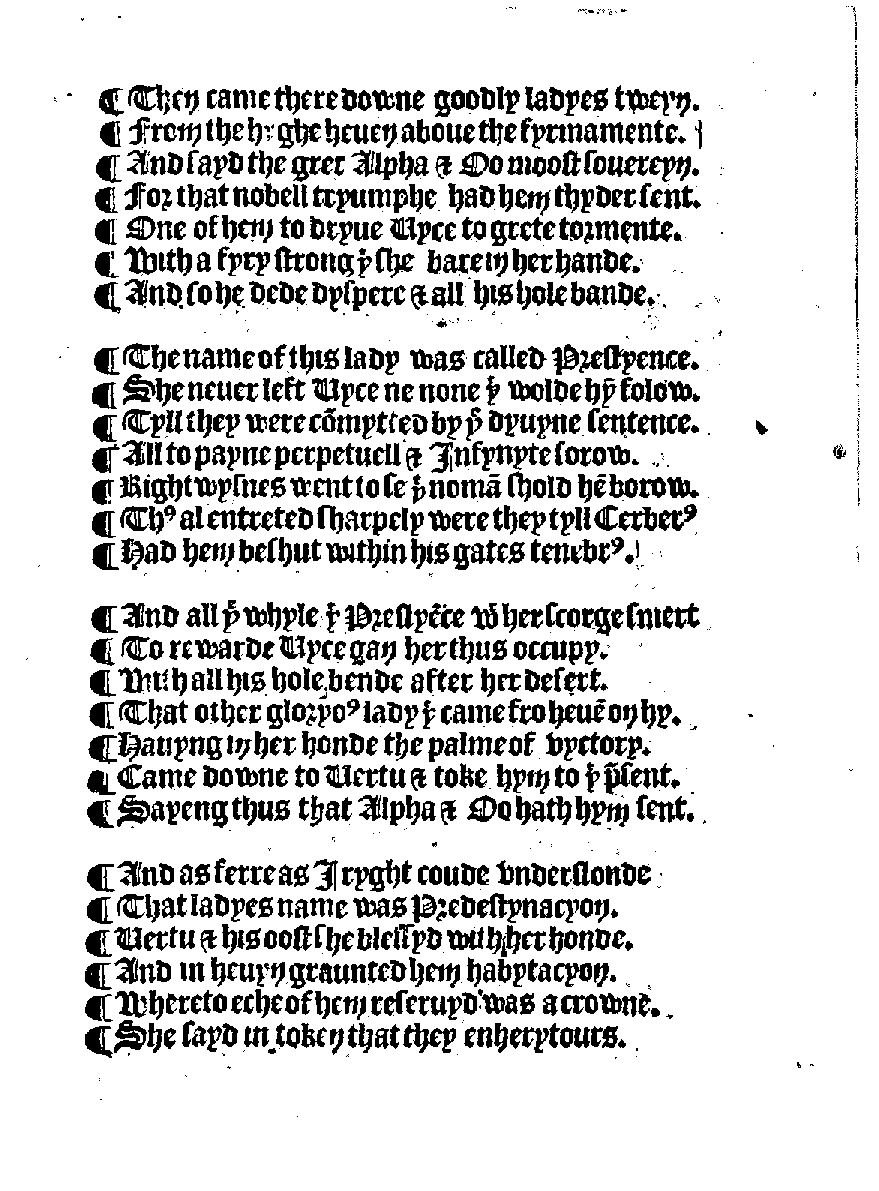 Then came there downe
goodly ladyes tweyn.
Then came there downe
goodly ladyes tweyn.From the hyghe heuen aboue the fyrmamente.
And sayd the gret Alpha & Oo moost souereyn.
For that nobell tryumphe had hem thyder sent.
One of hem to dryue Vyce to grete tormente.
With a fyry strong that she bare in her hande.
And so he dede dyspere & all his hole bande.
She neuer left Vyce ne none that wolde hym folow.
Tyll they were commytted by the dyuyne sentence.
All to payne perpetuell & Infynyte sorow.
Right wysnes went to se that noman shold hem borow.
Thus al entreted sharpely were they tyll Cerberus
Had hem beshut within his gates tenebrus.
To rewarde Vyce gan her thus occupy.
With all his hole bende after her desert.
That other gloryous lady that came fro heuen on hy.
Hauyng in her honde the palme of vyctory.
Came downe to Vertu & toke hym to that present.
Sayeng thus that Alpha & Oo hath hym sent.
That ladyes name was Predestynacyon.
Vertu & his oost she blessyd with her honde.
And in heuyn graunted hem habytacyon.
Whereto eche of hem reseruyd was a crowne.
She sayd in token that they enherytours.
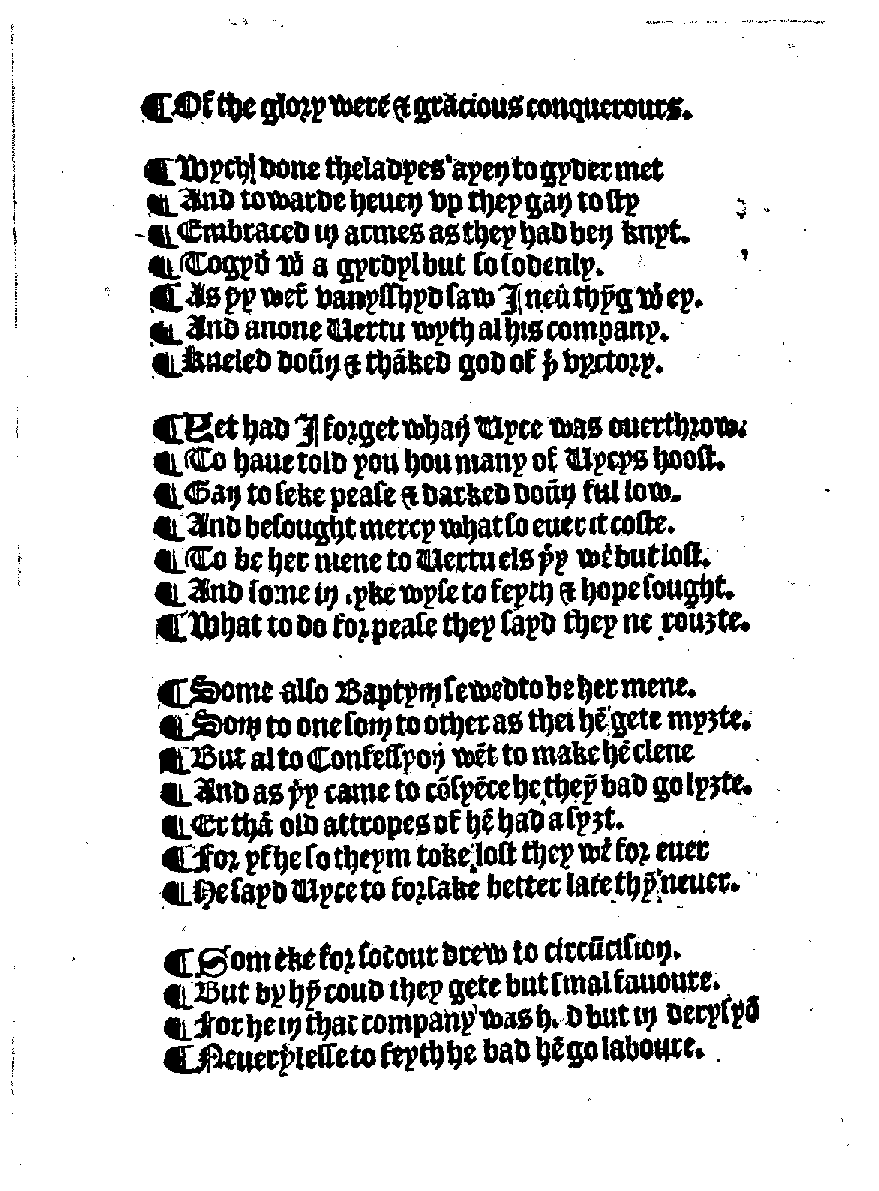 Of the glory were &
gracious conquerours.
Of the glory were &
gracious conquerours.And towarde heuen vp they gan to fly
Embraced in armes as they had ben knyt.
Togyder with a gyrdyl but so sodenly.
As they were vanysshyd saw I neuer thyng with ey.
And anone Vertu wyth al his company.
Kneled dounn & thanked god of that vyctory.
To haue told you hou many of Vycys hoost.
Gan to seke pease & darked dounn ful low.
And besought mercy what so euer it coste.
To be her mene to Vertu els they were but lost.
And some in lyke wyse to feyth & hope sought.
What to do for pease they sayd they ne roughte.
Som to one som to other as thei hem gete myghte.
But al to Confessyon went to make hem clene
And as they came to consyence he theym bad go lyghte.
Er than old attropes of hem had a syght.
For yf he so theym toke lost they were for euer
He sayd Vyce to forsake better late thyn neuer.
But by hym coud they gete but smal fauoure.
For he in that company was had but in derysyon
Neuerthelesse to feyth he bad hem go laboure.
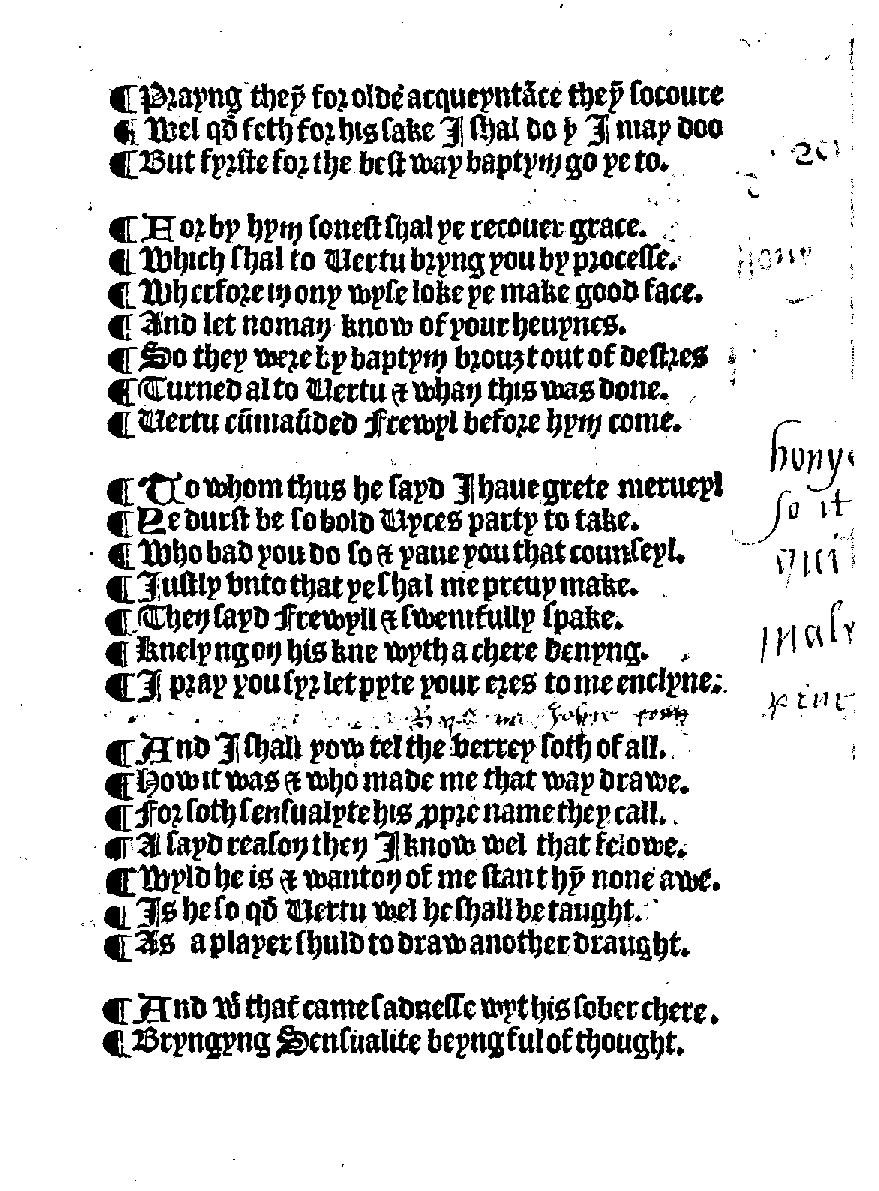 Prayng theym for
olde acqueyntance theym socoure
Prayng theym for
olde acqueyntance theym socoureWel quod feth for his sake I shal do that I may doo
But fyrste for the best way baptym go ye to.
Which shal to Vertu bryng you by processe.
Wherfore in ony wyse loke ye make good face.
And let noman know of your heuynes.
So they were by baptym brought out of destres
Turned al to Vertu & whan this was done.
Vertu cummaunded Frewyl before hym come.
Ye durst be so bold Vyces party to take.
Who bad you do so & yaue you that counseyl.
Iustly vnto that ye shal me preuy make.
Then sayd Frewyll & swemfully spake.
Knelyng on his kne wyth a chere benygn.
I pray you syr let pyte your eres to me enclyne.
How it was & who made me that way drawe.
For soth sensualyte his propre name they call.
A sayd reason then I know wel that felowe.
Wyld he is & wanton of me stant hym none awe.
Is he so quod Vertu wel he shall be taught.
As a player shuld to draw another draught.
Bryngyng Sensualite beyng ful of thought.
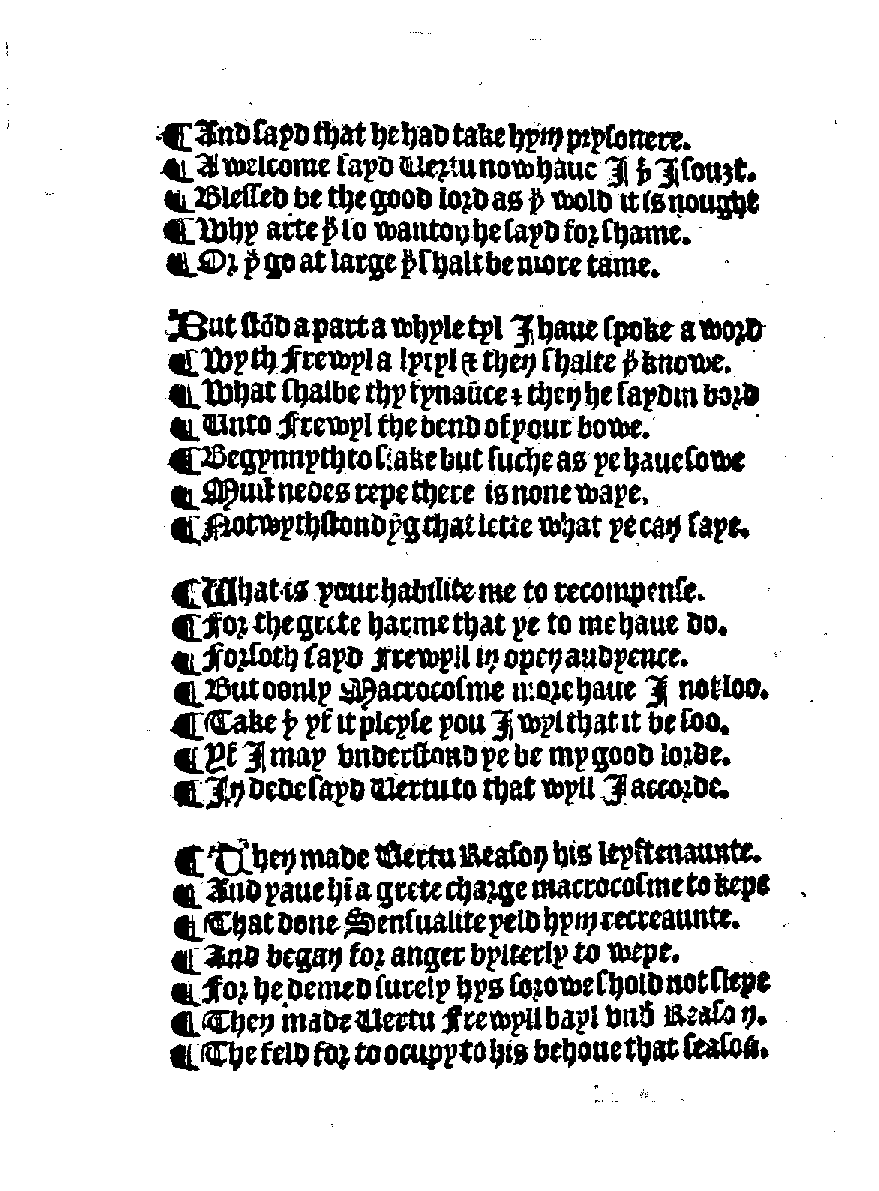 And sayd that he had take hym
prysonere.
And sayd that he had take hym
prysonere.A welcome sayd Vertu now haue I that I sought.
Blessed be the good lord as thou wold it is nought
Why arte thou so wanton he sayd for shame.
Or thou go at large thou shalt be more tame.
Wyth Frewyl a lytyl & then shalte thou knowe.
What shalbe thy fynaunce & then he sayd in bord
Vnto Frewyl the bend of your bowe.
Begynnyth to slake but suche as ye haue sowe
Must nedes repe there is none waye.
Notwythstondyng that lette what ye can saye.
For the grete harme that ye to me haue do.
Forsoth sayd Frewyll in open audyence.
But oonly Macrocosme more haue I not loo.
Take that yf it pleyse you I wyl that it be soo.
Yf I may vnderstond ye be my good lorde.
In dede sayd Vertu to that wyll I accorde.
And yaue him a grete charge macrocosme to kepe
That done Sensualite yeld hym recreaunte.
And began for anger bytterly to wepe.
For he demed surely hys sorowe shold not slepe
Then made Vertu Frewyll bayl vnder Reason.
The feld for to ocupy to his behoue that season.
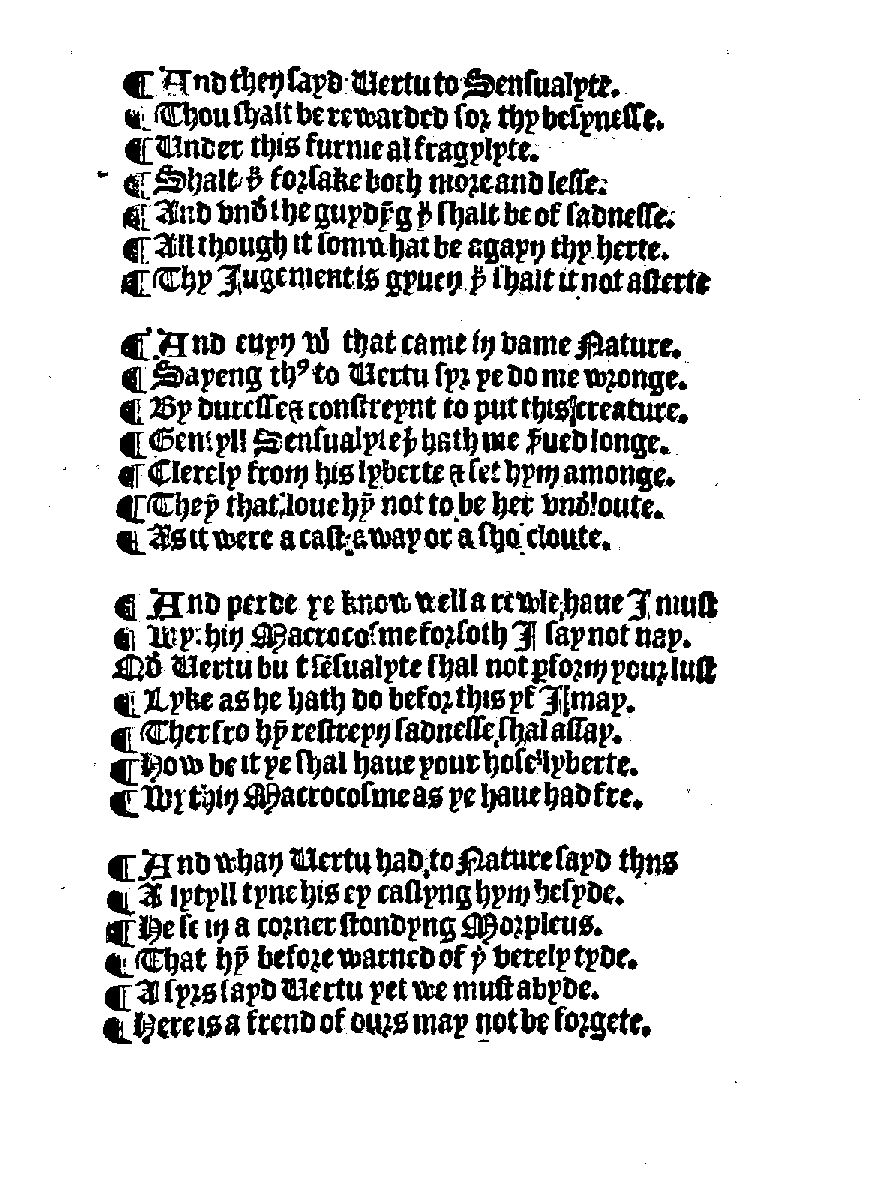 And then sayd Vertu to
Sensualyte.
And then sayd Vertu to
Sensualyte.Thou shalt be rewarded for thy besynesse.
Vnder this furme al fragylyte
Shalt thou forsake both more and lesse.
And vnder the guydyng thou shalt be of sadnesse.
All though it somwhat be agayn thy herte.
Thy Iugements gyuen thou shalt it not asterte.
Sayeng thus to Vertu syr ye do me wronge.
By duresse & constreynt to put this creature.
Gentyll Sensualyte that hath me serued longe.
Clerely from his lyberte & set hym amonge.
Theym that loue hym not to be her vnderloute.
As it were a cast away or a sho cloute.
Wythin Macrocosme forsoth I say not nay.
Quod Vertu but sensualyte shal not perform your lust
Lyke as he hath do befor this yf I may.
Therfro hym restreyn sadnesse shal assay.
How be it ye shal haue your hole lyberte.
Wythin Macrocosme as ye haue had fre.
A lytyll tyne his ey castyng hym besyde.
He se in a corner stondyng Morpleus
That hym before warned of that berely tyde.
A syrs sayd Vertu yet we must abyde.
Here is a frend of ours may not be forgete.
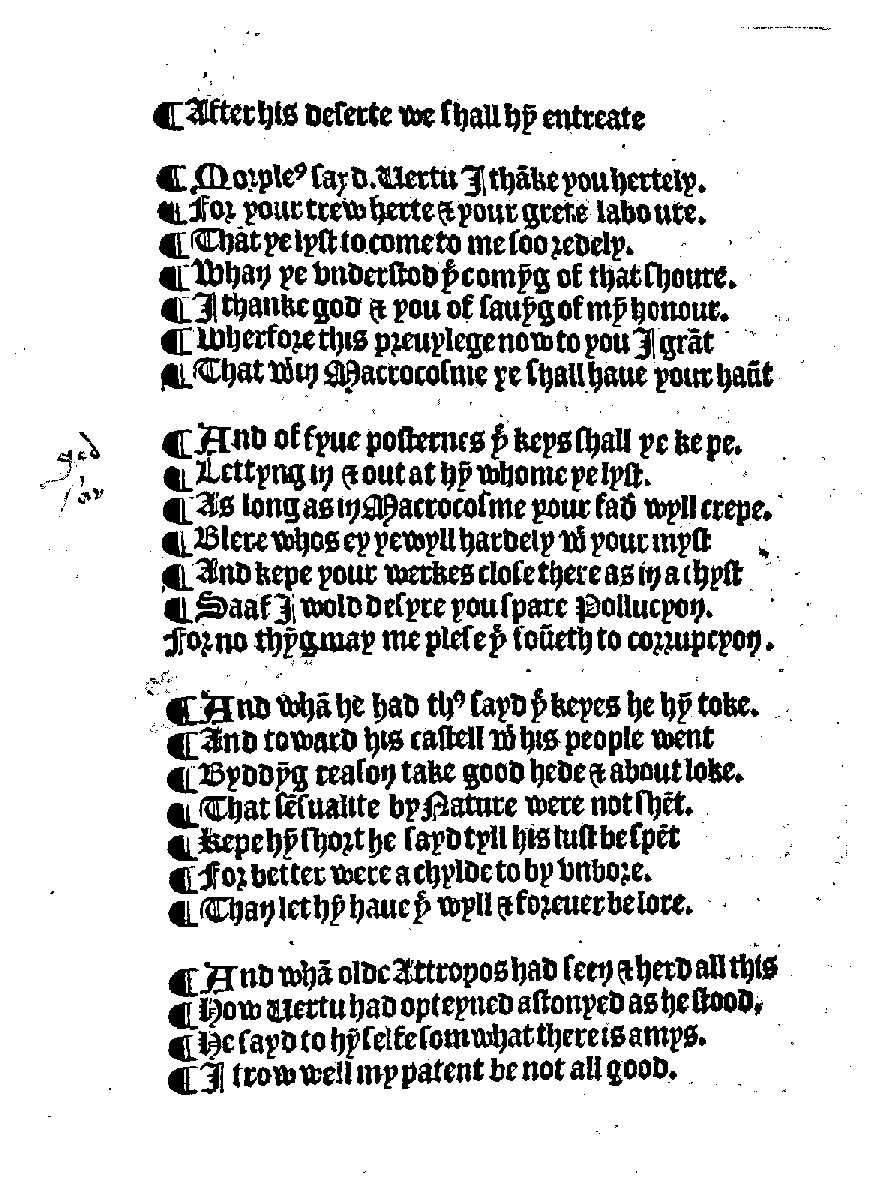 After his deserte we
shall hym entreate
After his deserte we
shall hym entreateFor your trew herte & your grete laboure.
That ye lyst to come to me soo redely.
Whan ye vnderstood the comyng of that shoure.
I thanke god & you of sauyng of myn honour.
Wherfore this preuylege now to you I grant
That within Macrocosme ye shall haue your haunt
Lettyng in & out at hym whome ye lyst.
As long as in Macrocosme your fader wyll crepe.
Blere whos ey ye wyll hardely with your myst
And kepe your werkes close there as in a chyst
Saaf I wold desyre you spare Pollucyon.
For no thyng may me plese the souneth to corrupcyon.
And toward his castell with his people went
Byddyng reason take good hede & about loke
That sensualite by Nature were not shent.
Kepe hym short he sayd tyll his lust be spent
For better were a chylde to by vnbore
Than let hym haue the wyll & foreuer be lore.
How Vertu had opteyned astonyed as he stood.
He sayd to hymselfe somwhat there is amys.
I trow well my patent be not all good.[2]
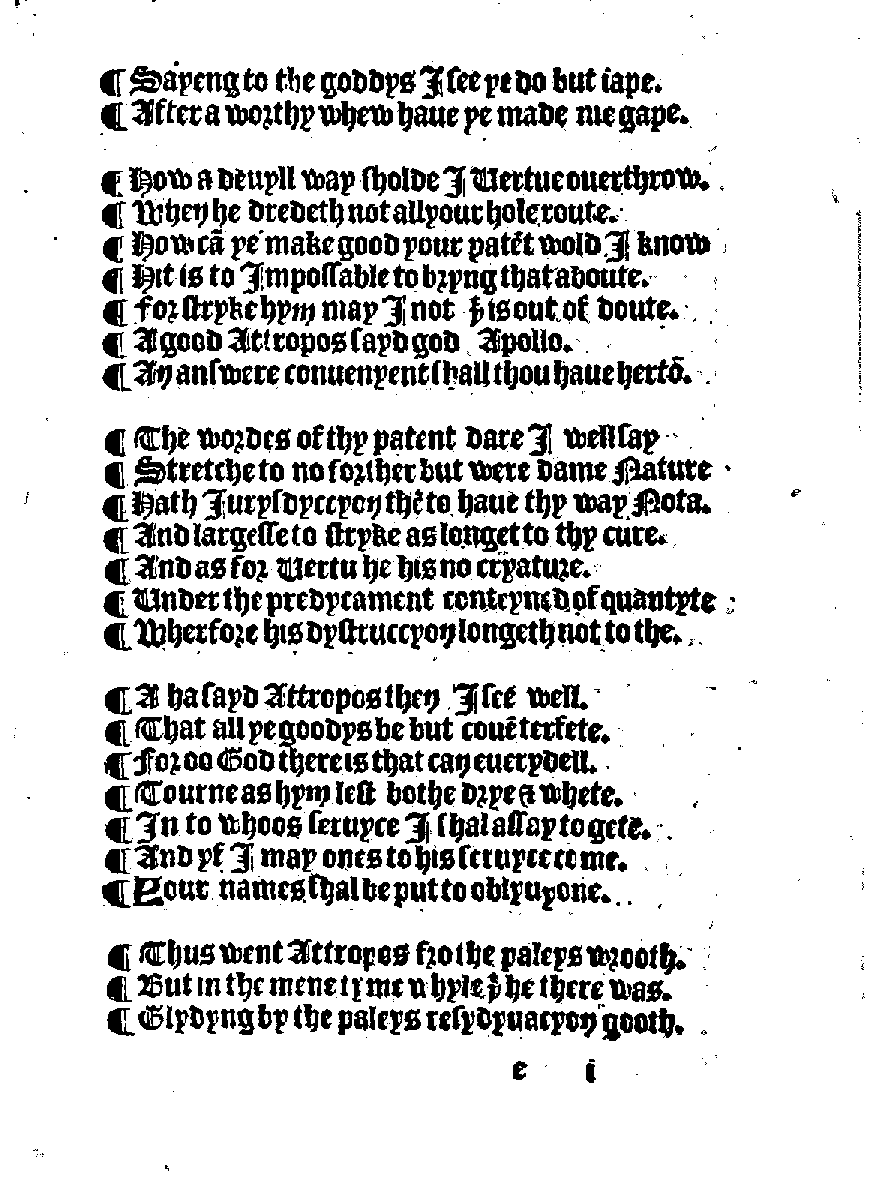 Sayeng to the goddys I see ye do but
iape.
Sayeng to the goddys I see ye do but
iape.After a worthy whew haue ye made me gape.
When he dredeth not all your hole route.
How cam ye make good your patent wold I know
Hit is to Impossable to bryng that aboute.
For stryke hym may I not that is out of doute.
A good Attropos sayd god Apollo.
An answere conuenyent shall thou haue herto.
Stretche to no forther but were dame Nature
Hath Iurysdyccyon there to haue the way Nota.
And largesse to stryke as longet to thy cure.
And as for Vertu he his no cryature.
Vnder the predycament conteyned of quantyte
Wherefore his dystruccyon longeth not to the.
That all ye goddys be but counterfete.
For oo God there is that can euerydell.
Tourne as hym lest bothe drye & whete.
In to whoos seruyce I shal assay to gete.
And yf I may ones to his seruyce come.
Your names shal be put to oblyuyone.
But in the mene tyme whyle that he there was.
Glydyng by the paleys resydyuacyon gooth.
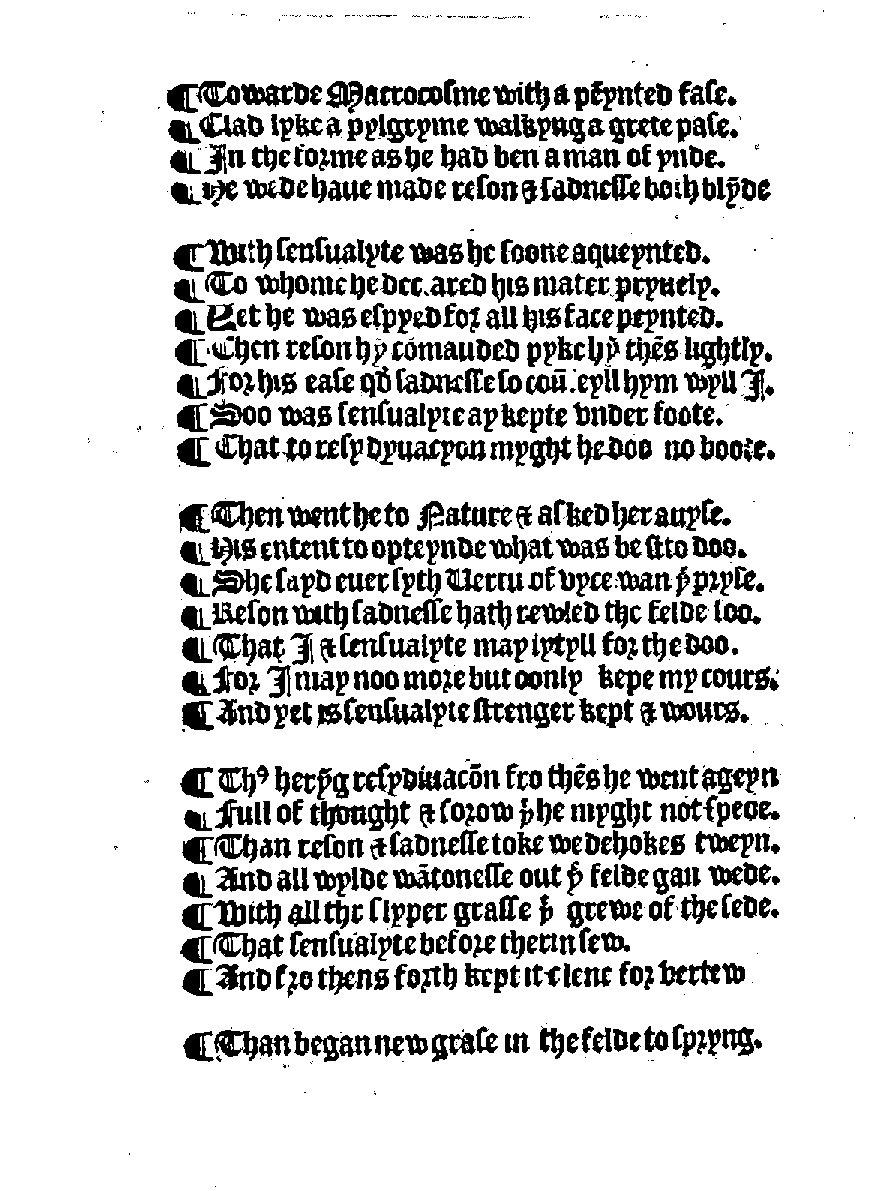 Towarde Macrocosme with a peynted
fase.
Towarde Macrocosme with a peynted
fase.Clad lyke a pylgryme walkyng a grete pase.
In the forme as he had ben a man of ynde.
He wede haue made reson & sadnesse both blynde
To whome he declared his mater pryuely.
Yet he was espyed for all his face peynted.
Then reson hym commauded pyke hym thens lightly.
For his ease quod sadnesse so counseyll hym wyll I.
Soo was sensualyte ay kepte vnder foote.
That to resydyuacyon myght he doo no boote.
His entent to opteynde what was best to doo.
She sayd euer syth Vertu of vyce wan the pryse.
Reson with sadnesse hath rewled the felde soo.
That I & sensualyte may lytyll for the doo.
For I may noo more but oonly kepe my cours.
And yet is sensualyte strenger kept & wours.
Full of thought & sorow that he myght not spede.
Than reson & sadnesse toke wedehokes tweyn.
And all wylde wantonesse out the felde gan wede.
With all the slyper grasse that grewe of the sede.
That sensualyte before therin sew.
And fro thens forth kept it clene for vertew
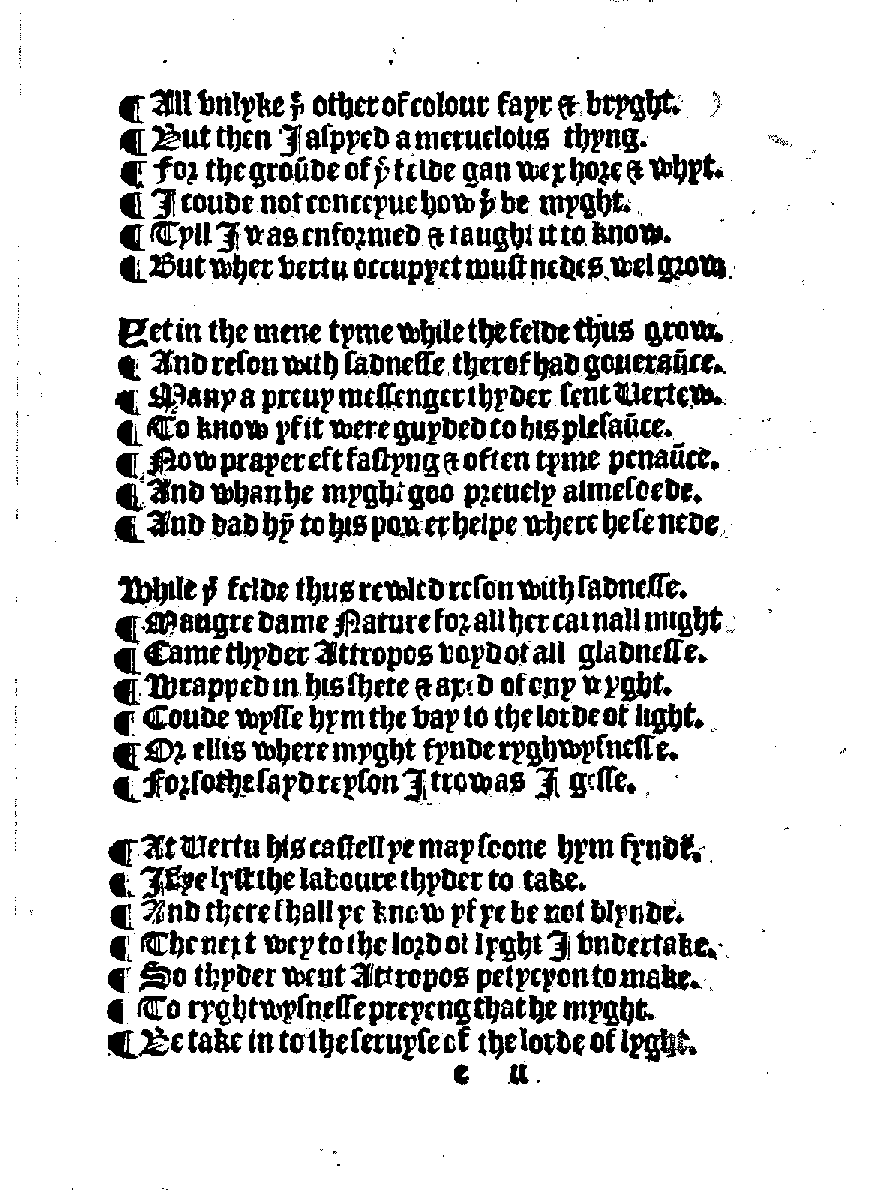 All vnlyke that
other of colour fayr & bryght.
All vnlyke that
other of colour fayr & bryght.But then I aspyed a meruelous thyng.
For the grounde of the felde gan wex hore & whyt.
I coude not conceyue how that be myght.
Tyll I was enformed & taught it to know.
But wher vertu occupyet must nedes wel grow
And reson with sadnesse therof had goueraunce.
Many a preuy messenger thyder sent Vertew.
To know yf it were guyded to his plesaunce.
Now prayer eft fastyng & often tyme penaunce.
And whan he myght goo preuely almesdede.
And bad hym to his power helpe where he se nede
Maugre dame Nature for all her carnall might
Came thyder Attropos voyd of all gladnesse.
Wrapped in his shete & axed of ony wyght.
Coude wysse hym the vay to the lorde of light.
Or ellis where myght fynde ryghtwysnesse.
Forsothe sayd reyson I trow as I gesse.
If ye lyst the laboure thyder to take.
And there shall ye know yf ye be not blynde.
The next wey to the lord of lyght I vndertake.
So thyder went Attropos petycyon to make.
To ryghtwysnesse preyeng that he myght.
Be take in to the seruyse of the lorde of lyght.
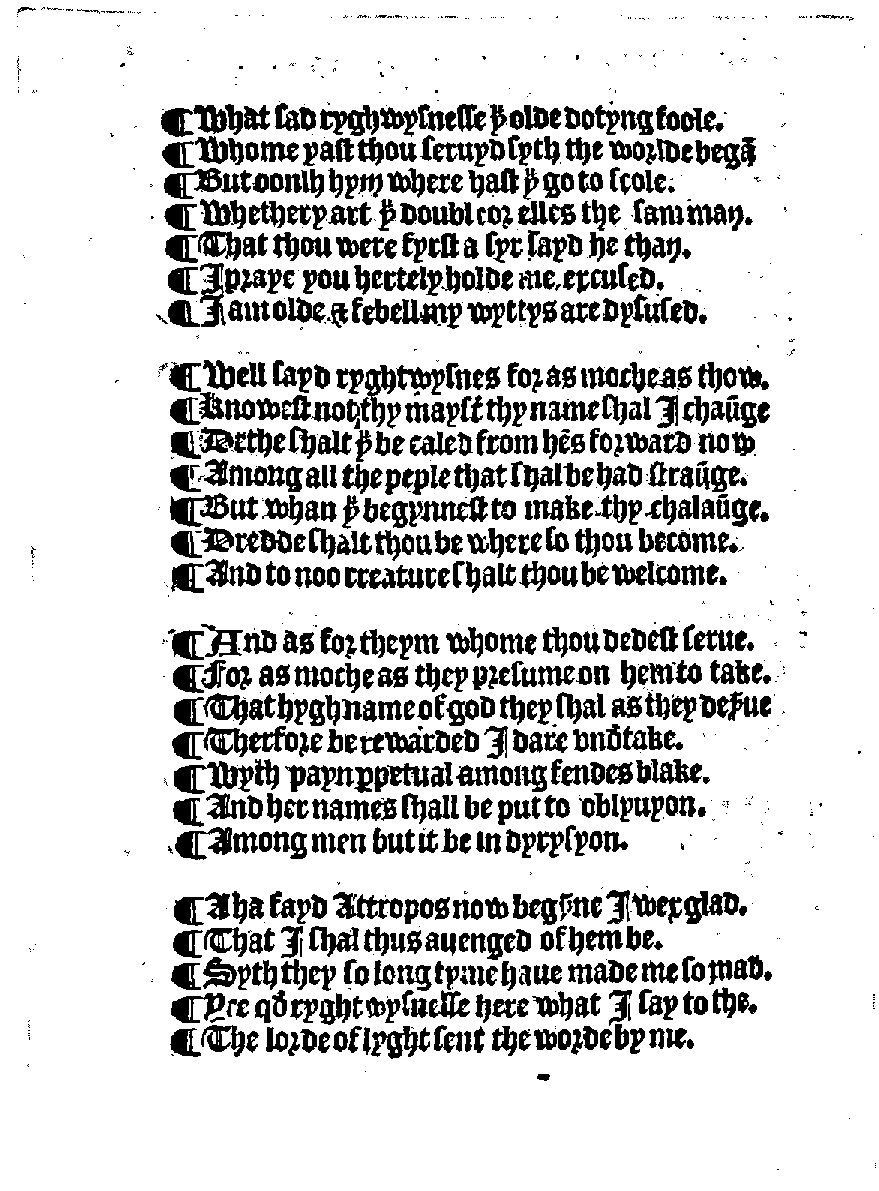 What sad ryghtwysnesse thou olde
dotyng foole.
What sad ryghtwysnesse thou olde
dotyng foole.Whome hast thou seruyd syth the worlde began
But oonly hym where hast thou go to scole.
Whethery art thou double or elles the sam man.
That thou were fyrst a syr sayd he than.
I praye you hertely holde me excused.
I am olde & febell my wyttys are dysused.
Knowest not thy mayster thy name shal I chaunge
Dethe shalt thou be caled from hens forward now
Among all the peple that shal be had straunge.
But whan thou begynnest to make thy chalaunge.
Dredde shalt thou be where so thou become.
And to noo creature shalt thou be welcome.
For as moche as they presume on hem to take.
That hygh name of god they shal as they deserue
Therfore be rewarded I dare vndertake.
Wyth payn perpetual among fendes blake.
And her names shall be put to oblyuyon.
Among men but it be in dyrysyon.
That I shal thus auenged of hem be.
Syth they so long tyme haue made me so mad.
Yee quod ryghtwysnesse here what I say to the.
The lorde of lyght sent the worde by me.
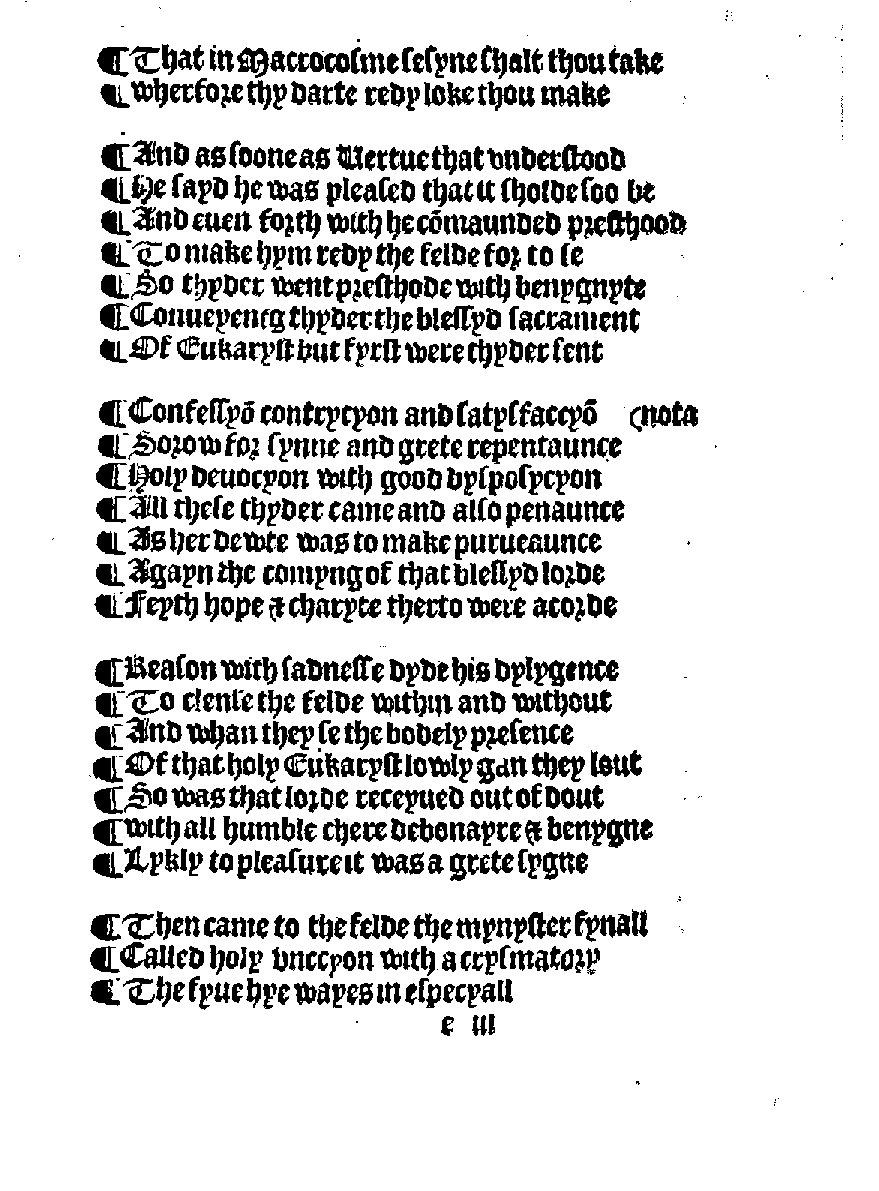 That in Macrocosme
sesyne shalt thou take
That in Macrocosme
sesyne shalt thou takewherfore thy darte redy loke thou make
He sayd he was pleased that it sholde soo be
And euen forth with he commaunded presthood
To make hym redy the felde for to se
So thyder went presthode with benygnyte
Conueyening thyder the blessyd sacrament
Of Eukaryst but fyrst were thyder sent
Sorow for synne and grete repentaunce
Holy deuocyon with good dysposycyon
All these thyder came and also penaunce
As her dewte was to make purueaunce
Agayn the comyng of that blessyd lorde
Feyth hope & charyte therto were acorde
To clense the felde within and without
And whan they se the bodely presence
Of that holy Eukaryst lowly gan they lout
So was that lorde receyued out of dout
With all humble chere debonayre & benygne
Lykly to pleasure it was a grete sygne
Called holy vnccyon with a crysmatory
The fyue hye wayes in especyall
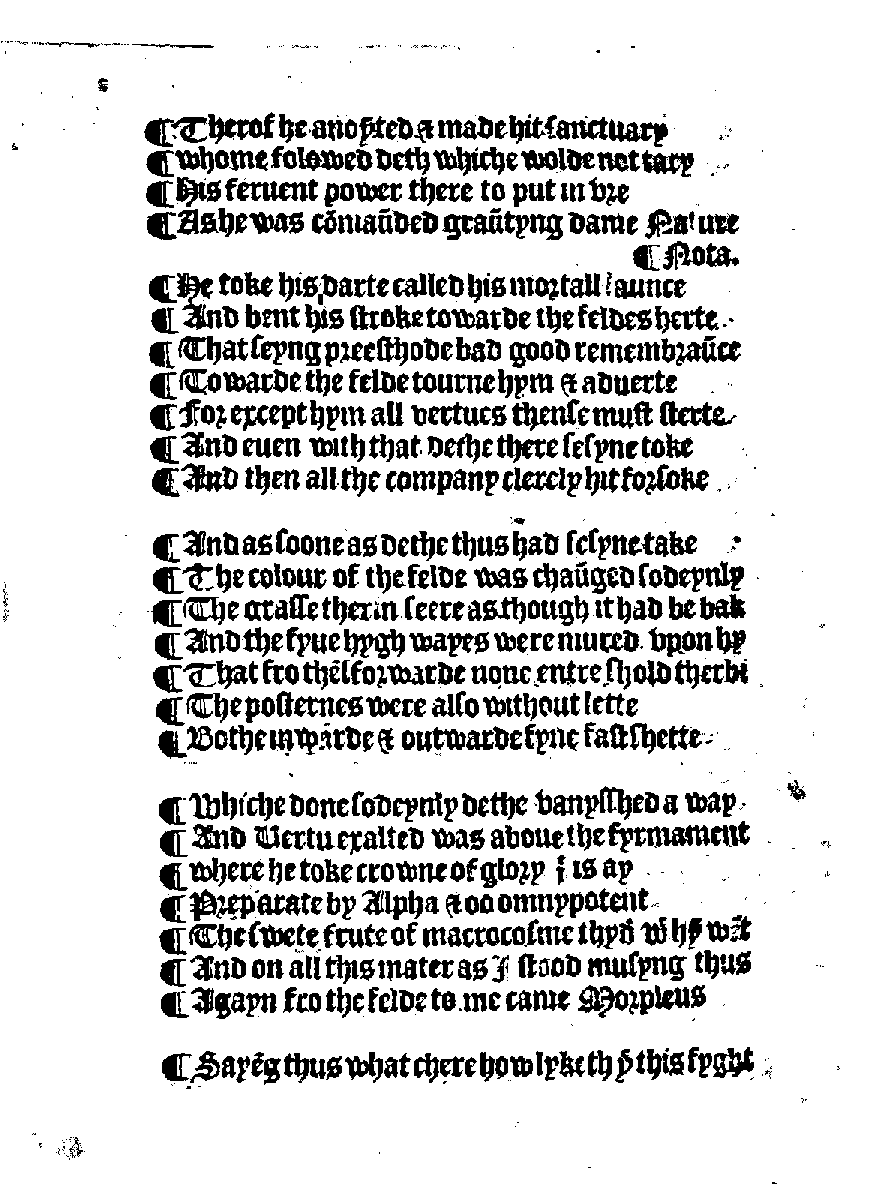 Therof he
anoynted & made hit sanctuary
Therof he
anoynted & made hit sanctuaryWhome folowed deth whiche wolde not tary
His feruent power there to put in vre
As he was commaunded grauntyng dame Nature
And bent his stroke towarde the feldes herte
That seyng preesthode bad good remembraunce
Towarde the felde tourne hym & aduerte
For except hym all vertues thense must sterte
And euen with that dethe there sesyne toke
And then all the company clerely hit forsoke
The colour of the felde was chaunged sodeynly
The grasse therin seere as though it had be bak
And the fyue hygh wayes were mured vpon hy
That fro thensforwarde none entre shold therbi
The posternes were also without lette
Bothe inwarde & outwarde fyne fast shette
And Vertu exalted was aboue the fyrmament
Where he toke crowne of glory that is ay
Preparate by Alpha & oo omnypotent
The swete frute of macrocosme thyder with hym went
And on all this mater as I stood musyng thus
Agayn fro the felde to me came Morpleus
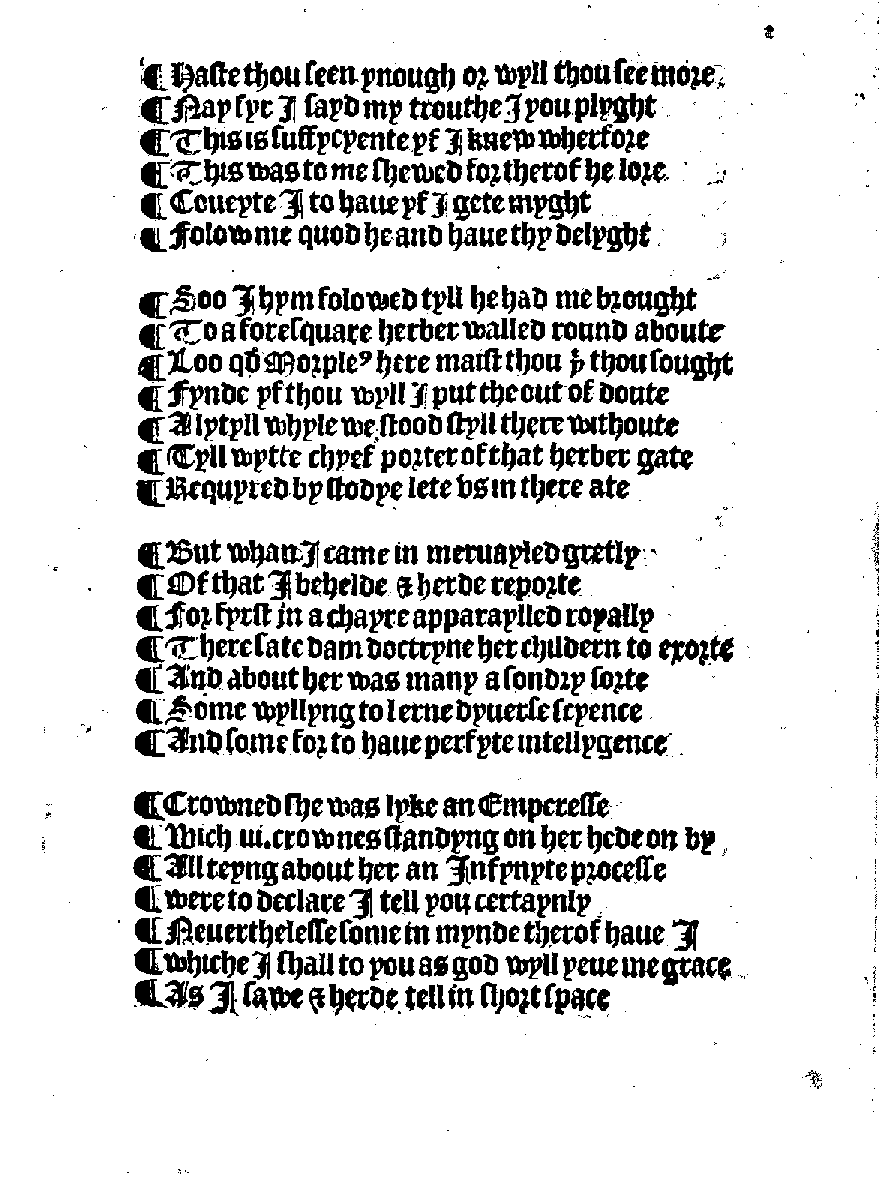 Haste
thou seen ynough or wyll thou see more
Haste
thou seen ynough or wyll thou see moreNay syr I sayd my trouthe I you plyght
This is suffycyente yf I knew wherfore
This was to me shewed for therof he lore
Coueyte I to haue yf I gete myght
Folow me quod he and haue thy delyght
To a foresquare herber walled round aboute
Loo quod Morpleus here maist thou that thou sought
Fynde yf thou wyll I put the out of doute
A lytyll whyle we stood styll there withoute
Tyll wytte chyef porter of that herber gate
Requyred by stodye lete vs in there ate
Of that I behelde & herde reporte
For fyrst in a chayre apparaylled royally
There sate dam doctryne her childern to exorte
And about her was many a sondry sorte
Some wyllyng to lerne dyuerse scyence
And some for to haue perfyte intellygence
With .iii. crownes standyng on her hede on by
All thyng about her an Infynyte processe
Were to declare I tell you certaynly
Neuerthelesse some in mynde therof haue I
Whiche I shall to you as god wyll yeue me grace
As I sawe & herde tell in short space
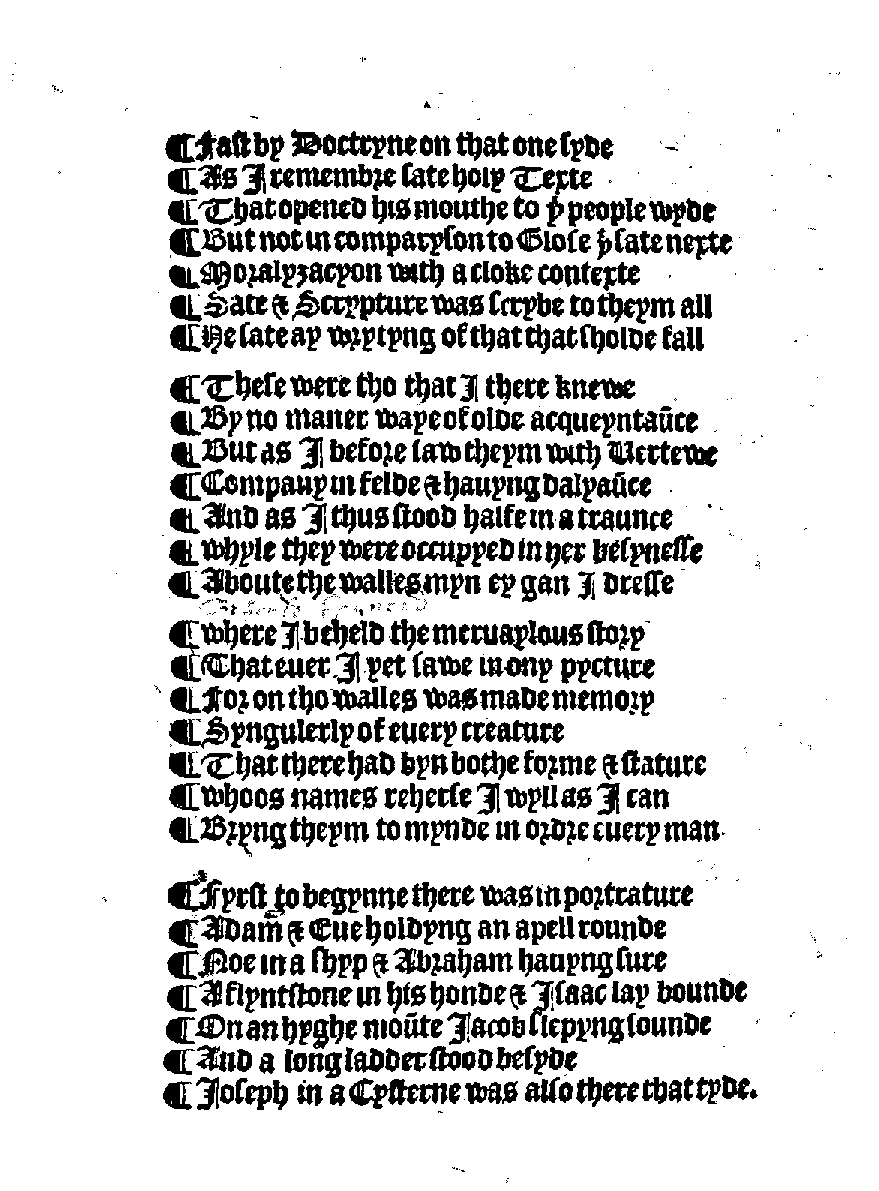 Fast by Doctryne on that
one syde
Fast by Doctryne on that
one sydeAs I remembre sate holy Texte
That opened his mouthe to the people wyde
But not in comparyson to Glose that sate nexte.
Moralyzacyon with a cloke contexte
Sate & Scrypture was scrybe to theym all
He sate ay wrytyng of that that sholde fall
By no maner waye of olde acqueyntaunce
But as I before saw theym with Vertewe
Company in felde & hauyng dalyaunce
And as I thus stood halfe in a traunce
Whyle they were occupyed in her besynesse
Aboute the walles myn ey gan I dresse
That euer I yet sawe in ony pycture
For on tho walles was made memory
Syngulerly of euery creature
That there had byn bothe forme & stature
Whoos names reherse I wyll as I can
Bryng theym to mynde in ordre euery man
Adam & Eue holdyng an apell rounde
Noe in a shyp & Abraham hauyng sure
A flyntstone in his honde & Isaac lay bounde
On an hyghe mounte Iacob slepyng sounde
And a long ladder stood besyde
Ioseph in a Cysterne was also there that tyde.
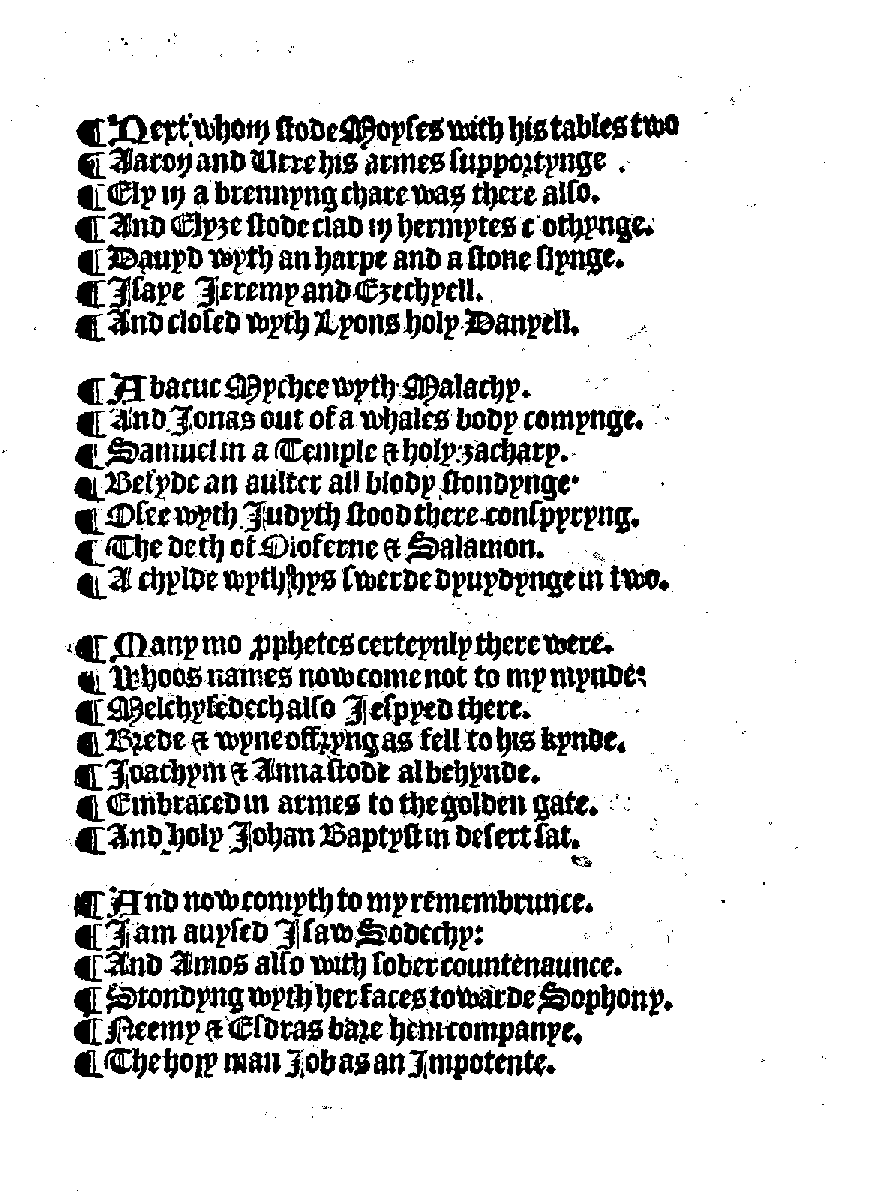 Next whom stode Moyses
with his tables two
Next whom stode Moyses
with his tables twoAaron and Vrre his armes supportynge
Ely in a brennyng chare was there also.
And Elyze stode clad in hermytes clothynge.
Dauyd wyth an harpe and a stone slynge.
Isaye Ieremy and Ezechyell.
And closed wyth Lyons holy Danyell.
And Ionas out of a whales body comynge.
Samuel in a Temple & holy zachary.
Besyde an aulter all blody stondynge.
Osee wyth Iudyth stood there conspyryng.
The deth of Dioferne & Salamon.
A chylde wyth hys swerde dyuydynge in two.
Whoos names now come not to my mynde:
Melchysedech also I espyed there.
Brede & wyne offryng as fell to his kynde.
Ioachym & Anna stode al behynde.
Embraced in armes to the golden gate.
And holy Iohan Baptyst in desert sat.
I am auysed I saw Sodechy:
And Amos also with sober countenaunce.
Stondyng wyth her faces towarde Sophony.
Neemy & Esdras bare hem companye.
The holy man Iob as an Impotente.
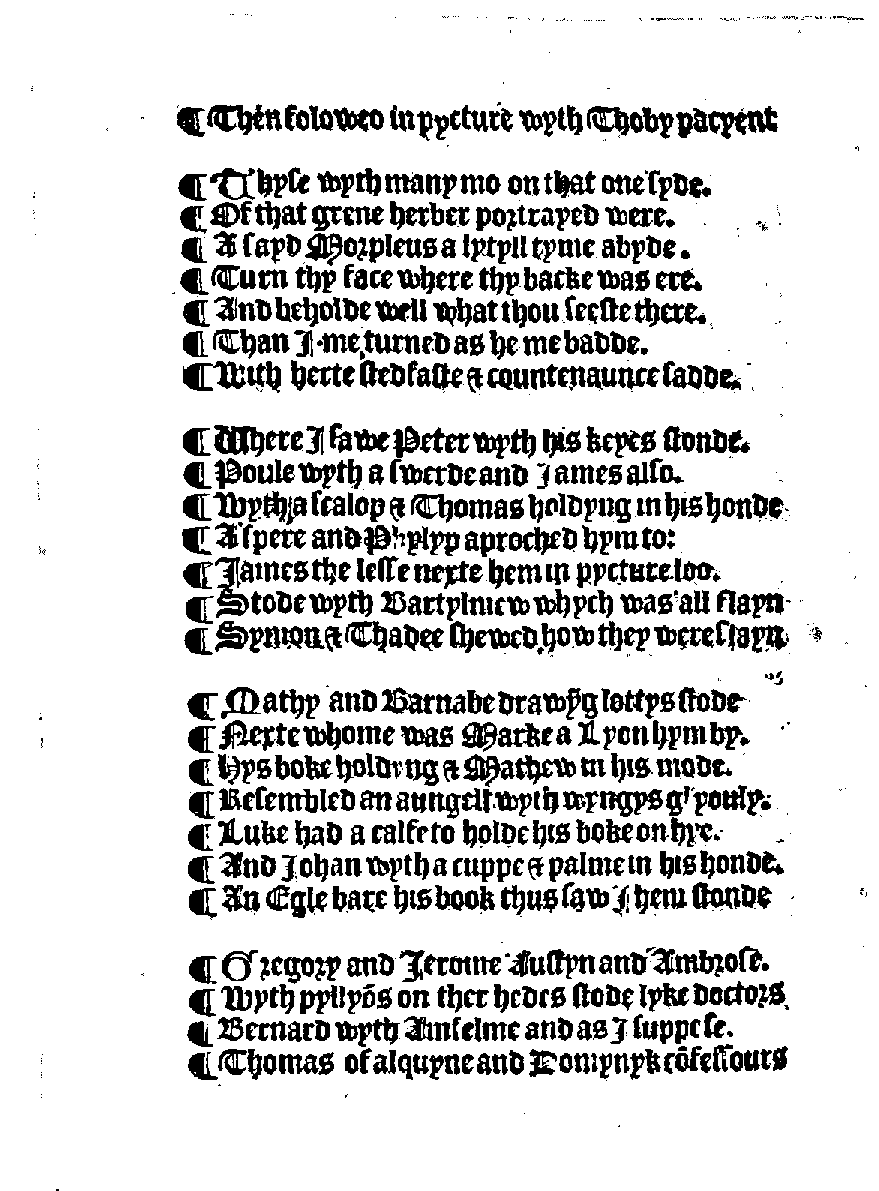 Then folowed in pycture
wyth Thoby pacyent
Then folowed in pycture
wyth Thoby pacyentOf that grene herber portrayed were.
A sayd Morpleus a lytyll tyme abyde.
Turn thy face where thy backe was ere.
And beholde well what thou seeste there.
Than I me turned as he me badde.
With herte stedfaste & countenaunce sadde.
Poule wyth a swerde and Iames also.
Wyth a scalop & Thomas holdyng in his honde
A spere and Phylyp aproched hym to:
Iames the lesse nexte hem in pycture too.
Stode wyth Bartylmew whych was all flayn
Symon & Thadee shewed how they were slayn
Nexte whome was Marke a Lyon hym by.
Hys boke holdyng & Mathew in his mode.
Resembled an aungell wyth wyngys gloryously.
Luke had a calfe to holde his boke on hye.
And Iohan wyth a cuppe & palme in his honde.
An Egle bare his book thus saw I hem stonde
Wyth pyllyons on ther hedes stode lyke doctors
Bernard wyth Amselme and as I suppose.
Thomas of alquyne and Domynyk confessours.
 Benet and Hew relygyous
gouernours.
Benet and Hew relygyous
gouernours.Martyn & Iohan with bysshops tweyne.
Were there also and Crysostom certayne.
All behynde and next hym stood Orygene.
Hydynge his face as he of his dede.
Had hem ashamed ye wote what I mene.
For of errour he was not al clene.
And on that syde stode laste of alle.
The noble prophetyssa Sybell men her call.
My barayn is so thynne I deme in my herte
Some of the felyshyp that I there say.
In all this whyle to haue ouersterte.
A benedicite none coude I aduerte.
To thynke on Andrew the apostle with his crosse.
Whome to forgete were a grete losse.
Whoos names come not to my remembraunce.
But thyse I marked in especyall.
And moo coude I tell in countenaunce.
Of tyme but forth to shewe you the substaunce.
Of this mater in the myndys of that arbere.
Sat Doctryne coloured as ony crystall clere.
Whoos apparayl wos worth tresour Infynyte
 All erthly rychesse
count I no more.
All erthly rychesse
count I no more.To that in comparyson valewyng then a myte.
Ouer her hede houed a culuer fayr & whyte.
Out of her byll proceded a grete leme.
Downward to Doctryne lyke a sonne beme
In swetnesse of sauour to her dyscyples al.
It fer exceded myr & frankencense.
Or ony other tre spyce or els galle.
And whan she me espyed anone she gan me cal.
And commaunded morpleus that he shold bryng me nere
For she wold me hew the effect of my desyre.
Is to vnderstond be myn enformal yon.
Sensyble the mater of morpleus his shewynge
As he hath the led about in vesyon.
Wherfore now I apply thy natural reason.
Vnto my wordes & or thou hens wend.
Thou shalt it know begynnyng and ende.
By hys owne neclygence taken prysonere.
Wythin the erth for he so fer foughte.
Sygnyfed is no more be that matere.
But only to shew the how it doth appere:
That welth vnbrydeled at thyn eye.
Enbraseth mysrewle and oft causyth foly.
 For lyke as Colus beyng
at his large
For lyke as Colus beyng
at his largeStreyted hymself thrugh his own lewdenesse
For he wolde deele where he had no charge
Ryght soo wantons by her wyldenesse
Oftesythe bryng hymselfe in dystresse
Because they sometyme to largely deele
What may wors be suffred than ouermykell weele
May be vnderstonde goddys ryghtwysnes
That to euery wyght his payne deputate
Assygneth acordyng to his wyckednes
Wherfore he is called Iuge of cruelnes
And as for Dyana & Neptunus compleynte
Fygured may be fooles reason feynt.
To haue me Colus from cours of hys kynde
Which was Impossyble to bryng to correccyon
For euermore hys lyberte haue wyll the wynde
In lyke wyse fooles other whyle be blynde
Wenyng to subdew with her one honde
That is ouermykell for all an hole londe
When they were come to the bankete
The grete Apollo with his sad chere
Soo fayre & curtously gan theym entret
That he made her beerdys on the new gete
Loo what wysdome dooth to a foole
 Wherefore are children put to
scoole
Wherefore are children put to
scooleThat wyse men fooles ouercome ay
Tornyng as hem lyst & all her varyaunce
Chaunge from ernest in to mery play
What were they bothe amendeth that day
When they were dreuen to her wyttes ende
Were they not fayne to graunt to be his frende
All that they can than be they fayne
Gyue vp hed mater to oblyuyone
Without rewarde they haue no more brayne
And yet ful ofte hath hit be sayne
When they it haue foryete & set at nought
That they full dere haue afterwarde it bought
To be called goddys at that banket
Resemble false ydollys but to his entent
Was Morpleus commaunded thyder the to fet
That thou sholdest know the maner & the get
Of the paynym law and of her byleue
How false ydolatry ledeth hem by the sleue
When Adam and Eve had broke the precept
Whiche clerkes call the tyme of deuyacyon
The worldly people in paynym law slept
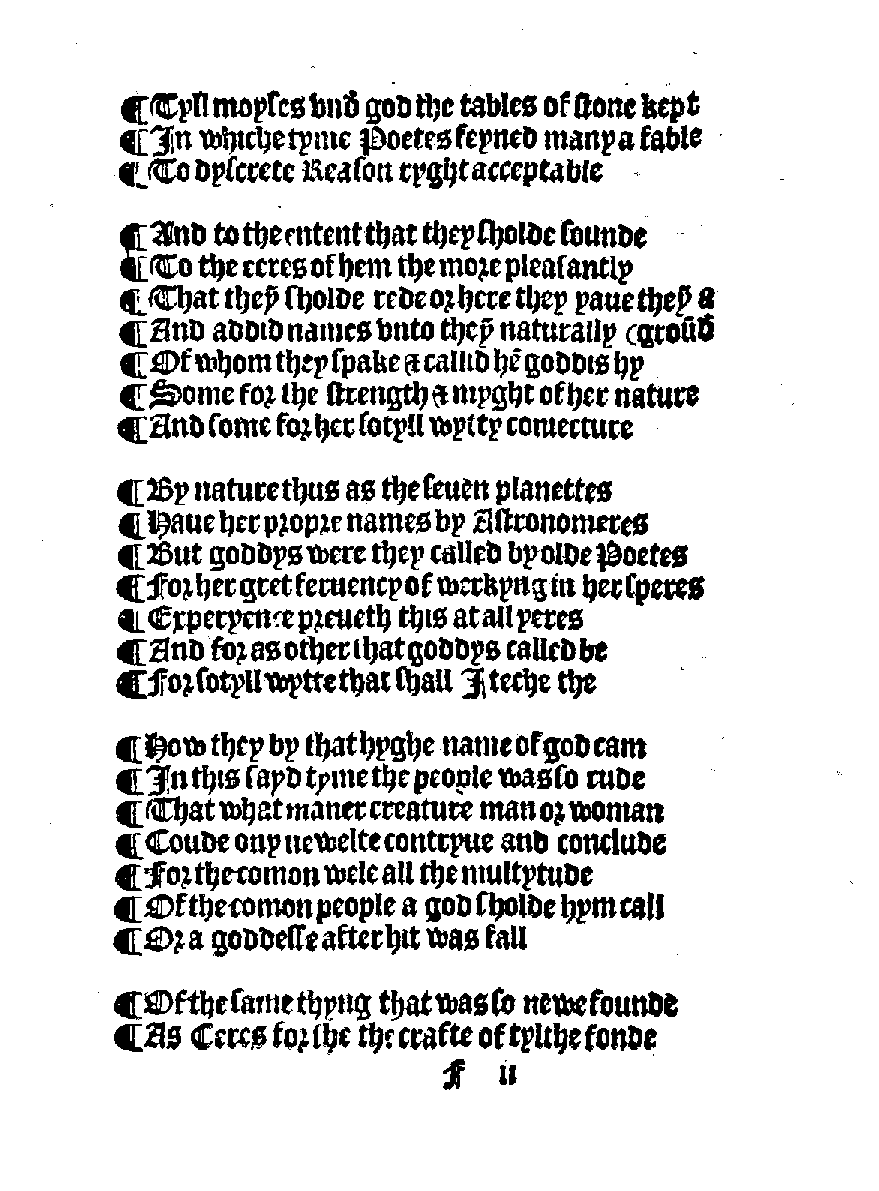 Tyll
moyses vnder god the tables of stone kept
Tyll
moyses vnder god the tables of stone keptIn whiche tyme Poetes feyned many a fable
To dyscrete Reason ryght acceptable
To the eeres of hem the more pleasantly
That theym sholde rede or here the yaue theym a grounde
And addid names vnto theym naturally
Of whom they spake & callid hem goddis hy
Some for the strength & myght of her nature
And some for her sotyll wytty coniecture
Haue her propre names by Astronomeres
But goddys were they called by old Poetes
For her gret feruency of werkyng in her speres
Experyence preueth this at all yeres
And for as other that goddys called be
For sotyll wytte that shall I teche the
In this sayd tyme the people was so rude
That what maner creature man or woman
Coude ony newelte contryue and conclude
For the comon wele all the multytude
Of the comon people a god sholde hym call
Or a goddesse after hit was fall
As Ceres for she the crafte of tylthe fonde
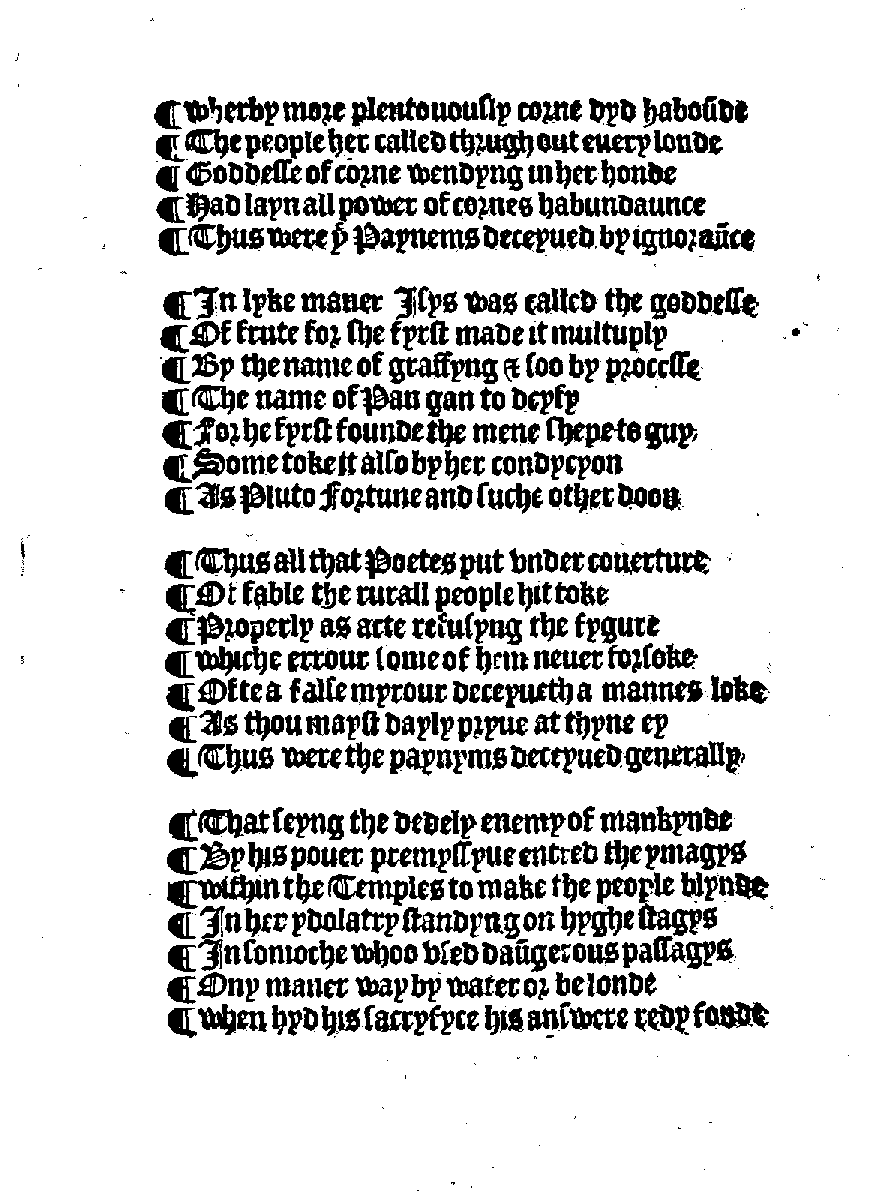 Wherby more plentouously
corne dyd habounde
Wherby more plentouously
corne dyd haboundeThe people her called thrugh out euery londe
Goddesse of corne wendyng in her honde
Had layn all power of cornes habundaunce
Thus were the Paynems deceyued by ignoraunce
Of frute for she fyrst made it multuply
By the name of graffyng & soo by processe
The name of Pan gan to deyfy
For he fyrst founde the mene shepe to guy
Some toke it also by her condycyon
As Pluto Fortune and suche other doon
Of fable the rurall people hit toke
Properly as acte refusyng the fygure
Which errour some of hem neuer forsoke
Ofte a false myrour deceyueth a mannes loke
As thou mayst dayly pryue at thyne ey
Thus were the paynyms deceyued generally
By his pouer premyssyue entred the ymagys
Within the Temples to make the people blynde
In her ydolatry standyng on hyghe stagys
Insomoche whoo vsed daungerous passagys
Ony maner way by water or be londe
When hyd his sacryfyce his answere redy fonde
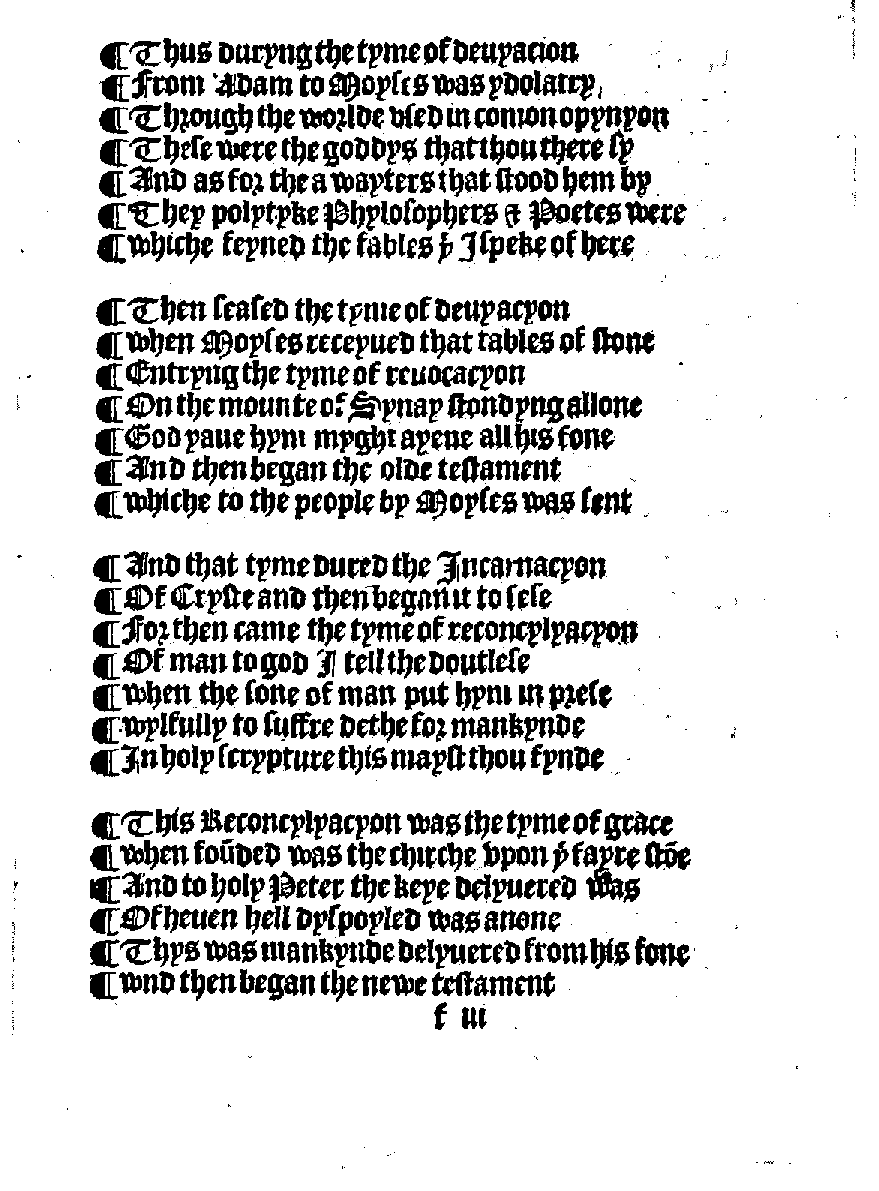 Thus duryng the tyme of
deuyacion
Thus duryng the tyme of
deuyacionFrom Adam to Moyses was ydolatry
Through the worlde vsed in comon opynyon
These were the goddys that thou there sy
And as for the awayters that stood hem by
They polytyke Phylosophers & Poetes were
Whiche feyned the fables that I speke of here
When Moyses receyued that tables of stone
Entryng the tyme of reuocacyon
On the mounte of Synay stondyng allone
God yaue hym myght ayene all his fone
And then began the olde testament
Whiche to the people by Moyses was sent
Of Cryste and then began it to sese
For then came the tyme of reconcylyacyon
Of man to god I tell the doutlese
When the sone of man put hym in prese
Wylfully to suffre dethe for mankynde
In holy scrypture this mayst thou fynde
When founded was the chirche vpon that fayre stone
And to holy Peter the keye delyuered was
Of heuen hell dyspoyled was anone
Thys was mankynde delyuered from his fone
And then began the newe testament[3]
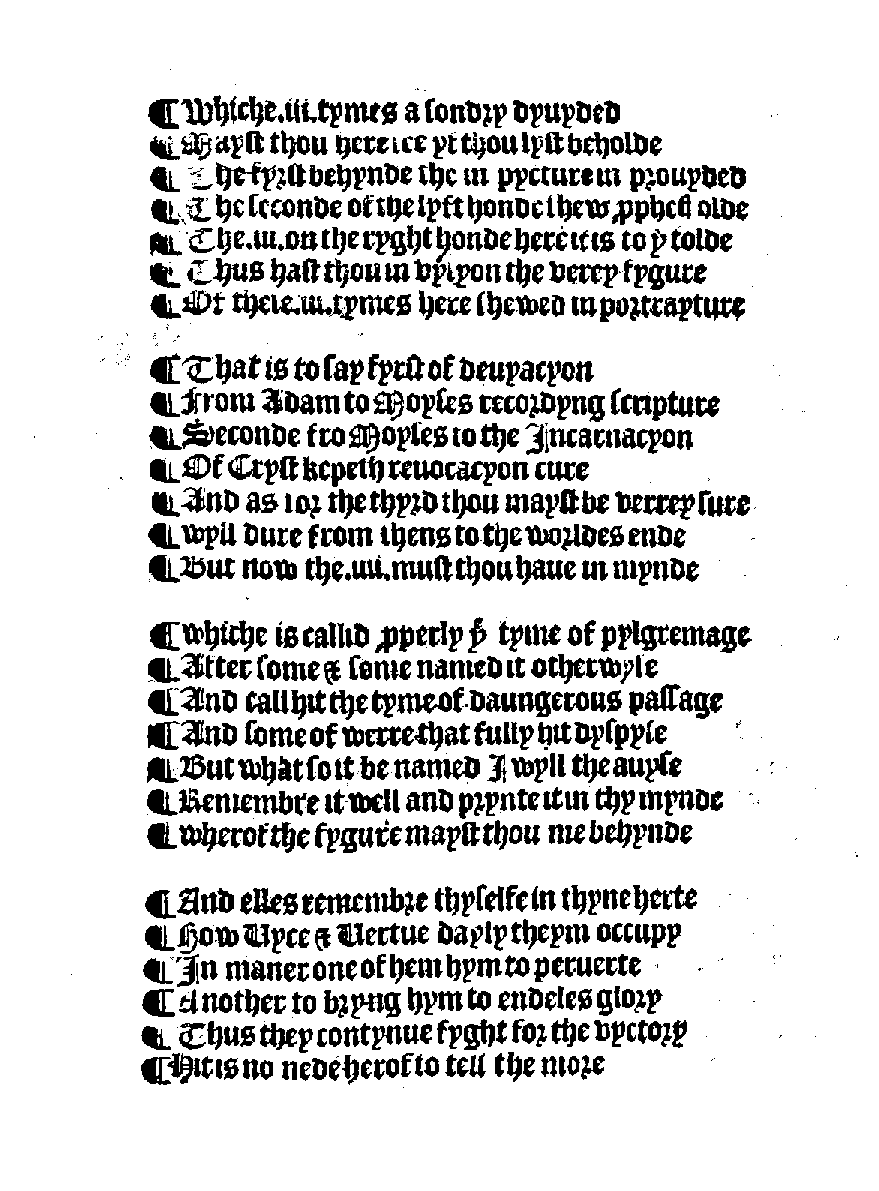 Whiche .iii. tymes a
sondry dyuyded
Whiche .iii. tymes a
sondry dyuydedMayst thou here see yf thou lyst beholde
The fyrst behynde the in pycture is prouyded
The seconde of the lyft honde shew prophet olde
The .iii. on the ryght honde here it is to the tolde
Thus hast thou in vysyon the verey fygure
Of these .iii. tymes here shewed in portrayture
From Adam to Moyses recordyng scripture
Seconde fro Moyses to the Incarnacyon
Of Cryst kepeth reuocacyon cure
And as for the thyrd thou mayst be verrey sure
Wylt dure from thens to the worldes ende
But now the .iiii. must thou haue in mynde
After some & some named it otherwyse
And call hit the tyme of daungerous passage
And some of werre that fully hit dyspyse
But what so it be named I wyll the auyse
Remembre it well and prynte it in thy mynde
Wherof the fygure mayst thou me behynde
How Vyce & Vertue dayly theym occupy
In maner one of hem hym to peruerte
Another to bryng hym to endeles glory
Thus they contynue fyght for the vyctory
Hit is no nede herof to tell the more
 For in this short vysyon thou hast seen
it before
For in this short vysyon thou hast seen
it beforeVnto the goddys betokeneth noo more
But oonly to shew the how frendely constreynt
On a stedfast herte weyeth full sore
Good wyll requyreth good wyll ayene therfore
Dyscorde to deth hathe ay byn a frende
For Dyscorde bryngeth many to her ende
On his frendes quarell yf that he myghte
For her gret vnkyndnesse is somoche as she
Was among hem all had so in despyte
And at that ba[n]ket made of soo lyte
Which caused hym among hem to cast in a bone
That founde theym gnawyng ynough euerichone
Wyll say & doo and some tyme maters feyne
And also kynnysmen a cosyne or a brother
Wyll for his alyer he haue cause compleyne
And where that he loueth doo his besy peyne
His frendes mater as his owne to take
Whiche oft sythe causeth mychyll sorow awake
Ap towarde that poynt he taketh lytyll hede
So that he may haue his frowarde appetyte
Performed he careth not how his soule spede (note
 Of God or Deuyll haue
suche lytyll drede
Of God or Deuyll haue
suche lytyll dredeHow be it one there is that lord is of all
Whiche to euery wyght at last rewarde shall
Soo playnly appereth to the inwardly
To make exposycyon therof new or olde
Were but superfluyte therefore refuse hit I
In man shall thou fynde that were kept dayly
Lyke as thou hast seen it fowty[u]e before thy face
The pycture me behynde sheweth it in lytyll space
But the lesse worlde to the comon entent
Whiche applyed is to man both nyght & day
Soo is man the felde to which all were sent
On bothe partyes & they that thyder went
Sygnyfye nomore but after the condycyon
Of euery manes opynyon
Which gate the felde when it was almost gone
Betokeneth nomore but the contynuaunce
Of vertuous lyvyng tyll dethe hath auergone
Who soo wyll doo rewarded is anone
As Vertue was with the crowne on hy
whiche is noo more but euerlastyng glory
That eche of hem rewarded after his deserte
 Is to vnderstonde nomore
but dampnacyon
Is to vnderstonde nomore
but dampnacyonTo vycyous people is the verey scourge smert
Rewarde for they fro Vertue wolde peruert
And endelesse Ioye is to hem that be electe
Rewarded & to all that folow the same secte
Whiche were to Morpleus rewarded for his laboure
Sygnyfye not elles but whyle man is on lyue
His fyue inwarde wyttes shall be euery hour
In his slepe occupyed in hele & in langour
With fantasyes tryfels Illusyons & dremes
Whiche Poetes call Morpleus stremes
But after Confessyon tornyng ayene to synne
Whiche to euery man retornyth sauns delay
To vycyous lyuyng agayn hym to wynne
Whyle ony man lyueth wyll it neuer blynne
That cursed conclusyon for to bryng aboute
But Reason with Sadnes kepe it styll oute
Perde now declared of this vysyon
The pycture also yeueth clere intellygence
Therof beholden with good dyscresyon
Loke well aboute and take consyderasyon
As I haue declared whether hit soo be
A syr quoth Morpleus what tolde I the
 Hast thou properly the
verey sentence
Hast thou properly the
verey sentenceLoke on yon wall yonder before
And all that tyme stood I in a wyre
Whiche way first myn hert wolde yeue more
To loke in a stody stood I therfore
Neuerthelesse at last as Morpleus me badde
I loked forwarde with contenaunce sadde
The maner of the felde euen as it was
Shewed me before & euery creature
On bothe sydes beyng drawyng in small space
Soo caryously in soo lytyll a compace
In all this worlde was neuer thyng wrought
Hit were Impossyble in erthe to be thought
What quod Morpleus how longe shalte thou loke
Daryng as a dastard on yon portrayture:
Come of for shame thy wytte stante a croke
I heryng that myn herte to me toke
Towarde the fourthe wall tornyng my vysage
Where I sawe Poetes & Phylosophers sage
Serued the goddes as I sayde before
Som were made standyng & som in chayris set
Som lokyng on bokys as they had stodyed sore
Som drawyng almenakis & in her hondis bore
Astyrlabes takyng the altytude of the sonne
 Among whome Dyogenes
sate in a tonne
Among whome Dyogenes
sate in a tonneOf Dyogenes beholdyng the ymage
Sodeynly Doctryne began me to call
And bad me tourne towarde hyr my vysage
And soo then I dyde with humble corage
Whan thynkest thou she sayd hast thou not thentent
Yet of these foure walles what they represent
Sheweth the the present tyme of pylgremage
Of whiche before I vnto the spake
Whiche is the tyme of daungerous passage
The seconde dyscrettly agayne my vysage
The tyme expresseth of Deuyacyon
Whyle paynyme lawe had the domynacyon
The tyme representeth of Reuocacyon
And the fourthe standyng on my ryght honde
Determyneth the tyme of Reconsylyacyon
This is the effecte of thy vysyon
Wherfore the nedeth no more theron to muse
Hit were but veyne thy wyttes to dysuse
Thy tyme of pylgremage loke well thou spende
And then woll gracyous Predestynacyon
Bryng the to glory at thy law ende
 And euen with that came
to my mynde
And euen with that came
to my myndeMy fyrst conclusyon that I was aboute
To haue dreuen er slepe made me to lute
With Reason to acorde myght be brought aboute
Whiche caused me to knele downe on my kne
And beseke Doctryne determyne that doute
Oo Lord god sayd Doctryne canst thou not withoute
Me that conclusyon bryng to an ende
Ferre is fro the wytte & ferther good mende
Shewyng hymselfe as though that he wolde
His darte haue occupyed within that herbere
But there was none for hym yong nor olde
Saue oonly I Doctrine hym tolde
And when I herde hyr with hym comon thus
I me withdrew behynde Morpleus.
Through Doctrynes wordes ony entresse.
In me wolde haue had or claymed ony part
Which sholde haue caused me grete heuynesse
Within whiche tyme & short processe
Came thyder Reason and Sensualyte.
A quoth Doctryne ryght welcome be ye
Ye must er ye goo determyne a doute
 And euen with that she
the mater brake
And euen with that she
the mater brakeTo theym & tolde hit euery where aboute
I wolde haue be thens yf I had moute
For fere I loked as blake as a cole
I wolde haue cropen in a mouse hole
That meu[i]d this mater straunge & dyffuse
He is a cowarde I make myn auow
He hyded his hede his mocyon to refuse
Blame hym not quod Reason alway that to vse
When he seeth Dethe soo nere at his honde
Yet is his part hym to withstonde
As longe as he may who dooth other wyse
Is an ydeote quoth Sensualytee
Who dredeth not Dethe wyse men hym dyspyse
What said Doctryne how long hathe this gyse
Be holden & vsed thus atwixe you tweyne
Ye were not wonte to acorde certeyne
To euery man haue we yeuen our counsayll
Dethe for to flee as long as they may
Although wo otherwyse haue done our trauayl
Eche other to represse yet withoute fayll
In that poynt oonly dyscordeth we neuer
Thus condescended therin be we for euer
 Aha sayd Doctryne then
is the conclusyon
Aha sayd Doctryne then
is the conclusyonClerely determined of the gret doute
That here wes meuyd & halfe in derysyon
She me then called & bade me loke oute
Come forthe she sayd & feere not this route
And euen with that Reason & Sensualyte
And Dethe fro thens were vanysshed all thre
When Dethe was gone me thought I was bolde
To shewe myselfe but yet was I sadde
Me thought my doute was not as I wolde
Clerely and openly declared & tolde
Hit sowned to me as a parable
Derke as a myste or a fayned fable
Wherfore sayd she standest thou soo styll
Wherin is thy thought arte thou in stody
Of thy questyon hast thou not thy fyll
To the declared tell me thy wyll.
Herdest thou not Reason & Sensualyte
Declared thy doute here before the
But neuerthelesse my wytte is so thynne
And also of Dethe I was so afrayde
That hit is out where hit vent ynne
And so that mater can I not wynne
Without your helpe & benyuolence
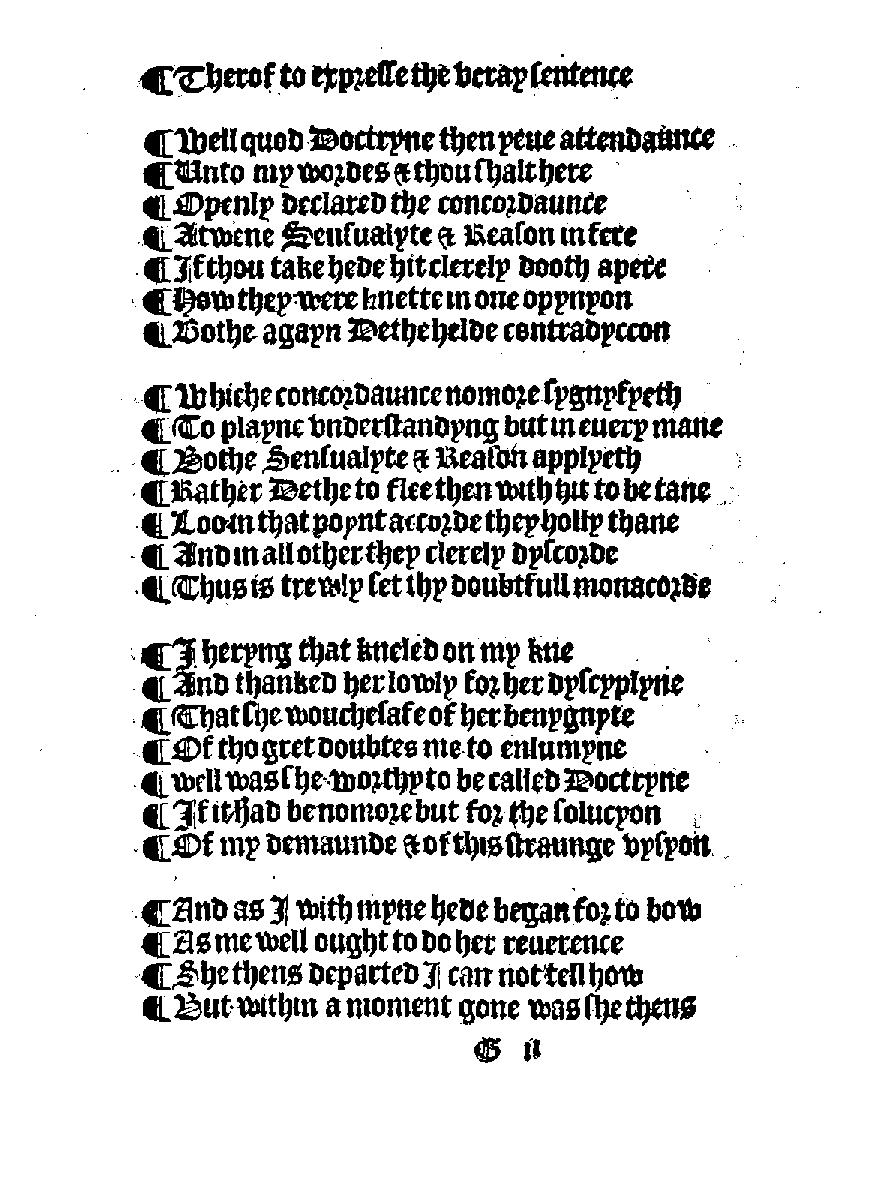 Therof to expresse the
veray sentence
Therof to expresse the
veray sentenceVnto my wordes & thou shalt here
Openly declared the concordaunce
Atwene Sensualyte & Reason in fere
If thou take hede hit clerely dooth apere
How they were knette in one opynyon
Bothe agayn Dethe helde contradyccon
To playne vnderstandyng but in euery mane
Bothe Sensualyte & Reason applyeth
Rather Dethe to flee then with hir to be tane
Loo in that poynt accorde they holly thane
And in all other they clerely dyscorde
Thus is trewly set thy doubtfull monacorde
And thanked her lowly for her dyscyplyne
That she wouchesafe of her benygnyte
Of tho gret doubtes me to enlumyne
Well was she worthy to be called Doctryne
If it had be no more but for the solucyon
Of my demaunde & of this straunge vysyon
As me well ought to do her reuerence
She thens departed I can not tell how
But within a moment gone was she thens
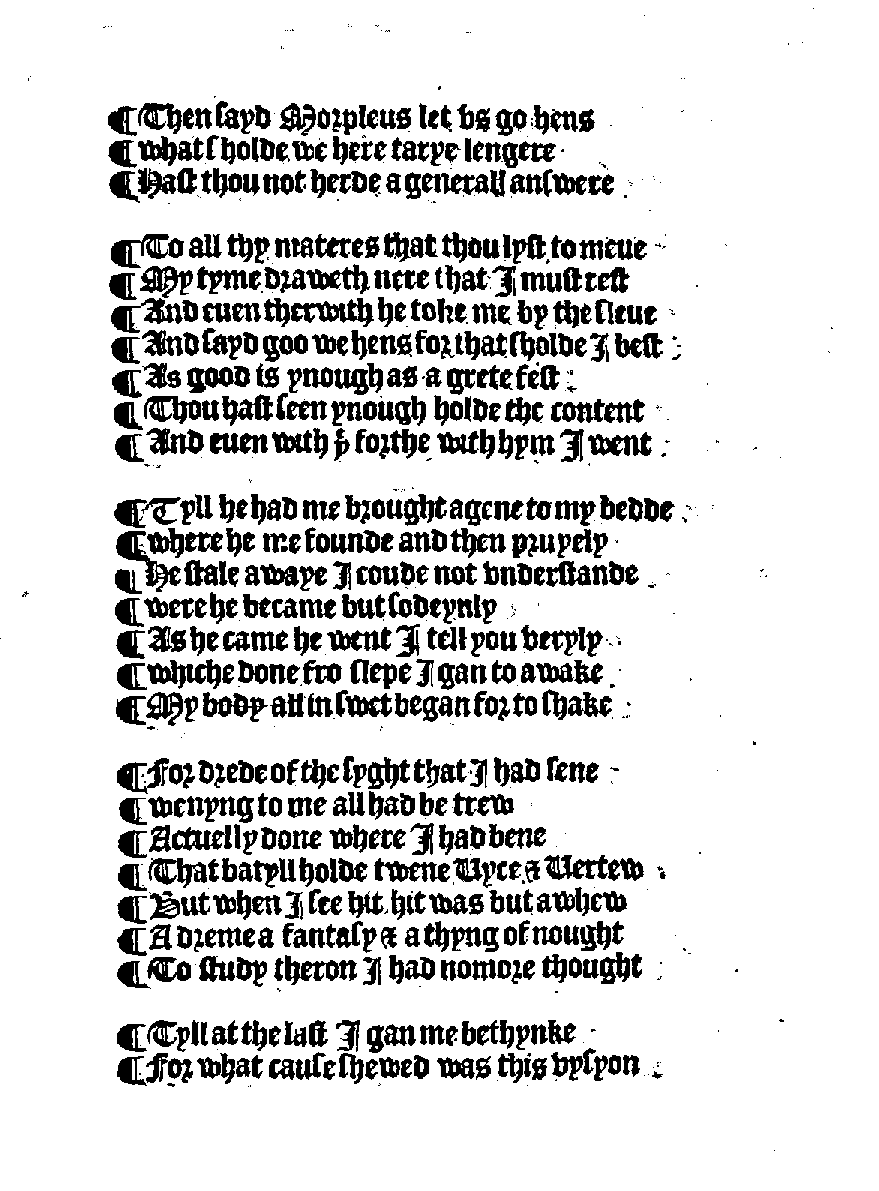 Then
sayd Morpleus let vs go hens
Then
sayd Morpleus let vs go henswhat sholde we here tarye lengere
Hast thou not herde a generall answere
My tyme draweth nere that I must rest
And euen therewith he toke me by the sleue
And sayd goo we hens for that sholde I best
As good is ynough as a grete fest
Thou hast seen ynough holde the content
And euen with that forthe with hym I went
where he me founde and then pryuely
He stale awaye I coude not vnderstande
were he became but sodeynly
As he came he went I tell you veryly
whiche done fro slepe I gan to awake
My body all in swet began for to shake
wenyng to me all had be trew
Actuelly done where I had bene
That batyll holde twene Vyce & Vertew
But when I see hit hit was but a whew
A dreme a fantasy & a thyng of nought
To study thereon I had nomore thought
For what cause shewed was this vysyon
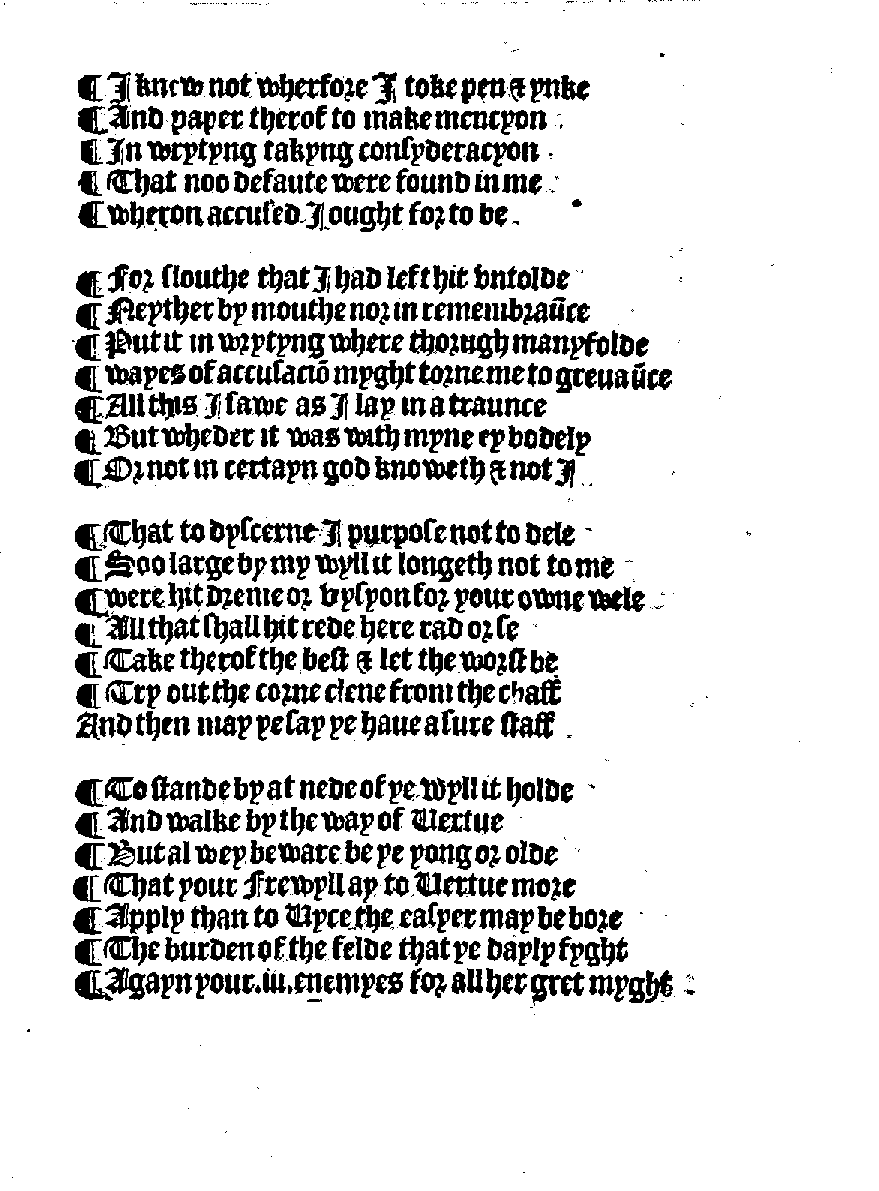 I knew not wherefore I
toke pen & ynke
I knew not wherefore I
toke pen & ynkeAnd paper therof to make mencyon
In wrytyng takyng consyderacyon
That noo defaute were found in me
whereon accused I ought for to be
Neyther by mouthe nor in remembraunce
Put it in wrytyng where thorugh manyfolde
wayes of accusacion myght torne me to greuaunce
All this I sawe as I lay in a traunce
But wheder it was with myne ey bodely
Or not in certayn god knoweth & not I
Soo large by my wyll it longeth not to me
were hit dreme or vysyon for your owne wele
All that shall hit rede here rad or se
Take thereof the best & let the worst be
Try out the corne clene from the chaff
And then may ye say ye have a sure staff
And walke by the way of Vertue
But alwey beware be ye yong or olde
That your Frewyll ay to Vertue more
Apply than to Vyce the easyer may be bore
The burden of the felde that ye dayly fyght
Agayn your .iii. enemyes for all her gret myght
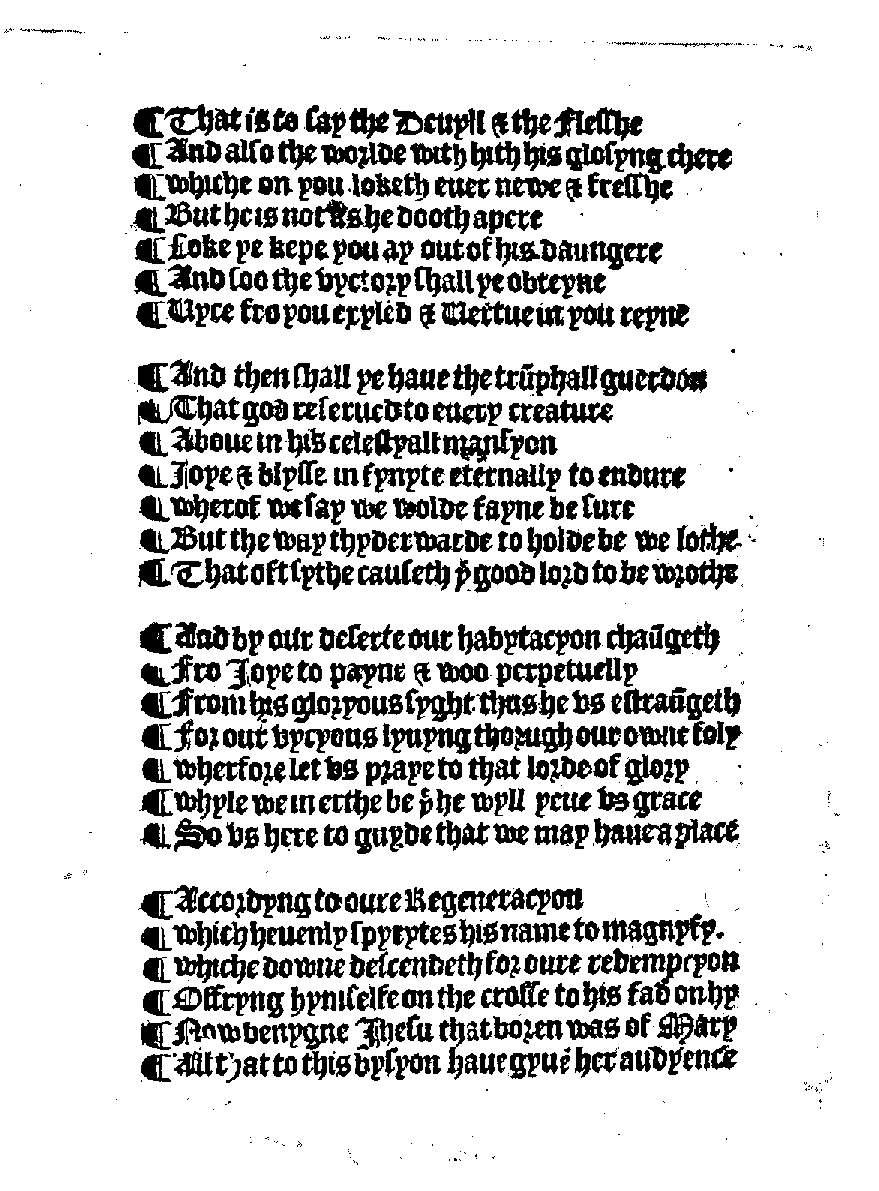 That is to say the
Deuyll & the Flesshe
That is to say the
Deuyll & the FlessheAnd also the worlde with hith his glosyng chere
Whyche on you loketh euer newe & fresshe
But he is not as he dooth apere
Loke ye kepe you ay out of his daungere
And soo the vyctory shall ye obteyne
Vyce fro you exyled & Vertue in you reyne
That god reserued to euery creature
Aboue in his celestyall mansyon
Ioye & blysse infynyte eternally to endure
Wherof we say we wolde fayne be sure
But the way thyderwarde to holde be we lothe
That oft sythe causeth the good lord to be wrothe
Fro Ioye to payne & woo perpetuelly
From his gloryous syght thus he vs estraungeth
For our vycyous lyuyng thorugh our owne foly
Wherfore let vs praye to that lorde of glory
Whyle we in erthe be that he wyll yeue vs grace
So vs here to guyde that we may haue a place
Which heuenly spyrytes his name to magnyfy.
Whiche downe descendeth for oure redempcyon
Offryng hymselfe on the crosse to his fader on hy
Now benygne Ihesu that boren was of Mary
All that to this vysyon haue gyuen her audyence
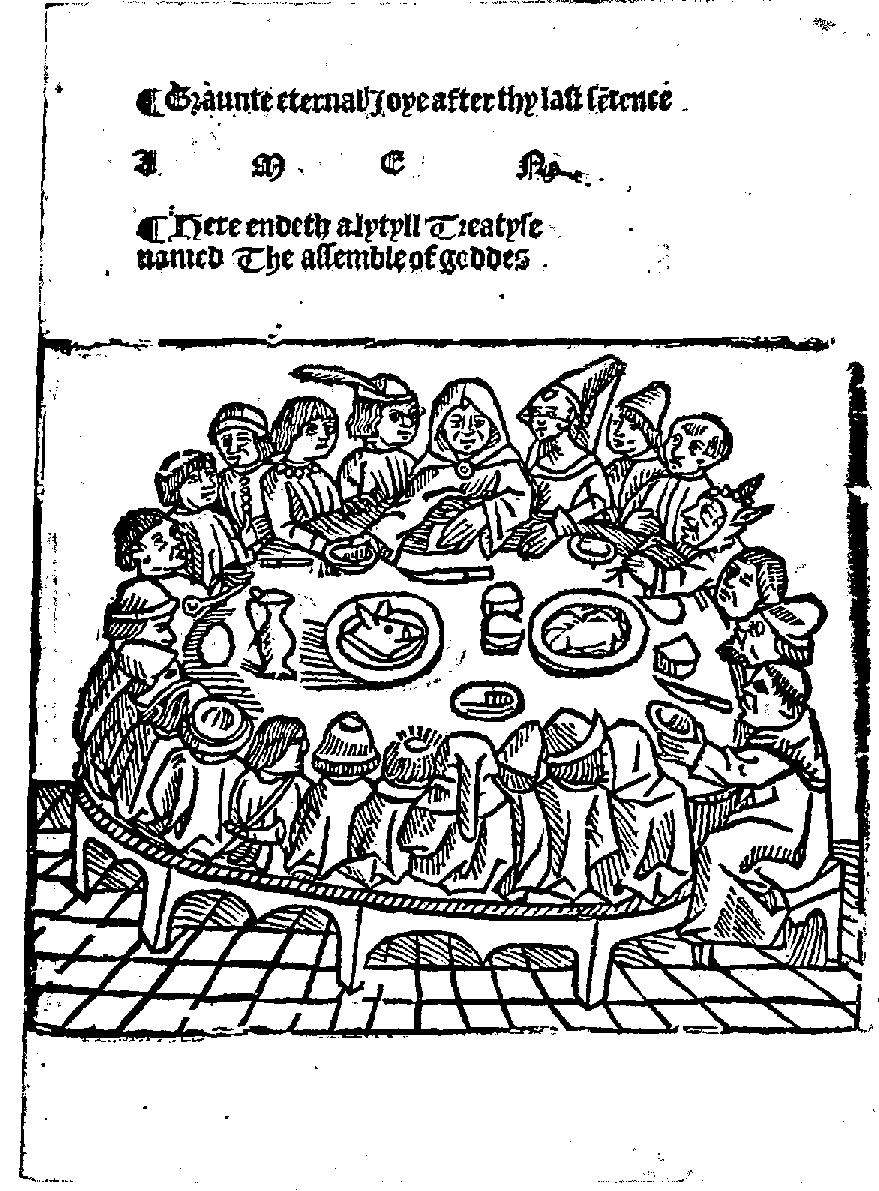 Graunte
eternal Ioye after thy last sentence
Graunte
eternal Ioye after thy last sentencenamed The assemble of goddes
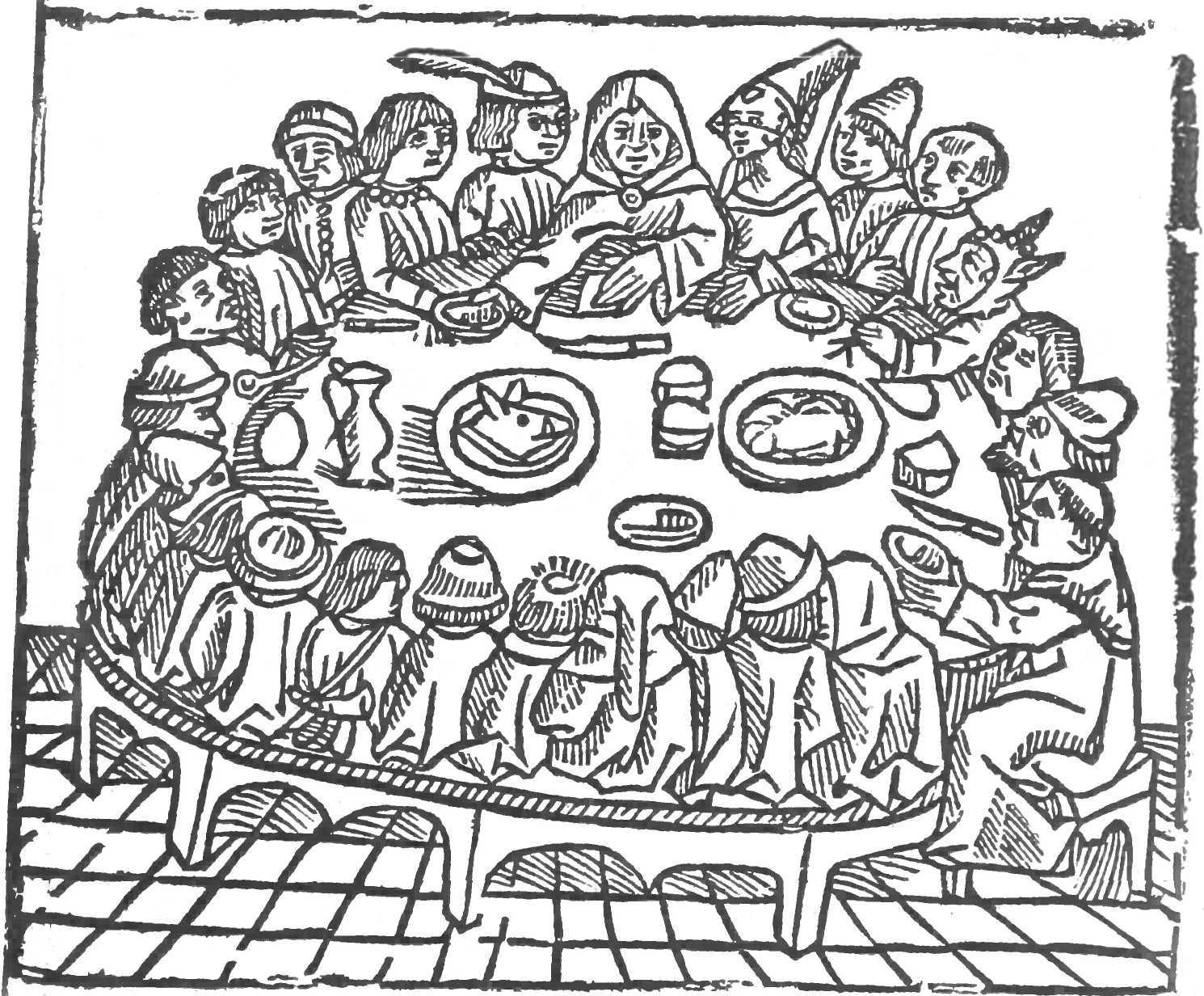
TRANSCRIBER'S NOTES:
[1] The next line is missing from the original. The missing line reads:
[2] The next line is missing from the original. The missing line reads:
[3] The next line is missing from the original. The missing line reads:
[4] This line has some missing letters from the middle. The line should read: